
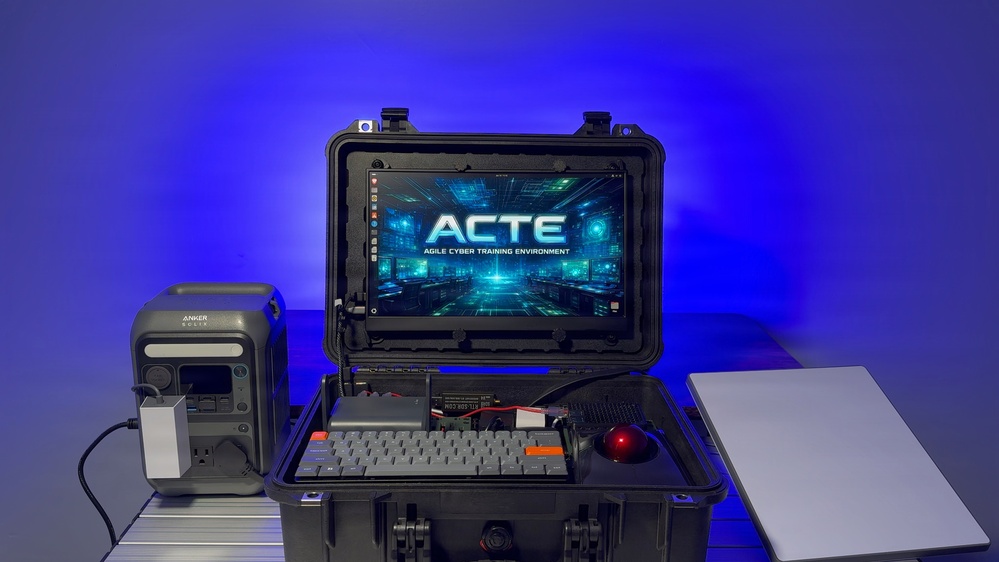
Courtesy Photo | The Agile Cyber Training Environment (ACTE) is a self-contained, portable cyber...... read more read more
 Subscribe
Senior Master Sgt. Taylor Gow saw a gap in cyber readiness and created a solution that lets Airmen train anywhere, anytime, without relying on costly lab infrastructure. The Agile Cyber Training Environment (ACTE) fits in a backpack and can be set up in less than a minute to provide realistic, hands-on training environments anywhere, from classrooms to field exercises.
The ACTE is a self-contained, portable cyber training and development platform, essentially a deployable cyber sandbox. Its core capabilities are test, train and develop.
“Throughout my career in cyber operations, I repeatedly saw the same challenge: our Airmen are highly capable, but they don’t always have access to safe, flexible environments to test tooling, simulate threats or experiment with new ideas,” said Gow, a cyber systems operations specialist with the 202nd Intelligence Support Squadron. “Traditional cyber ranges and lab environments require significant infrastructure, formal approval processes, and/or enterprise connectivity. This creates delays and limits how quickly we can innovate or train on emerging threats. The ACTE was developed to combat these problems.”
Gow’s project was accepted into the Department of the Air Force Spark Tank 2026. Spark Tank is the Air Force’s flagship innovation campaign, where Airmen and Guardians present solutions to senior leaders and industry experts to secure sponsorship and bring ideas to life. The competition fosters internal innovation, retains top talent and accelerates the adoption of emerging technologies, especially those developed by Airmen and Guardians with the potential for transformative impact.
Acceptance into Spark Tank provided Gow a platform to refine his design and translate technical concepts into a mission-focused innovation story.
“A key characteristic of the system is its modular design, allowing its uses to evolve over time,” Gow said. “Competing in Spark Tank 2026 required translating technical concepts into a mission-focused innovation narrative. That meant refining the problem statement, identifying measurable impact and ensuring alignment with 102nd Intelligence Wing and DAF priorities. This was very much an exercise in both technical proficiency and strategic vision.”
The ACTE improves readiness by increasing hands-on training hours, speeding validation of locally developed tools and automations, lowering costs compared with maintaining large static labs, and encouraging innovation and experimentation.
From a mission perspective, the platform allows Airmen to practice defending realistic simulated environments, test configuration changes before fielding, prototype automation and defensive tools, and conduct small-scale exercises without disrupting operations. For the 102nd IW and the broader Air Force and Space Force, the ACTE supports Agile Combat Employment concepts, decentralized operations, development of multi-capable Airmen and a culture of bottom-up innovation. Overall, it strengthens the force’s ability to adapt quickly to evolving cyber threats.
“The 102nd IW Spark Tank and Continuous Process Improvement program created an environment where operator-level innovation was encouraged and supported,” Gow said. “The process for developing this idea was iterative. I first identified the core requirements I wanted to meet. The system needed to be portable, self-contained, secure, isolated, cost-effective, scalable and repeatable. From there, I built prototypes, with the current version at iteration three, tested configurations, refined the hardware layout and validated use cases.”
Gow has used the ACTE to train his unit at the Massachusetts National Guard. While assigned to the 126th Cyber Protection Battalion with the Army National Guard, he deployed incident response tools for training and reporting requirements. He also tested defensive and offensive cyber tactics with the Massachusetts Cyber Incident Response Team, which includes Army, Air and police units in joint-force exercises. He has even used the system to process drone images using photogrammetry.
Gow envisions the ACTE as a flexible template that can be tailored to specific unit missions. He hopes to build a community of users who collaborate and share insights on a dedicated platform across the enterprise.
“The ACTE was designed by an Airman, for Airmen,” Gow said. “This platform is intended to provide an environment to test, train and develop at the squadron level. I hope that, regardless of the outcome, the 102nd IW will recognize the critical gaps the ACTE fills.”
For DAF Spark Tank 2026, the ACTE is in the first round of community voting alongside more than 340 submissions from across the Air Force and Space Force. Airmen and Guardians can view all Spark Tank entries and cast a vote on the Guardians and Airmen Innovation Network (GAIN) platform at this link: https://gain.il4.afwerx.dso.mil/daf/spark-tank-2026/overview
| Date Taken: | 02.26.2026 |
| Date Posted: | 02.26.2026 13:41 |
| Story ID: | 558990 |
| Location: | OTIS AIR NATIONAL GUARD BASE, MASSACHUSETTS, US |
| Web Views: | 231 |
| Downloads: | 0 |

This work, Massachusetts National Guardsman invents portable cyber training, development platform, by SrA Julia Ahaesy, identified by DVIDS, must comply with the restrictions shown on https://www.dvidshub.net/about/copyright.

No keywords found.




