
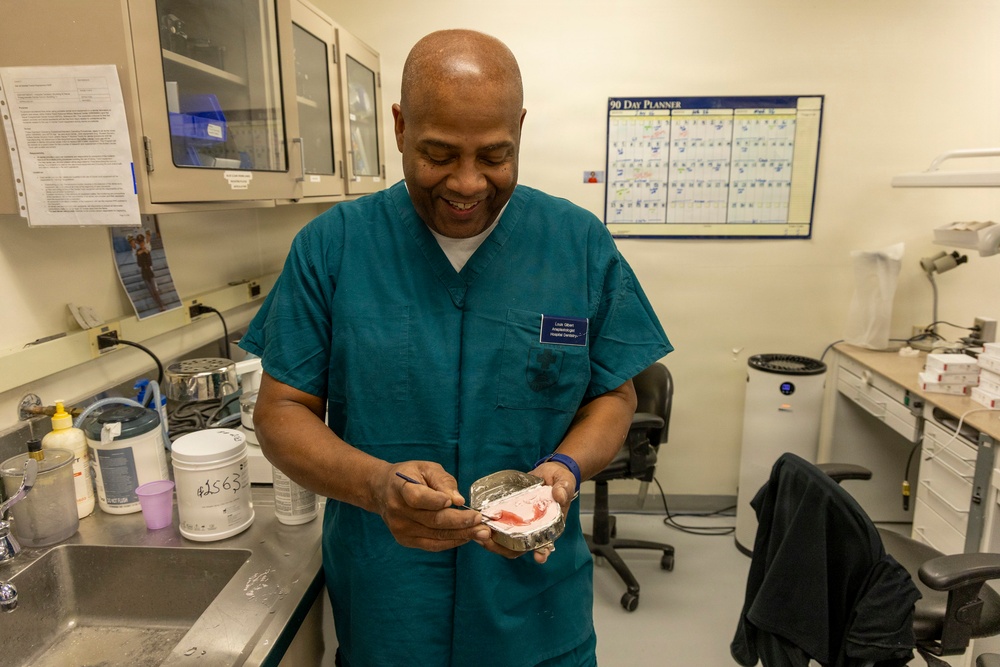
Photo By Ann Brandstadter | Anaplastologist Louis Gilbert touches up a dental prosthetic at the Maxillofacial Lab...... read more read more
 Subscribe
By Ann Brandstadter Walter Reed Hospital Communications
Bethesda, MD — A unique and highly specialized team of medical professionals at Walter Reed National Military Medical Center is dedicated to restoring the physical appearance of the wounded, ill and injured in the Military Health System.
Known as anaplastologists, these skilled artisans combine a rare blend of artistic talent and scientific knowledge to create custom-made prostheses for patients who have lost facial or body parts due to trauma, disease, or congenital conditions.
There are currently two civilian anaplastologists in the Department of War (DOW), Jean Paul Cruz and Louis Gilbert, who work in the Hospital Dentistry Department in Bldg. 9 at Walter Reed.
“There are quite a few military individuals that [are anaplastologists], located in Bethesda, Md., Portsmouth, Va., San Diego, Calif., and San Antonio, Texas, but civilian wise, we are the only two in DOW,” said Cruz.
Cruz and Gilbert met while serving in the Navy, and now work in an ever-busy lab, creating pieces for hours on end. “We are technicians. We were dental lab techs in the Navy, then after that we went to study dental maxillofacial prosthetics,” said Gilbert.
“The people we help are patients who, [for example], have lost their eyes or an eye due to trauma, during combat and explosions. So, this is a place to get these things reconstructed,” said Gilbert.
Cruz and Gilbert are unique by the fact they develop both dental and facial prostheses.
“We do teeth as well as facial prosthetics. In the civilian world, you wouldn't be able to have a place for both, they are separate. But in the military (or the Navy), specifically, anaplastologists have gone to dental laboratory school, also. So, we basically can do both,” said Cruz.
“The Maxillofacial Laboratory Technician “C” School is located here aboard the Navy Support Activity Bethesda,” said Gilbert, where he and Cruz received their training to become anaplastologists. “Students come to see what we do,” said Cruz. “Optometry students come here; it's part of the training that they go through.”
To start the process of creating a prothesis, an impression is taken of the affected area, using traditional mold-making techniques with materials like alginate or, increasingly, with advanced digital technologies like 3D scanning.
“We use the same materials for eyes, mouth and teeth. A lot of the materials are processed the same way,” said Gilbert.
“Mr. Gilbert is the painter, and I am the sculptor,” said Cruz. “So, Gilbert would paint the color of my eyes, for example, if I was patient. I create ears.”
Gilbert will carefully paint the iris, matching every intricate detail of the patient's remaining eye. “I do all the painting of the eyes, and I make the prosthetic eyes as well, and the eyebrows on the prosthetic are real human hair."
The creation of an artificial eye, for example, is a detailed process that can take from eight to 10 hours. Steps include making a mold of the defective site, creating a wax blank for fitting, painting the iris, setting the eye in place, and processing the sclera (white portion of eye) using acrylic.
“With prosthetic eyes, you just sit and paint using oil paints,” mused Gilbert. “The patient who comes in is the model for any painting of the eyes or sculpting of the face. I paint the patient while the patient is here.” “We make sure everything is symmetrical, that's why you need them in person. We make the prosthesis before they arrive [using a photograph] and then adjust it when [the patient] comes to the office. You fine-tune it,” explained Gilbert.
An ear could take more than 12 hours, possibly 16, from start to finish. “The ears are sculpted with wax; we prepare it with a negative mold,” said Cruz. “Patients have roughly two to three appointments, to make sure everything's good.”
Through their dedication and skill, the work of anaplastologists Cruz and Gilbert at Walter Reed is a powerful example of the intersection of art and science in medicine. Beyond physical restoration, a well-crafted prosthesis can significantly improve a patient's confidence and quality of life, offering a renewed sense of hope and a chance for patients to move forward with their lives.
To reach the Walter Reed Maxillofacial Lab, call 301-400-2071.
| Date Taken: | 02.26.2026 |
| Date Posted: | 02.26.2026 12:02 |
| Story ID: | 558969 |
| Location: | US |
| Web Views: | 158 |
| Downloads: | 0 |

This work, Beyond the Battlefield: The Artisans and Anaplastologists of Walter Reed, by Ann Brandstadter, identified by DVIDS, must comply with the restrictions shown on https://www.dvidshub.net/about/copyright.


No keywords found.




