
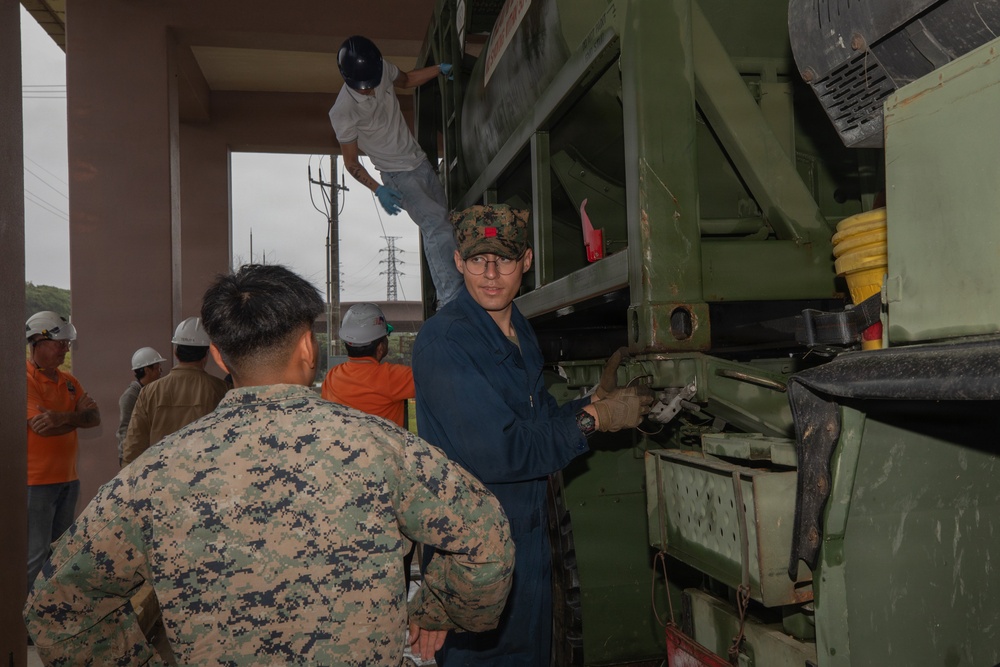
Photo By Lance Cpl. Marcus Henson | U.S. Marine Corps Lance Cpl. Gianni MartinezCordova, left, a motor vehicle operator,...... read more read more
 Subscribe
OKINAWA, JAPAN– In a strategic initiative to bolster joint operational readiness within the Indo-Pacific, 9th Engineer Support Battalion (ESB) has embedded its expeditionary fuel technicians with key partner units on Okinawa, synchronizing efforts with the U.S. Air Force's 18th Logistics Readiness Squadron (LRS) and the Defense Logistics Agency (DLA) Energy's Defense Fuel Supply Point (DFSP) Okinawa.
This integration represents a significant step in strengthening the bonds between the Marine Corps, Air Force, and DLA, which creates a more resilient and versatile logistics operational environment. By working together daily, service members from different organizations gain invaluable cross-training and a deeper understanding of each other's roles and operational methods. As a subordinate unit of 3rd Marine Logistics Group, 9th ESB provides general and direct engineering support, including the handling, storage, and distribution of bulk fuel.
The collaboration centers on DFSP Okinawa, an important spot in the region's fuel supply chain. William Davenport, deputy director of Defense Logistics Energy Okinawa, highlighted the partnership's importance.
"As the Executive Agent of Class III Bulk Petroleum products, the Defense Logistics Agency Energy is vital to the success of all Department of War missions on island," Davenport said. "We are the only Defense Fuel Support Point in the Indo-Pacific Region operated by internal DLA Energy personnel, with a dedicated team primarily composed of a 90% local national workforce under the Master Labor and Mariners Contracts. The inclusion of the 9th Engineer Support Battalion Marines has significantly strengthened our support for the warfighter and enhanced stability throughout the region."
The benefits of this integration are mutual; it provides real-world experience for Marine technicians while reinforcing the skills of the DLA Energy team.
"This training relationship between DFSP Okinawa and 9th ESB has given us the opportunity to provide real-world experience to expeditionary fuels technicians while honing our own skills," Davenport said. "Bringing on a new technician has alleviated workload, decreased turnaround time, and boosted morale across the board. This relationship has also provided more insight on the testing capabilities of other DOW entities and, consequently, has increased our internal knowledge on how we may be of assistance to the warfighter."
From the perspective of the Marines who are directly involved, the experience is transformative, building both technical skills and the intangible, yet crucial, element of trust. Cpl. Robert Wilson, a bulk fuel technician with 9th ESB, emphasized the importance of interoperability.
"When we collaborate, we learn each other's roles, strengths, and capabilities," Wilson said. "That cross-training builds resilience—if someone goes down or a capability becomes unavailable, another team can step in and keep the mission moving forward. Working together makes us sharper, more adaptable, and better prepared for real-world challenges."
This enhanced cohesion translates directly to improved operational effectiveness. When units are familiar with each other's procedures and communication styles, friction is reduced and decision-making is accelerated.
"When you know how another unit works, their strengths, their limitations, and how they communicate—you eliminate hesitation and second-guessing," Wilson said. "That confidence allows everyone to focus on the mission instead of wondering whether a task will be done correctly. Strong inter-unit relationships turn separate teams into a cohesive force, and that cohesion often determines the success of a mission."
This initiative, which also involves coordination with Combat Logistics Regiment 3, is a forward-thinking approach to joint logistics. By embedding personnel and fostering daily interaction, the Department of War is not just planning for joint operations, but actively building the trust and proficiency required to execute them seamlessly in a complex and dynamic global environment. The success of this program in Okinawa serves as a powerful model for strengthening the entire joint logistics enterprise.
| Date Taken: | 02.24.2026 |
| Date Posted: | 02.25.2026 21:00 |
| Story ID: | 558924 |
| Location: | OKINAWA, JP |
| Web Views: | 376 |
| Downloads: | 0 |

This work, Fueling the Fight: 9th ESB Integration Strengthens Joint Logistics in Okinawa, by 2LT Cooper Haseley, identified by DVIDS, must comply with the restrictions shown on https://www.dvidshub.net/about/copyright.

No keywords found.




