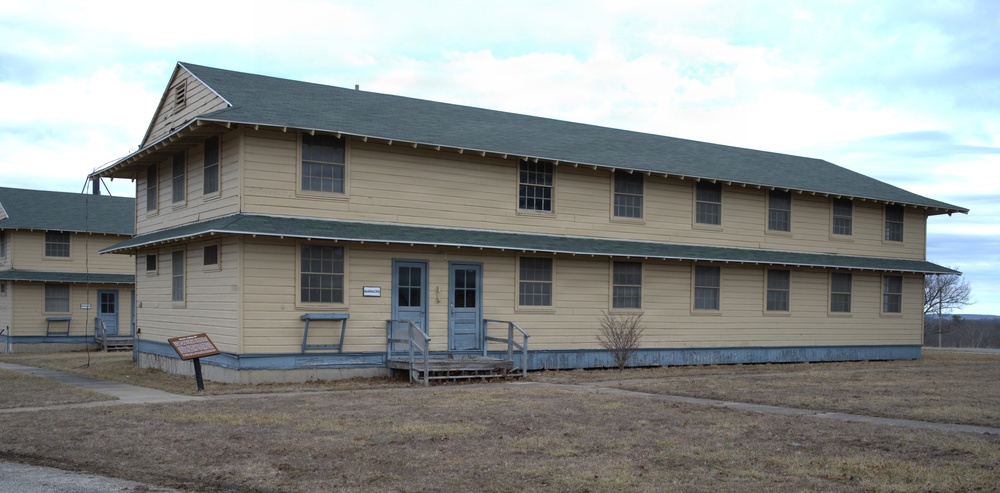
FORT LEONARD WOOD, Mo. — As the U.S. Army continues to evolve and transform to meet today’s mission, so too must Fort Leonard Wood’s cantonment area. A group of aging, temporary wooden structures built to support World War II efforts are scheduled to be torn down in March.
“They no longer have a designated use, don't meet today's building standards and are too expensive to renovate and maintain. They are quickly becoming a safety hazard,” said Mark Lenox, Department of Public Works director.
“We absolutely understand that these buildings hold a special place in our history and that many in our community, including me, will be sad to see them go. It’s a difficult but necessary decision. Our primary responsibility is to the Army's mission,” Lenox said.
The 10 buildings scheduled for demolition were built in 1941 when Fort Leonard Wood was established as a training camp to train infantry and engineer Soldiers during World War II.
According to Jason Baker, Project Management Branch chief with the Directorate of Public Works, the 10 buildings are part of the 12 World War II-era buildings located along Nebraska Avenue across from the Auto Skills Center.
The buildings scheduled for demolition are 1314, 1315, 1316, 1317, 1319, 1320, 1321, 1322, 1323 and 1324.
“The two remaining buildings will be the restroom and the chapel,” Baker said.
Lenox said making the decision to tear down these buildings wasn’t made “lightly.”
“We have a deep and abiding respect for our military history. However, we must also be practical and responsible. We looked at everything from future use to the high cost of maintenance. In the end, the buildings had fallen into such disrepair that we faced a tough choice — conduct a controlled demolition now or allow them to become a serious safety hazard for everyone on post,” Lenox said.
Stephanie Nutt, Cultural Resources manager and archaeologist with DPW’s Environmental Division, said the temporary buildings had an expected life span of only 10 years when they were built during the first phase of Fort Leonard Wood’s construction.
“The buildings in this area were originally built as barracks, mess halls, day rooms, storehouses, and company administrative space for the 182nd Field Artillery Regiment stationed at Fort Leonard Wood during World War II,” Nutt said.
The buildings continued to be used to house and support Soldiers until 1981, when they were converted to historic museum space.
“They were operated by the museum with displays depicting World War II and Vietnam-era military history,” Nutt said. “One building housed an exhibit highlighting the history of the Prisoner of War camp which was operated on the installation from 1943 through 1946.”
According to Scott Franklin, John B. Mahaffey Museum Complex interim director, the museum stopped using these buildings around 2019.
“In mid-2015 the Army Chief of Staff directed the Center of Military History to reduce the size of the historical collection and the number of museum activities, and to optimize the command and control and resourcing of Army museums,” Franklin said, and the result of this decision was the creation of the Army Museum Enterprise.
The AME at Fort Leonard Wood includes the three branch museums of Military Police, Engineer and Chemical, Biological, Radiological and Nuclear.
“The World War II area was not an AME approved mission or storyline, so those buildings fell outside of the AME’s scope and purview,” Franklin said. “The responsibility for the maintenance and upkeep of the buildings was turned over to DPW and the staff that maintained the World War II area displays were eventually lost through attrition.”
According to Baker, the exact March demolition schedule depends on Missouri’s weather.
And as far as the future for the land, located between Memorial Grove and the John B. Mahaffey Museum complex, Lenox said they are “putting a lot of thought into what comes next for this area.”
“It will be a collaborative process where we work to ensure the future is compatible with the museum and Memorial Grove.We are still evaluating the future use of the World War II chapel to see if it we can continue to use it,” Lenox added.
More information about Fort Leonard Wood’s history can be found on [Fort Leonard Wood’s website](https://home.army.mil/wood/about/history).
| Date Taken: |
02.25.2026 |
| Date Posted: |
02.25.2026 11:22 |
| Story ID: |
558853 |
| Location: |
FORT LEONARD WOOD, MISSOURI, US |
| Web Views: |
72 |
| Downloads: |
0 |
PUBLIC DOMAIN

This work, World War II-era buildings at Fort Leonard Wood set for demolition, by Melissa Buckley, identified by DVIDS, must comply with the restrictions shown on https://www.dvidshub.net/about/copyright.