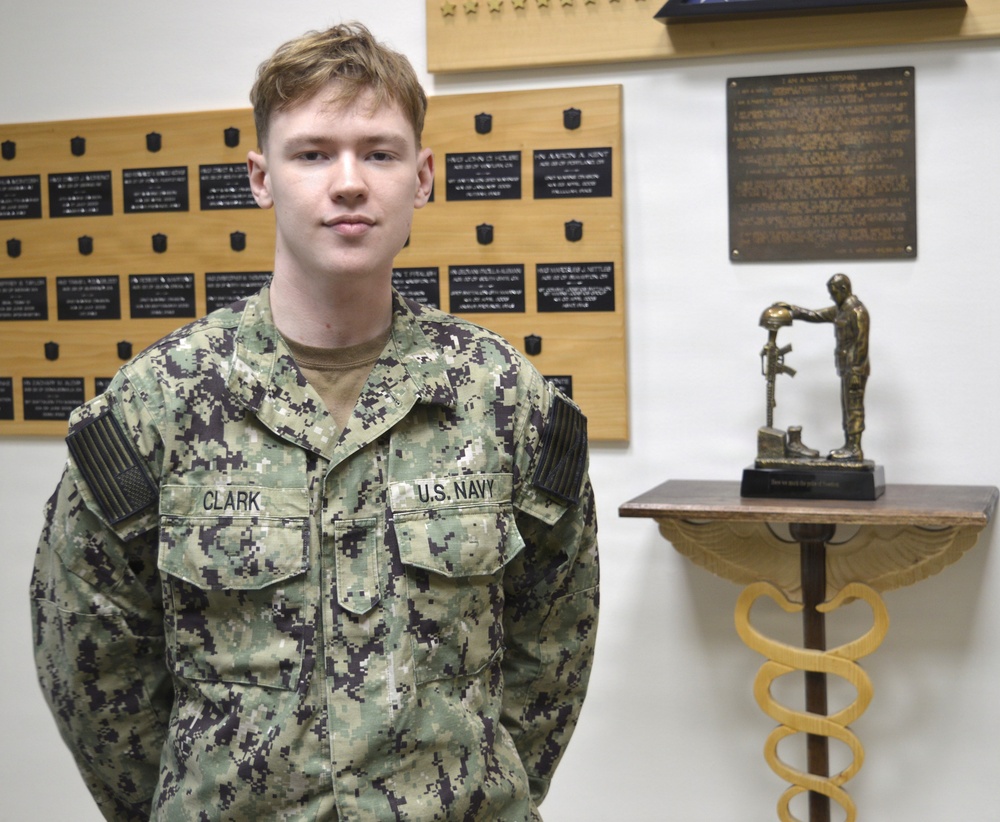
A routine lunchtime gym visit turned into anything but normal for U.S. Navy Hospitalman Joseph Clark in Waukegan, Illinois.
It was corpsman up for man down.
Clark, along with Hospital Corpsmen 3rd Class Adam Altreche, Zachary Evans and Dillon Talburt, responded to an urgent call with medical support for a gym patron who collapsed in the men’s locker room, Feb. 3, 2026.
Rendering immediate assistance was a reflective effect of each corpsman enrolled in the Hospital Corpsman Trauma Training course.
We weren’t exactly sure what was going on. We were doing our own thing in the gym. A staff member was asking if anyone had medical training. We said we did and we went into the locker room. Saw the person unconscious, with agonal breathing [gasping],” said Clark, a Bradenton, Florida native assigned to Navy Medicine Readiness Training Command Bremerton.
No equipment. No gear. No problem. They had knowledge and initiative.
“We did our assessment, watched over him to make sure everything was okay,” Clark continued. “But he then went into cardiac arrest. We started to perform chest compressions [cardiopulmonary resuscitation] until the emergency medical technicians showed up, which wasn’t that long after. We continued to assist the EMTs until they transferred him to the nearest hospital. We did what we could. We didn’t have much, but anything you can do to try…”
For Clark, providing such medical care to someone in need was merely doing his duty as a hospital corpsman.
“I didn’t think much about it afterwards. We felt confident to be able to help and were not unnerved at all. It felt like I was doing my regular job as a corpsman, doing what I needed to do to help save someone. We got a pat on the back from our instructors. They were really proud of us,” Clark said.
Clark and the others were fortuitously able to provide the critical medical care needed by attending the HMTT course, a distinctive partnership between Navy Medicine, Capt. James A. Lovell Federal Health Care Center and John H. Stroger Jr. Hospital of Cook County designed to improve the knowledge, skills, and abilities of corpsmen.
The training consisted of classroom training at Lovell FHCC, followed by multiple weeks of trauma training at Cook County, focusing on Trauma Resuscitation, Trauma Intensive Care Unit, Burn Unit, and the Emergency Department.
Clark and the others received hands-on opportunities to hone treatment skills and clinical knowledge to provide medical care in a trauma environment. They divided into teams and worked overlapping day and night shifts primarily in the trauma bay. They observed a lot. They also got a lot of practical guidance and instructive engagement.
“The instructors were very knowledgeable, and they taught us a lot about medicine. The experience there was amazing. We got to do a lot which we don’t do normally do. A lot of penetrating wounds, anything trauma related. Mostly motor vehicle collisions,” said Clark.
It was real-world trauma set in an urban environment. Patients arrived at all hours. Many were bloodied; some were bandaged – all were battered and bruised. They suffered a grisly array of wounds from stabbings to gunshots to automotive accidents.
The benefits of the training included improved readiness and clinical competency, increased corpsmen knowledge, skills, and abilities, along with enhanced future partnership framework. The value of teamwork was also continually emphasized.
Team dynamics were important. Everything, Clark said, in such a trauma environment is centered on teamwork.
“I felt fortunate with the group I was with. We were tightknit. Even the instructors stated we were one of their favorites classes they had in a long time. We were always ready to go and on top of things. Our class was a bunch of great people. Good skills, good medicine. All you’d ever need in a corpsman,” stated Clark.
Clark attests his knowledge gained from the HMTT course was instrumental in knowing how to recognize and response to a medical emergency. When the unforeseen happens, as it did, Clark was a trained corpsman prepared to intuitively act.
Clark is also a strong advocate of the course benefits.
“I honestly think every corpsman should do Hospital Corpsman Trauma Training to know what kind of medical training is needed. HMTT is vital medical training that we need to know. We don’t get to do this anywhere else,” explained Clark, noting, “When we go to field medicine, we’re primarily going to do Tactical Combat Casualty Care. Being out in the field is vastly different than in a hospital setting. With HMTT we learn good medicine in a civilian hospital setting that we just don’t see every day. It gives us a really good perspective. It’s important.”
Since the inception of the Hospital Corps rate in 1898, when it was man down on the field of battle the cry for “corpsman up’ was a common refrain. Which is exactly what Clark, Altreche, Evans and Talburt did on a cold winter day along the Great Lakes.
“Our roots are to prevent people from dying and to also make sure those injured get to the next echelon of care,” added Clark.
| Date Taken: |
02.24.2026 |
| Date Posted: |
02.24.2026 13:56 |
| Story ID: |
558771 |
| Location: |
WAUKEGAN, ILLINOIS, US |
| Hometown: |
BRADENTON, FLORIDA, US |
| Web Views: |
474 |
| Downloads: |
0 |
PUBLIC DOMAIN

This work, NMRTC Bremerton Corpsman Helps with Life-Saving Efforts, by Douglas Stutz, identified by DVIDS, must comply with the restrictions shown on https://www.dvidshub.net/about/copyright.