
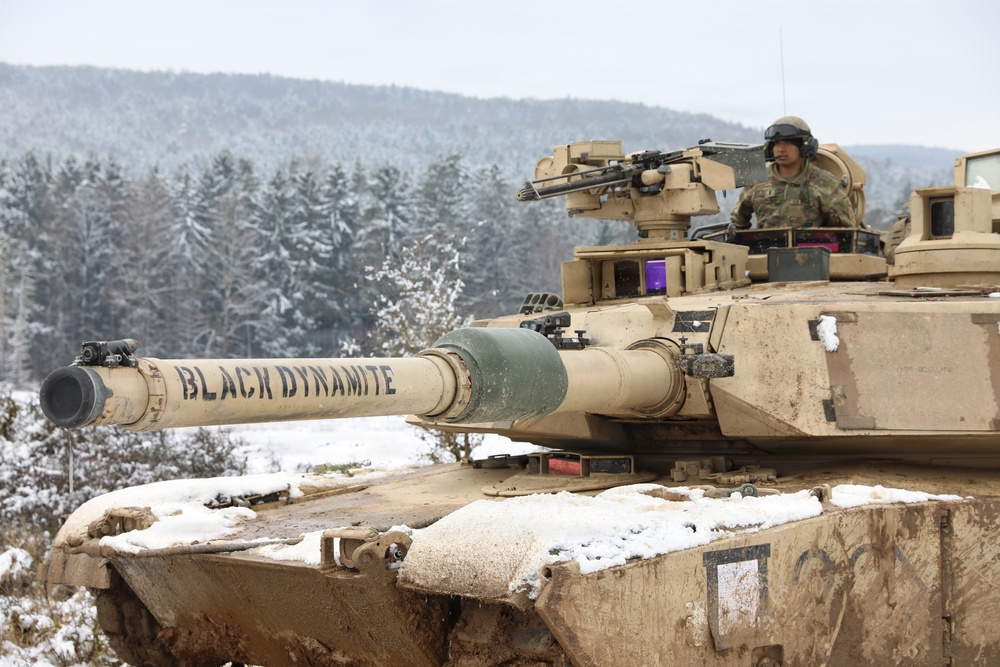
Photo By Spc. Noah Carlsson | U.S. Army Soldiers of 1st Armored Brigade Combat Team, 1st Infantry Division hold...... read more read more
 Subscribe
Hohenfels, Germany is no stranger to the U.S. Army in wintertime. What’s more surprising are the 70-ton Abrams Tanks trudging through miles of snow and muck like it's nothing. The global battlefield is changing, and the U.S. Army is innovating and adapting to respond to its challenges. Capt. Maxwell McVicar, 1st Squadron, 4th Cavalry Regiment, is in the thick of what that looks like in the field. “We’re executing missions against a simulated force that combines light infantry tactics, mechanized infantry, heavy use of field artillery that knows the terrain that we’re fighting through right now in a force-on-force exercise, to simulate how a potential conflict with a near peer enemy to the United States might progress in European terrain.” Maneuvering all that steel and munitions through ice and mud is a significant challenge for cavalry units like McVicar’s. Not being aware of the terrain can cause vehicles to get stuck, which diverts valuable time and resources to recover them. When asked why terrain awareness was important, he said: “For a million reasons, knowing the terrain allows you to know exactly how you can fight on that terrain…knowing the terrain allows you to know where the enemy is going to go, where you think you can go to counter that, and how you actually fight and win that battle on the ground that you’re staring at.” Sgt. 1st Class Ashanti Darity of 1st Squadron, 4th Cavalry Regiment detailed what he and his soldiers are learning about the environment they’re training in. “We are learning a lot about how to maneuver tanks through heavily wooded brush and trees…I’m learning that tanks do not like mud.” Darity outlined that the greatest challenge outside of the terrain is communication. The battlefield is constantly changing, therefore orders are changing to adapt. Darity attributes his unit's success to his section sergeants. Communication is key, and plans change on a dime. “My Section Sergeants are really squared away. When we hit them with different challenges, they’re quick to change their mindset, get their crew all together, attack and engage.” When asked for any further comment, Darity had this to say: “I definitely think that this is important training. I’ve been in the Army for 12 years, and I’ve never been in terrain like this, the cold, the snow, the wet terrain, if this is where our next fight is going to be, then I definitely want my platoon to be able to survive in this kind of environment.” Capt. McVicars closed by saying: “It’s a changing battlefield. The trainers here, the OCs (observer/controllers) at Hohenfels Training Area have designed a scarily realistic experience of what it would be like in conflict with a modern enemy, with modern UAS (Unmanned Aircraft) systems, modern artillery systems, modern tank and IFV (Infantry Fighting Vehicle) platforms, so being able to train that has been an incredible opportunity. It’s something that I really do recommend for any leader, from the most junior corporal, all the way up to troop commanders. It teaches you a lot about yourself, your formation, and what you can and can’t do with the elements at your disposal.”
| Date Taken: | 02.23.2026 |
| Date Posted: | 02.25.2026 02:35 |
| Story ID: | 558671 |
| Location: | HOHENFELS, DE |
| Web Views: | 189 |
| Downloads: | 0 |

This work, WINTER WARFIGHTING: How The U.S. Army is Adapting to a Frozen, Changing Battlefield., by SPC Noah Carlsson, identified by DVIDS, must comply with the restrictions shown on https://www.dvidshub.net/about/copyright.

No keywords found.




