
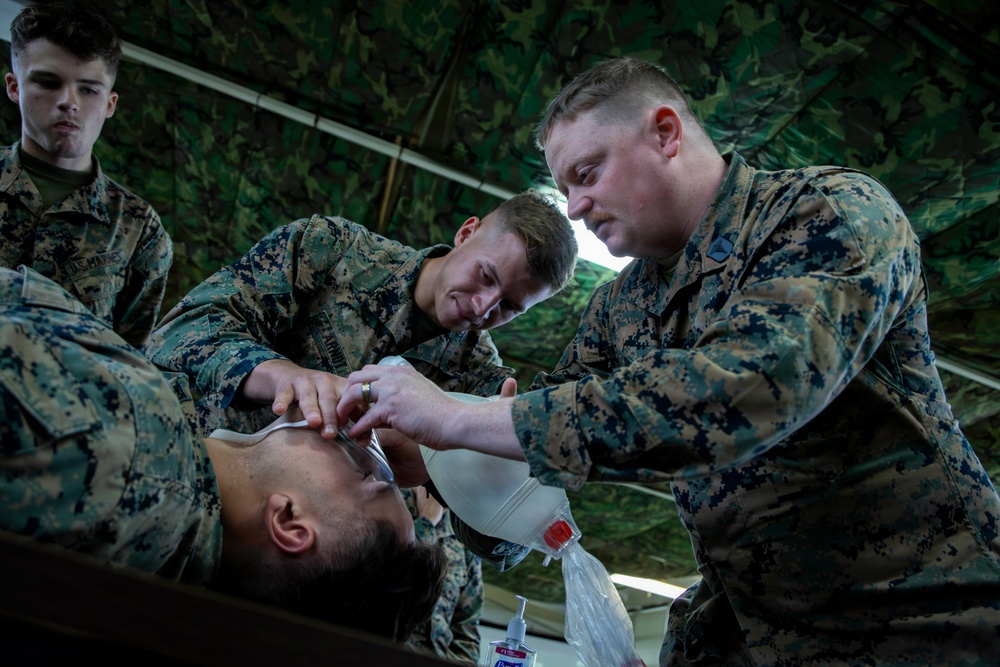
Photo By Sgt. Jackson Ricker | U.S. Navy Hospital Corpsman 3rd Class Kevin Price, right, a course instructor with...... read more read more
 Subscribe
CAMP HANSEN, OKINAWA, JAPAN- Before the sun rises over Camp Hansen\, Marines from across III Marine Expeditionary Force gather inside a classroom lined with detailed medical diagrams. Each seat is prepared with a medical aid bag containing the essential tools needed to care for a wounded Marine in combat. Voluntarily\, these Marines have chosen to take the next step in Tactical Combat Casualty Care by earning the combat lifesaver (CLS) certification.
Through courses like Combat Lifesaver, the Expeditionary Operations Training Group ensures III MEF Marines and corpsmen remain ready to preserve combat power, and the force, when it matters most. By instilling technical proficiency alongside disciplined communication and adaptability, EOTG’s instructor cadre embody the very principles they teach.
“Growing up, I always wanted to help others,” said U.S. Navy Hospital Corpsman 3rd Class Kevin Price, an instructor with III MEF’s Expeditionary Operations Training Group. “I was planning on enlisting in the Marine Corps, but a close friend told me that if I truly wanted to help people, I should consider becoming a corpsman. I listened to him, and I’ve followed that path ever since.”
Seven years later, Price now serves as an instructor for TCCC and the CLS course, training Marines to provide advanced lifesaving care when corpsmen may not be immediately available.
“You won’t always have everything you need,” said Price. “So how do you solve an impossible problem? You use what’s around you—the people and the equipment you have. You create solutions, you adapt, and you make it happen. And the way you do that is through communication.”
The principles of TCCC are simple but critical: treat the casualty, prevent additional casualties, and complete the mission. Throughout the intensive course, students learn the leading causes of preventable battlefield deaths, how to identify them, and how to apply the correct medical interventions, all while accounting for the stress and constraints of a combat environment. Beginning with presentations and diagrams, students practice these methods notionally on each other and on medical mannequins before their final test. A high-stress, simulated mass casualty mission where the students must depend on each other and their skills under pressure without the aid of the instructors.
For Price, serving as a CLS instructor is more than a billet.
“It’s been an honor to teach and mentor these Marines,” he said. “This has been the highlight of my career.”
The CLS course provides Marines with the repetitions and confidence needed to communicate effectively, think critically, and act decisively - skills that can mean the difference between life and death on the battlefield.
| Date Taken: | 02.22.2026 |
| Date Posted: | 02.22.2026 18:49 |
| Story ID: | 558548 |
| Location: | OKINAWA, JP |
| Hometown: | CHICAGO, ILLINOIS, US |
| Web Views: | 241 |
| Downloads: | 0 |

This work, Combat Lifesaver Course | Lifesaving Skills in Life Threatening Conditions, by Sgt Jackson Ricker, identified by DVIDS, must comply with the restrictions shown on https://www.dvidshub.net/about/copyright.

No keywords found.




