
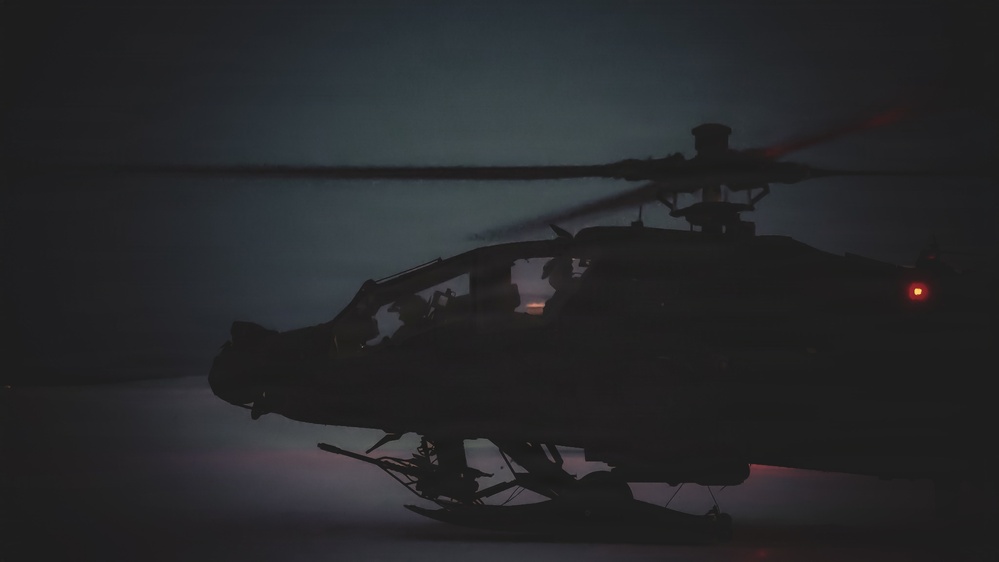
Photo By Correy Mathews | An AH-64 Apache idles on a snow covered flight line while aircrew conduct nighttime...... read more read more
 Subscribe
YUKON TRAINING AREA, Alaska — In the darkness of an Arctic night, Soldiers assigned to the 11th Airborne Division’s Arctic Aviation Command, 1-25th Attack Reconnaissance Battalion, conducted a deep attack with AH-64E Apache helicopters to clear the battlespace and enable a follow on air assault by the 1st Infantry Brigade Combat Team (Air Assault), 11th Airborne Division, during Joint Pacific Multinational Readiness Center 26-02. The exercise marked several firsts for the battalion, showcasing its growing role in Arctic aviation operations.
Launching under limited visibility and extreme cold weather conditions, Arctic Attack crews located and engaged enemy positions threatening inbound assault forces. The attack aviation mission created a window for lift aircraft carrying 1/11 IBCT Soldiers to maneuver into contested terrain, demonstrating the division’s ability to synchronize aviation fires with ground maneuver across Alaska’s austere environment. Apache crews used advanced sensors and weapons systems to detect threats, fight through contested airspace and protect inbound air assault forces, clearing the way for ground Soldiers to seize objectives and maintain operational momentum in demanding Arctic conditions.
Flying the newest AH-64E Apache variant, crews leveraged digital connectivity and long-range targeting capabilities to conduct the nighttime mission while maintaining standoff from simulated threats. The aircraft were equipped with Arctic-specific survival pods designed to sustain crews in the event of an emergency landing in remote, subzero environments, reinforcing the division’s emphasis on operating independently in extreme conditions.
“D-model Apaches had fairly limited power and still fairly short range. With the E-models here, we finally have the right tool to make the best use of the mountains, the flats, restricted area, the emitters, all of the things Alaska offers,” said Lt. Col. Jeff Hayes, commander of 1-25th Attack Reconnaissance Battalion. The upgraded aircraft enhance the battalion’s ability to operate across Alaska’s vast and complex terrain while integrating seamlessly with ground maneuver forces.
The mission required detailed coordination between attack aviation, air assault planners and ground maneuver leaders to synchronize timing, communications and target handoff procedures. By clearing the airspace and suppressing threats ahead of the assault force, the Apaches enabled lift aircraft to insert Soldiers onto the objective with reduced risk, allowing ground forces to rapidly transition from movement to combat operations.
Arctic Aviation Command’s ability to launch and sustain aircraft in extreme cold weather highlighted the growing proficiency of 11th Airborne Division aviation forces. Maintenance teams and ground crews worked continuously to keep aircraft mission capable despite deep snow, freezing temperatures and limited daylight.
Lt. Col. Jeff Hayes said operating in Alaska demands a higher level of discipline, planning and resilience from every Soldier involved. “Everything is tougher on the frontier,” he said, underscoring how Arctic Angels continue to refine their ability to fight, survive and win in one of the most demanding operational environments in the world.
| Date Taken: | 02.21.2026 |
| Date Posted: | 02.22.2026 04:51 |
| Story ID: | 558539 |
| Location: | ALASKA, US |
| Web Views: | 772 |
| Downloads: | 1 |

This work, Arctic Apaches Clear the Way: 11th Airborne Division Conducts Deep Attack Ahead of Air Assault, by Correy Mathews, identified by DVIDS, must comply with the restrictions shown on https://www.dvidshub.net/about/copyright.

No keywords found.




