
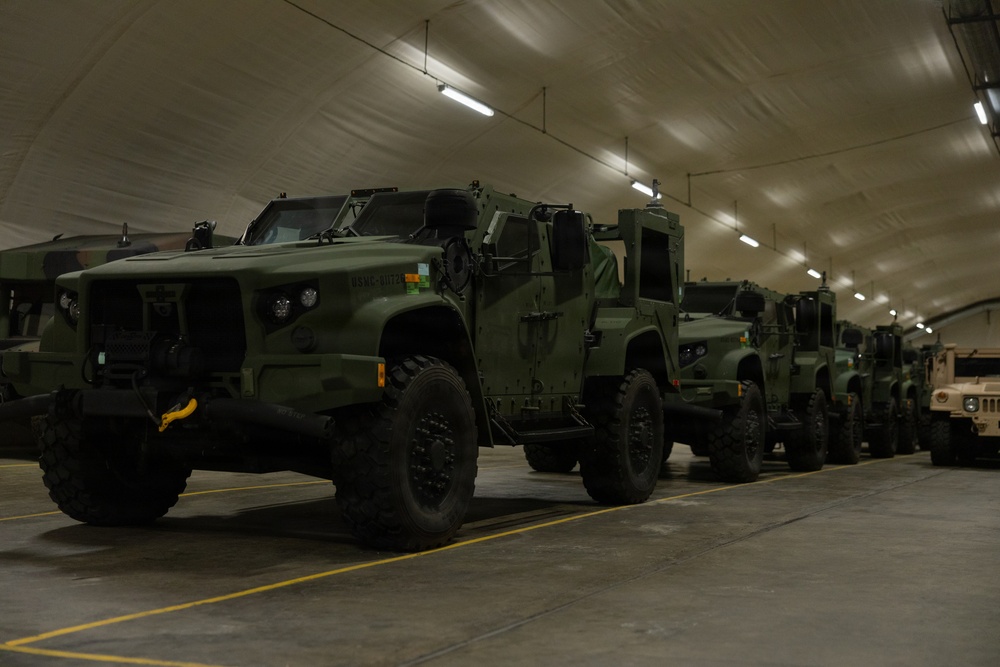
Photo By Lance Cpl. Franco Lewis | U.S. Marine Corps tactical vehicles are staged in preparation for exercise Cold...... read more read more
 Subscribe
NORWAY —Above the Arctic Circle, winter dominates the landscape. Snow blankets the mountains and subzero winds cut across frozen valleys. For most people, this terrain can feel remote and inhospitable. However, for U.S. Marines alongside NATO Allies and partners, it is a proving ground. In the Arctic, the environment can be as lethal as any adversary. This reality makes joint readiness, training, and the ability to rapidly mobilize equipment and personnel to crisis not optional, but essential to operational success in the event of armed conflict.
The ability to rapidly mobilize forces has shaped the outcomes of conflicts since the very beginning. During the opening stages of World War I, Germany’s war plans assumed that Russia would require months to mobilize its military. Instead, Russia mobilized faster than expected, forcing Germany to divert troops, weakening its advance against France and ultimately resulting in them fighting a war on multiple fronts.
More than a century later, that lesson remains relevant. In today’s security environment, the difference between days and weeks can determine whether forces deter conflict or respond to crisis.
Hidden within Norway’s mountains lie one of the United States’ most enduring yet least-known military partnerships; one that cuts more than a month from deployment timelines while also saving millions of dollars in transportation costs. For nearly four decades the Marine Corps has maintained prepositioned equipment in climate-controlled facilities across Norway. This equipment, part of the Marine Corps Prepositioning Program-Norway (MCPP-N), ensures U.S. forces can mobilize quickly, fall-in on gear, and begin operating immediately in the High North.
“The Marine Corps Prepositioning Program–Norway has been a solid bilateral cooperation between the United States and Norway for decades,” said Norway Lt. Col. Morten Aae, commanding officer of the Marine Expeditionary Brigade section of the Norwegian Defense Logistics Organization (NDLO/MEB). “Joint management of this program takes part from the sub-tactical level all the way up to Pentagon level; it’s a collaborative effort to ensure the best possible support to the warfighters,” Aae added.
Originally established to support the defense of Norway, the MCPP-N has evolved into a strategically significant capability that supports NATO’s collective defense and U.S. European Command’s operational objectives for joint interoperability and rapid deployment. Norwegian and U.S. personnel jointly manage the prepositioned equipment, ensuring it meets NATO standards and can be seamlessly integrated during multinational operations and exercises in the Arctic such as the upcoming exercise Cold Response 26.
A key component of NATO’s enhanced vigilance activity Arctic Sentry, exercise Cold Response 26 is a routine Norwegian-led winter military exercise in Northern Norway. U.S. forces are participating as part of U.S. government efforts to support Norwegian and NATO total defense concepts. The exercise is a significant milestone to demonstrate the readiness of a U.S.-based Marine Air Ground Task Force to swiftly composite and rapidly deploy across the Atlantic, be received by Norwegian forces, and conduct operations that enable larger NATO operations. Cold Response will bring together over 25,000 personnel from 12 nations, including Canada, Denmark, Finland, France, Germany, Italy, Netherlands, Spain, Sweden, United Kingdom, the United States, and NATO to enhance interoperability and prepare for future challenges in the Arctic.
In preparation for exercise Cold Response 26, U.S. Marines with Combat Logistics Regiment 27 and Combat Logistics Battalion 6, both part of 2nd Marine Logistics Group, are using the MCPP-N to draw vehicles, cold-weather gear and mission-essential equipment, allowing them to support U.S. forces’ transition from their arrival to the start of operations seamlessly.
Blount Island Command, the logistics hub for managing the lifecycle and maintenance of prepositioned equipment, worked with CLR-27 and CLB-6 to successfully issue over 14,000 items of equipment and supplies from within the MCPP-N.
“The MCPP-N directly supports our ability to deploy and fight in the Arctic,” said Buddy Cote, officer in charge of the technical assistance and advisory team. “By maintaining equipment forward, we reduce reaction time and ensure Marines can integrate quickly with NATO Allies and partners when it matters most.”
The MCPP-N builds the foundation for NATO Allies and partners to move fast and move together. Every vehicle maintained, every piece of cold-weather gear inspected, and every supply pallet accounted for represents joint readiness built in advance of crisis. When Marines arrive in Norway, they are not starting from scratch, they are stepping into a system designed over decades to ensure rapid response and integration. This capability is the conclusive factor in enabling successful joint training between U.S. and Norwegian forces in the Arctic.
“We have successfully equipped the U.S. Marine Corps component participating in exercise Cold Response 26 in a joint operation,” said Aae, emphasizing the close coordination between Norwegians and their U.S. counterparts in accountability and readiness. “We are now planning for an equally successful joint regeneration following the exercise.”
As exercise Cold Response 26 continues, Marines and Sailors operating in Norway are not only training for Arctic conditions, but validating the MCPP-N, a system built and refined over decades.
| Date Taken: | 02.05.2026 |
| Date Posted: | 02.20.2026 14:22 |
| Story ID: | 558489 |
| Location: | NO |
| Web Views: | 898 |
| Downloads: | 0 |

This work, CORE 26 | Beneath Norway's Mountains, a Nearly Four Decade Alliance Stands Ready, by CPT Jorin Hollenbeak, identified by DVIDS, must comply with the restrictions shown on https://www.dvidshub.net/about/copyright.


No keywords found.




