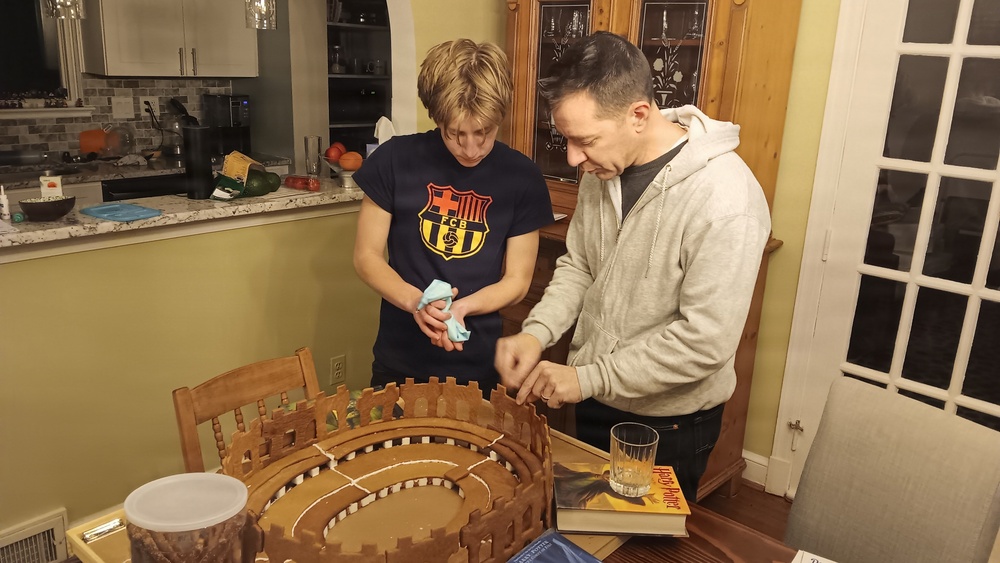
Photo By Tech. Sgt. Melissa Sterling | U.S. Army Lt. Col. Darian Toedtman, a member of the District of Columbia National Guard and battle captain for the Joint Task Force - D.C., builds a gingerbread Colosseum with his son in Washington, D.C., Jan. 11, 2025. Toedtman shares his family tradition with his sons, and his family participates in an annual gingerbread making competition against other extended family members. (Courtesy photo) see less
| View Image Page
WASHINGTON —For U.S. Army Lt. Col. Darian Toedtman, overseeing operations for the Joint Task Force-District of Columbia means managing troop movements, handling live ammunition, and the immense pressure of ensuring the District's safety. But the blueprint for his leadership can be found in an unlikely place: a gingerbread house.
For Toedtman, a D.C. resident for 26 years, the mission is intensely personal.“This means a lot to us DC guardsmen. We live here,”he said, emphasizing the dedication behind their work. He describes the focus as a meticulous, round-the-clock effort to make the city safer.“We’re watching what the movements of our troops are, making sure they're moving on time, making sure they're conducting their operations in accordance with the standard, and we do that one shift at a time.”
This commitment to a methodical process, however, is not confined to his professional duties. It is a mindset he also brings home, where a family tradition has become its own annual masterclass in project management and resilience—lessons he passes on to his two sons and, by extension, the Soldiers and Airmen under his command.
“We emphasize the importance of family because that's our support network,” Toedtman said. “Wherever we go, whatever we're doing, that's a critical part of what we do. It's very important to take a knee, spend that time with your family.”
This is no simple holiday hobby. A civil engineer by trade, Toedtman approaches each gingerbread project with the same precision he applies to his military duties.
“I am very exacting,” he said. The process involves drafting designs, creating scale drawings, and fabricating "form work pieces" to cut the gingerbread. The goal is structural integrity. A thinner gingerbread, he explained, "bakes harder and it's got more compressive strength. It just works as a better structural element."
This exacting process has become a leadership laboratory for his sons, ages 17 and 15. Toedtman described how they transitioned from being interested only in "consumption" to taking part in the design and execution.
He recalled a time when things went wrong during the construction of a gingerbread model of Wat Arun. An unexpected flex in the baked gingerbread and a miscalculation in the icing "mortar" threatened the project. His response was a lesson in leadership under pressure.
“Failing is an inevitability,” Toedtman said. “Staying calm in the moment is the key to it. It was all about keeping your cool and being quick on your feet to make sure we can reorganize.”
Beyond specific lessons in resilience, Toedtman said the true reward is providing his sons with the experience of seeing a complex project through from start to finish.
“One of the lasting things of going through this process with the kids is they get to see a project from inception to completion, and the different pieces of it and how it comes together,” he said, while joking that he tries not to “overwhelm them with MDMP step number three.” For him, it is about the shared experience. “There’s a lot of memories lodged with me grabbing one of them and saying, ‘okay, here, we’re gonna roll out the gingerbread today.’”
These moments of mentorship are the foundation of a leadership philosophy that was fundamentally changed by fatherhood. For Toedtman, the core principles are universal, whether he is at home or on duty.
“It's important for a leader to understand the values that you're instilling and most importantly, how you treat your people during the process,” he said. “Find common purpose, common understanding, and work with your teammates to make sure that you can approach and respond to any situation.”
According to Toedtman, that adaptability has been a prevalent and critical factor in the success of the current mission to help keep D.C. safe. He champions the growth that comes from pushing Soldiers into new roles, a reality for many service members supporting the JTF-DC.
“Take that opportunity of a new position, of new responsibilities, to look at things from a different light,” Toedtman urged.
He explained that this philosophy is not just a theory, but a practice currently being executed by his own staff.
“A lot of the individuals that are working with us in the JTF-DC staff, some of the battle captains, are from other non-operational MOSs,” he noted. “It’s a great experience for them to grow and learn a different way. And it’s going to better you in the long term of your career, to see holistically how the organization works.”
For Toedtman, this annual tradition is a vital component of his own readiness. He described it as something that "helps generate my energy, refills my core." It is a practice he encourages among his troops, sharing his hobby as an example of how to maintain a healthy work-life balance.
“I'm at 30 years since I enlisted at 18,” Toedtman said. “And the reason why I'm still here is because I enjoy working in this environment. I love working with Soldiers and Airmen, and I find joy in it. I hope that others can find joy in their work and enjoy time with the people that energize them.”