
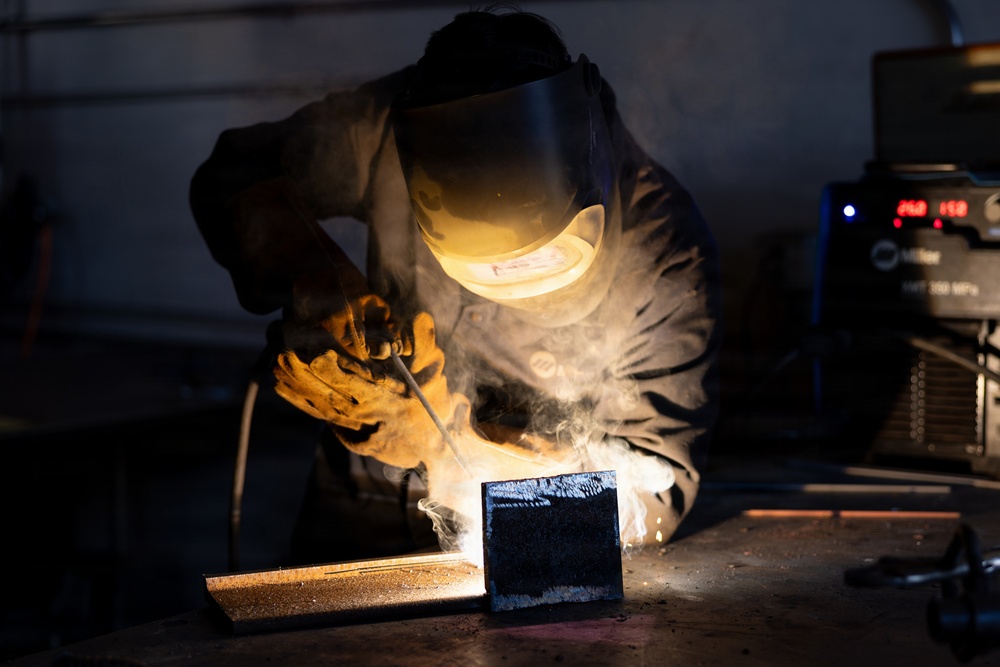
Photo By Staff Sgt. Seaira Moore | U.S. Marine Corps Cpl. Alex Morgan, a metal worker with 1st Maintenance Battalion, 1st...... read more read more
 Subscribe
MARINE CORPS BASE CAMP PENDLETON, Calif.- U.S. Marines with Fabrication Platoon, 1st Maintenance Battalion, 1st Marine Logistics Group, are revolutionizing maintenance and sustainment operations across I Marine Expeditionary Force through additive manufacturing, innovation, and expeditionary production capabilities. Equipped with advanced tools including Computer Numerical Control milling, lathing machines, plasma cutting systems, water jet cutters, welding stations, and 3D printers, the fabrication lab enables Marines to rapidly design, prototype, and manufacture solutions that reduce equipment downtime, limit reliance on extended supply chains, and restore combat readiness.
As the Marine Corps continues to adapt to the fabrication lab plays a critical role in enabling the sustainment of operations across dispersed environments. When logistical lines are limited, the fabrication lab ensures continued support to ground, medical, and air units without having to rely on traditional lines of supply. The ability to fabricate parts locally dramatically reduces costs associated with procurement and shipping, while also minimizing the potential for delays in obtaining critical components from the manufacture. One recent example of the capability to bolster readiness provided by the fabrication lab, included the Amphibious Combat Vehicle.
“The newest part that we have reverse engineered was an ACV dust cover seal for a piston on the ACV brake caliper” said Gunnery Sgt. Mark Cureo, the staff noncommissioned officer in charge of the fabrication lab. Before the fabrication lab reverse engineered the ACV dust cover seal, units had to buy full brake caliper sets. “The next higher assembly costs $4,100 and this part was produced locally for 12 cents, by reverse engineering this part its $615,000 dollars cost savings to the Marine Corps,” explained Cureo. The lab’s impact extends beyond vehicles, with medical units leveraging the lab's ability to provide faster, higher-quality care to casualties in the field.
An advanced cast was developed and tested by the Marines of 1st Maint. Bn. This custom-fitted cast can be printed in an MV-22 Osprey, allowing it to be delivered directly to the patient. “It was made by scanning a person’s arm, then printing the material, heating it, and bending it around the arm,” said Cpl. Connor Oliveira, the computer aided design noncommissioned officer chief. “We can print and deliver it faster than they would be able to get one elsewhere.” The ability to produce custom medical solutions, such as advanced casts, directly in the field enhances operational readiness and ensures quicker, higher-quality care in remote or high-risk environments.
As the Marine Corps evolves to meet the demands of operating in a distributed environment, 1st MLG is leading the charge in transforming how the Marine Corps maintains, sustains, and repairs its equipment. Through innovation, adaptability and harnessing cutting-edge technologies like additive manufacturing, 1st Maint. Bn is modernizing solutions, ensuring that no matter the location or condition, operational readiness is always within reach.
| Date Taken: | 02.18.2026 |
| Date Posted: | 02.23.2026 17:06 |
| Story ID: | 558343 |
| Location: | US |
| Web Views: | 230 |
| Downloads: | 0 |

This work, Leading Expeditionary Fabrication: How 1st MLG is Transforming Sustainment Operations, by 2LT Louis Sosa, identified by DVIDS, must comply with the restrictions shown on https://www.dvidshub.net/about/copyright.


No keywords found.




