
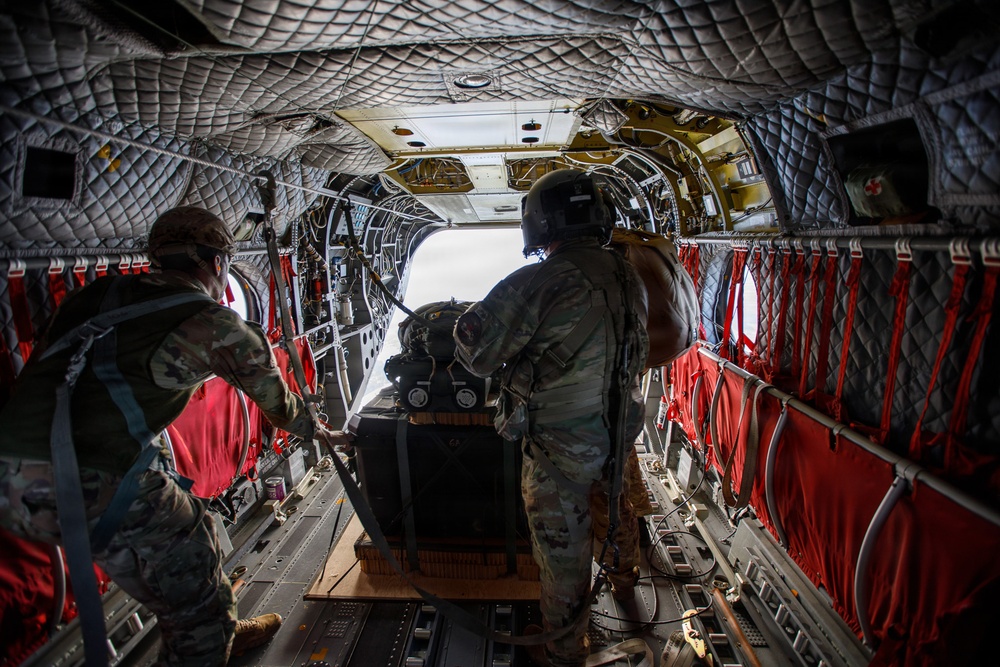
Photo By Staff Sgt. John Bae | U.S. Soldiers assigned to 1st Special Forces Group (Airborne) load the Joint Precision...... read more read more
 Subscribe
JOINT BASE LEWIS-McCHORD, Wash. — Parachute riggers assigned to Group Support Battalion, 1st Special Forces Group (Airborne) successfully executed the first drop of a Joint Precision Airdrop System (JPADS) at Joint Base Lewis-McChord (JBLM) on Feb. 12.
After nearly three years of planning and coordination with JBLM range control, the successful proof-of-concept demonstration facilitates future training and operational capabilities for 1SFG(A) and other adjacent units assigned to JBLM.
The JPADS is a self-steering, GPS guided airdrop platform consisting of a canopy and an autonomous guidance unit, capable of landing within 100 meters of its target. The demonstration unit notably utilized Modular Autonomous Guidance Unit 3.0 which incorporates GPS denied vision guided capability.
During the demonstration, the system carried a payload of 535 pounds suspended weight and was released from a CH-47 Chinook helicopter 4,750 above ground level.
The drop was followed by a military freefall pass simulating a Green Beret Operational Detachment Alpha (ODA) team securing the payload on the ground. Then 1SFG(A) parachute riggers conducted a proficiency jump, where all rigger personnel jumped with a static line parachute that they packed themselves, demonstrating confidence in their product.
Chief Warrant Officer 2 Wade Head, Group Airdrop Systems Technician, emphasized the operational significance of the capability.
“This is important because we can provide sustainment to the warfighter from a distance, that keeps the aircrew and aircraft safe.”
Operationally, ODA teams from the 1SFG(A) employ JPADS to deliver equipment and mission-critical items. These can be dropped at a desired impact point or sent to a pre-determined location for later retrieval. In some instances, a military freefall ODA pushes the JPADS first, immediately followed by an airborne operation, resulting in the personnel and equipment arriving to the desired impact point simultaneously.
“Now [the ODA teams] will be able to get their infiltration training locally, versus going to Yakima or somewhere else.” Said Sgt. 1st Class Mia Schwartz, Senior Airdrop Operations NCO.
A mixture of unit representatives from 2nd Ranger Battalion, 75th Ranger Regiment, 593rd Corps Sustainment Command and I Corps, attended the event to observe the demonstration. The Washington Army National Guard supported the event providing a CH-47 Chinook helicopter for the JPADS and airborne operations.
Planning the JPAD training came with challenges, particularly due to the installation’s proximity to adjacent roadways, neighborhoods and nearby towns. Organizers worked to mitigate risks while demonstrating the system’s precision and reliability. Most notably JBLM range control assisted 1SFG(A) with navigating safety protocol and ensuring safe implementation. This coordination provides a template for adjacent JBLM units to replicate similar training in the future.
The ability to train JPADS operation underscores the importance of the logistical support provided by the Group Support Battalion to mitigate interdiction of ground and sea lines of communication to the Special Forces Operators. By successfully completing this training both 1SFG(A) and conventional forces assigned to JBLM can better prepare for future operations.
| Date Taken: | 02.18.2026 |
| Date Posted: | 02.20.2026 00:04 |
| Story ID: | 558338 |
| Location: | JOINT BASE LEWIS-MCCHORD, WASHINGTON, US |
| Web Views: | 209 |
| Downloads: | 0 |

This work, 1st Special Forces Group (Airborne) Parachute Riggers make history on Joint Base Lewis-McChord, by SGT Alec Byrd, identified by DVIDS, must comply with the restrictions shown on https://www.dvidshub.net/about/copyright.


No keywords found.




