
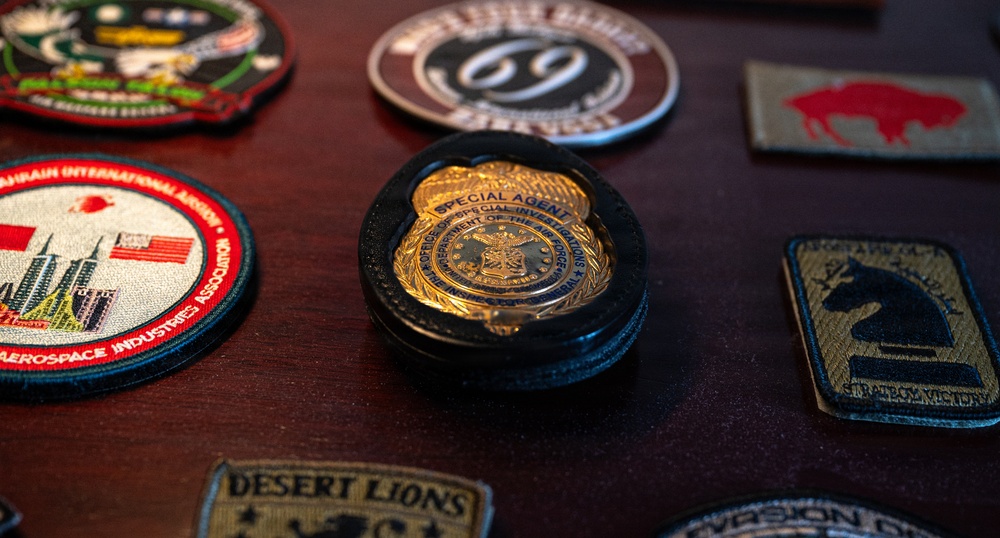
Photo By Airman 1st Class holly leonard | A U.S. Air Force Office of Special Investigations badge is displayed on a desk at...... read more read more
 Subscribe
SEYMOUR JOHNSON AIR FORCE BASE, N.C. — The Air Force Office of Special Investigations (AFOSI) intentionally operates primarily out of sight. This also applies to the AFOSI Special Agents of Detachment 216 at Seymour Johnson Air Force Base, North Carolina. Agents do not measure success by attention or recognition. Their mission is to protect the people, information and resources that allow the 4th Fighter Wing to generate mission-ready air power.
“Everyone sees the jets,” said Special Agent Justin Patterson, Senior Enlisted Leader for AFOSI Det 216 “Our job is to protect the reason those jets can launch in the first place.”
At Seymour Johnson, AFOSI detects threats that may go unnoticed from felony crimes like sexual assault and domestic violence, to fraud and foreign intelligence collection.
“Sometimes protecting the base looks like a major investigation,” Patterson said. “Other times it is a five-minute conversation that keeps a bad idea from turning into something much worse.”
Much of AFOSI’s success is measured by what does not happen. Many cases conclude quietly, with risks reduced before they disrupt people or the mission.
Agents work closely with Security Forces, commanders, first sergeants, local, state and federal law enforcement partners.
Though independent from the installation's chain of command, they operate under AFOSI Region 2, an intermediate headquarters responsible for overseeing units within its geographic area. But at the local level, they ensure commanders receive the information needed to make informed decisions.
“Our job is to assist commanders in keeping units ready and maintaining a pulse on risks to the mission,” Patterson said. “That allows decision makers to be well informed when tough choices have to be made.”
Protecting information is a growing focus of AFOSI’s work, Patterson explained that our digital environment, personal data and operational details can be exposed quickly through social media, mobile devices and online platforms.
“In today’s landscape, information is tied directly to people,” Patterson said. “It can be as simple as a photo with location data attached. With a click, that information can be exposed, and that puts personnel and resources at risk.”
According to Special Agent Douglas Edens, Special Agent-in-Charge of AFOSI Det 216, many investigations now stem from online activity.
“Social media and online platforms are one of the biggest risks,” Edens said. “People can be exploited through phones, computers and even gaming systems. Protecting your information helps protect the mission.”
AFOSI Det 216’s team also plays a role long before Airmen deploy. Agents conduct threat assessments, coordinate with other AFOSI units worldwide and provide briefings to ensure deploying personnel understand potential risks in their area of responsibility.
“We assess threats to deployed locations and coordinate with other AFOSI units to build a clearer picture of what Airmen may face,” Patterson said. “That awareness is critical before they ever leave home station.”
The work is not limited to investigations. AFOSI maintains regular coordination with base agencies such as Family Advocacy, Sexual Assault Prevention and Response, Airman Leadership School and Installation Resilience Offices. Agents also participate in community working groups and maintain partnerships across North Carolina.
Agents are on call around the clock, often working nights and weekends. They may also provide protective services for senior Air Force leaders visiting the region.
Despite the scope of the mission, AFOSI leaders stress that Special agents are not removed from the rest of the force.
“We are just another Air Force career field,” Edens said. “We serve the uniform in a unique way, but we are just as dedicated to the mission and the people as every other career field.”
Both leaders emphasized that AFOSI relies on Airmen across the installation to help keep the base safe.
“Every Airman is a sensor,” Patterson said. “If something feels off or out of the ordinary, report it. No matter how small it seems, we want to know about it.”
AFOSI accepts reports through supervisors, Security Forces, emergency services or directly through the AFOSI office, including anonymous tips.
“Talking to us is about prevention,” Patterson added. “We are here to find the truth, seek justice and work to stop threats before they affect the mission.”
Behind every sortie launched from Seymour Johnson Air Force Base, Agents work quietly to reduce risk and protect the wing. They do not seek attention, and most of their successes remain unseen. But day after day, the AFOSI ensures the 4th FW remains ready by protecting the Airmen who make the mission possible.
Anonymous tips can be submitted here through the AFOSI website.
| Date Taken: | 01.30.2026 |
| Date Posted: | 02.18.2026 14:32 |
| Story ID: | 558318 |
| Location: | SEYMOUR JOHNSON AIR FORCE BASE, NORTH CAROLINA, US |
| Web Views: | 212 |
| Downloads: | 1 |

This work, ‘Everyone is a Sensor’: Inside AFOSI’s role protecting 4th FW, by A1C holly leonard, identified by DVIDS, must comply with the restrictions shown on https://www.dvidshub.net/about/copyright.


No keywords found.




