
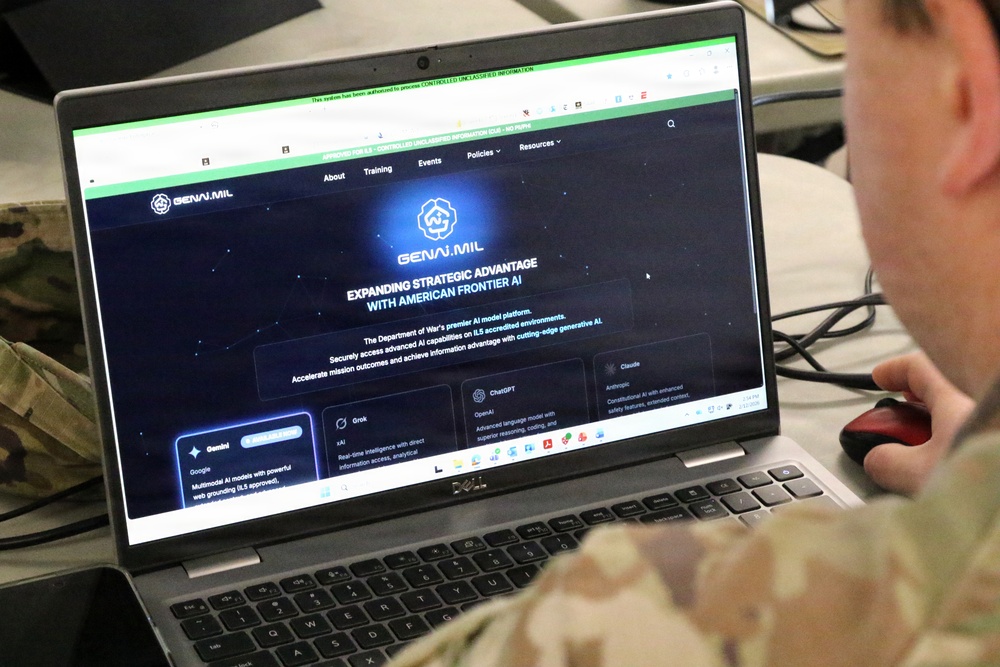
Photo By Sgt. 1st Class Shane Smith | Pennsylvania Army National Guard Soldiers and civilian personnel learn to integrate...... read more read more
 Subscribe
FORT INDIANTOWN GAP, Pa. – Pennsylvania Army National Guard Soldiers and civilian personnel are learning how to deliberately integrate artificial intelligence into military workflows during a two-day AI 201 course taught by U.S. Army War College faculty here Feb. 11-12.
The course builds on earlier introductory training and focuses on how Soldiers think through problems, manage workflows and determine where AI can responsibly improve performance across planning, operations and staff processes.
The training comes as Department of Defense leadership pushes to rapidly accelerate AI adoption across the joint force. In early 2026, U.S. Secretary of Defense Pete Hegseth launched an “AI-first” directive aimed at aggressively integrating artificial intelligence into operations across the department.
That shift is driving training events across the force, including hands-on instruction designed to help Soldiers understand not just what AI can do, but when and how to use it.
Kelly Ihme, an assistant professor at the War College, said the course is designed to close the gap between basic AI awareness and practical application.
Ihme, an early adopter of generative AI in academic workflows, said she began experimenting with AI tools as early as 2022 and later incorporated its use into education at the War College before helping bring that knowledge to the broader force.
“No one’s really teaching this type of material yet,” Ihme said. “The focus of this course is less about the AI tools we can use, and more about how we must use our brains to think about problems and determine when using AI would be a good solution.”
The AI 201 course focuses on seven core skill areas, or questioning set mind frames. One of these areas is task delegation, in which individuals must ask themselves which part(s) of a specific task AI can handle, versus which parts should be completed without the use of AI, and where in the process it makes sense for AI to be inserted, if at all. Instructors emphasized developing sustainable habits for integrating AI into daily tasks rather than relying on technology as a universal solution.
“Look at your day-to-day processes where AI could be introduced to save time and improve efficiency,” Ihme said. “You must develop the habit of using AI regularly to successfully integrate it into your workflow and have lasting impact.”
The training also introduces Soldiers to enterprise tools they are increasingly likely to see across the force, including GenAI.mil, the War Department’s generative AI environment designed to deliver advanced AI capabilities within a secure network architecture. The platform supports tasks such as document summarization, research assistance and data analysis while maintaining data protection and accountability requirements across military networks.
U.S. Army Sgt. Maj. Michael Donalski, a course participant, said expanding access to AI training could enhance the force.
“I think the Pennsylvania National Guard would benefit from having more of these AI-centric courses available, and widening the scope to bring a broader pool of service members into the training,” Donalski said.
Donalski added that one of the key takeaways from the course was the importance of mastering fundamental skills before introducing AI into a workflow.
“You need to know how to do the skill or task you’re trying to incorporate AI into before you can effectively use AI to assist,” he said.
At the conclusion of the course instructors stressed that while AI can support a wide variety of tasks to improve productivity, human judgment and oversight remain essential.
As the Army continues integrating AI-enabled systems and tools, education like AI 201 helps ensure Pennsylvania National Guard members are prepared to operate effectively in an increasingly data-centric operational environment.
| Date Taken: | 02.17.2026 |
| Date Posted: | 02.18.2026 13:21 |
| Story ID: | 558311 |
| Location: | FORT INDIANTOWN GAP, PENNSYLVANIA, US |
| Web Views: | 269 |
| Downloads: | 2 |

This work, AI education enhances workforce productivity, by SFC Shane Smith, identified by DVIDS, must comply with the restrictions shown on https://www.dvidshub.net/about/copyright.


No keywords found.




