
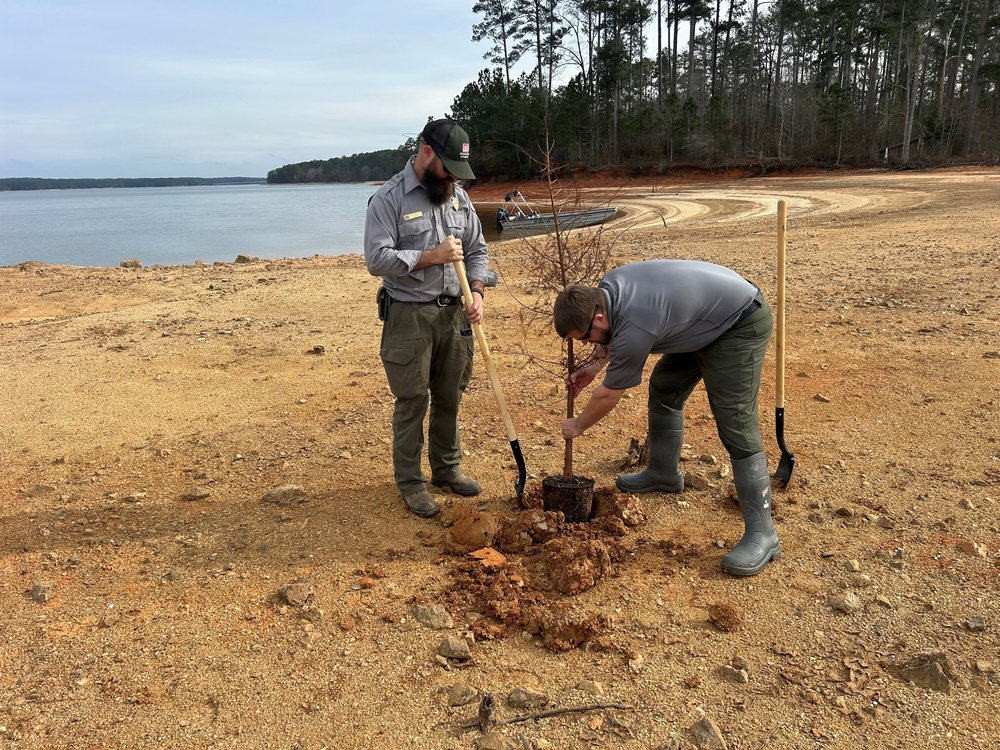
Photo By Michael Ariola | Evan Brashier, a conservation biologist, and Adam Weatherford, chief of the Forest,...... read more read more
SAVANNAH, Ga. — The U.S. Army Corps of Engineers’ Savannah District recently planted bald cypress trees at J. Strom Thurmond Lake, also known as Clarks Hill Lake. The trees were installed at six hazardous shoal locations to improve safety, stabilize shorelines and create long-term habitat for fish and other wildlife.
Improving boater safety
When planted on or around hazardous shoals with low-relief, hard-to-see features, bald cypress trees grow into tall, permanent visual markers that boaters can recognize from a distance in all seasons.
“Unlike floating buoys that can drift or get damaged, a live tree trunk rising out of the water or from a shallow bar clearly signals shallow water,” said Evan Brashier, a conservation biologist with the Savannah District. “Boaters then know to steer around the shoal, even if they are unfamiliar with the lake.”
Stabilizing shorelines
Bald cypress trees stabilize shorelines through their extensive, dense root systems that bind soil particles together, preventing erosion. The buttressed trunks and shallow lateral roots act like natural pilings, anchoring the trees and adding structural strength in wet, unstable soils.
“As waves and currents move sediment, the trunks and roots slow water velocity, allowing suspended material to settle and accumulate around the trees,” Brashier said. “Over time, this process can help rebuild eroded sections of shoreline. In addition, the vegetated buffer they form intercepts and absorbs stormwater runoff, reducing erosive energy and helping maintain a more stable slope at the water’s edge.”
Creating wildlife habitat
Bald cypress provide cover and food for a wide range of species, including frogs, toads, salamanders, ducks, raptors, songbirds, fish, squirrels and other small mammals.
The trunks, cavities, knees and submerged roots offer nesting sites, spawning areas and protective cover, especially along wetland edges and reservoir margins. Seeds are eaten by turkeys, wood ducks, squirrels and various songbirds, while leaf litter and complex root structures support aquatic invertebrates that feed fish and wading birds.
“By soaking up floodwaters, reducing erosion and trapping pollutants, the trees also help improve aquatic and wetland habitat, which indirectly benefits the entire local ecosystem,” Brashier said.
Why bald cypress
The Savannah District chose bald cypress for this purpose because they can live in water and in frequently flooded, wave-impacted areas where most other tree species would not survive, explained Brashier. The trees also have large, fibrous root systems and buttressed bases that grip loose lake sediments.
“The species is long-lived, native to southeastern floodplains and tolerant of water-level fluctuations and periodic inundation, which makes it a durable, low-maintenance living marker instead of a structure that must be replaced,” Brashier said. “In addition, its knees, trunks and crowns add high value fish and wildlife habitat while performing safety and erosion control functions, providing more ecological return than most alternative species.”
The bald cypress trees planted at the Thurmond Lake shoals were grown at the Savannah District’s Richard B. Russell Aquatic Plant Nursery.
“The nursery receives bald cypress seedlings from the Georgia Forestry Commission and transplants them into larger containers, where they mature for eight to 10 months before being sent to district reservoirs,” said Christopher Nelson, natural resources manager for the Savannah District. “By the time they are planted, the trees are typically three to four feet tall. That additional size significantly improves their survival rate.”
About Thurmond Lake
J. Strom Thurmond Lake is located on the Savannah River about 22 miles upstream from Augusta, Georgia. At full pool elevation, Thurmond Lake comprises nearly 71,100 acres of water and 1,200 miles of shoreline. It is one of three reservoirs along the upper Savannah River managed by the Savannah District.
| Date Taken: | 02.17.2026 |
| Date Posted: | 02.17.2026 11:24 |
| Story ID: | 558234 |
| Location: | GEORGIA, US |
| Web Views: | 79 |
| Downloads: | 0 |

This work, Strong Roots, Safer Waters: Cypress Trees Planted at Thurmond Lake, by Michael Ariola, identified by DVIDS, must comply with the restrictions shown on https://www.dvidshub.net/about/copyright.

No keywords found.





