
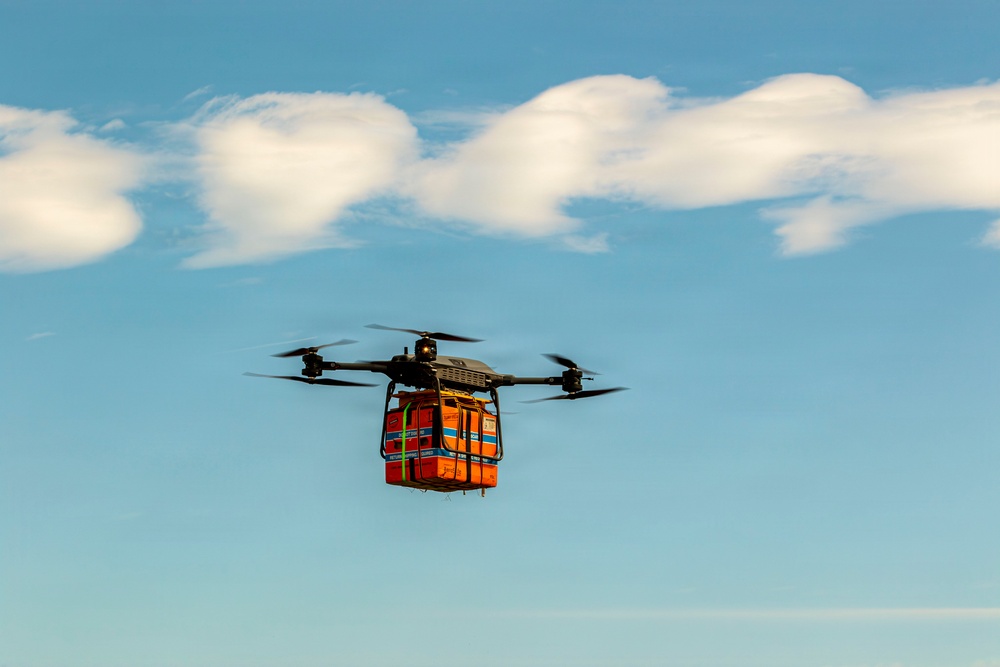
Photo By Staff Sgt. Anthony Herrera | U.S. Soldiers assigned to the 703rd Brigade Support Battalion, 2nd Armored Brigade...... read more read more
 Subscribe
As the U.S. Army’s leading Transformation in Contact 2.0 unit, the 3rd Infantry Division takes every opportunity to use innovation to increase lethality, precision, and maximize efficiency to exceed today’s modern warfare capabilities. Innovation doesn’t stop at tanks and weapon systems; it plays a role in every aspect of the battlefield, including medical care.
“The 703rd is known as the beating heart of Sparta, and we’re living up to our nickname in the field exercise,” said U.S. Army Maj. Patrick Smith, the 703rd Brigade Support Battalion (BSB) Executive Officer. “We’re using the Tactical Resupply Vehicle (TRV), a resupply unmanned aircraft system (UAS). Our medics have been trained and certified in launching, flying, and landing it.”
The TRV-150 has, until recently, been mainly used to carry supplies and equipment. During Spartan Focus, the 703rd BSB operated the TRV-150 more efficiently by using it to transport blood to three different training locations in Fort Stewart, drastically reducing the time it would normally take to provide potentially life-saving care on the battlefield. The drone is designed to provide rapid resupply in high-risk environments while reducing Soldiers’ exposure to enemy threat.
“We’re trying to find methods that are survivable, that are precise and that are responsive to the folks that are on the front line,” said Smith. “The blood delivery is an example of distributed logistics where our medics in one location will upload this payload of blood and fly it 600 feet in the air, at a speed of about 70 mph either the point of need, or to another node where it can be stored for future use.”
A system which historically consists of landing a helicopter on the front lines and evacuating casualties to receive medical treatment, has now tested and confirmed the ability to deliver blood via TRV-150. This heavy-lift unmanned drone can deliver up to 150 lbs of supplies within 43 miles, and at a speed of 67 mph.
The integration of the TRV-150 into medical care tactics as part of TiC 2.0 introduces a new capability for Combat Medic Specialists. Medics are being trained to operate the system independently, ensuring aerial resupply operations can be conducted seamlessly even in the absence of dedicated drone operators.
“Not only is it important to know how this system operates, but how we load and unload while we're using as payloads; whether it's blood or other medical supplies,” said U.S. Army 1st. Lt. Edgardo Rivera Marcano, 2nd ABCT’s Brigade Medical Supply Officer. “The medics need to know how those classes are supplied, how they are loaded, how they operate, and what the capabilities are of the system we are using.”
The rapid advancement of TiC 2.0 demands parallel progress across all warfighting functions, including medical care. Incorporating innovative capabilities ensures units meet emerging operational standards and maintain the ability to sustain forces in large-scale combat environments.
“We’re moving into large-scale combat operations. Before, we would rely on ambulance backhaul where we would return patients back to their units with medical equipment,” said Rivera Mercano. “Now, those operations would not be in a timely manner, so innovations like this would facilitate how we deliver care and supplies to people on the front lines.”
| Date Taken: | 02.13.2026 |
| Date Posted: | 02.17.2026 10:14 |
| Story ID: | 558190 |
| Location: | FORT STEWART, GEORGIA, US |
| Web Views: | 445 |
| Downloads: | 0 |

This work, TiC 2.0 meets medical care during Spartan Focus, by SSG Katelyn Vazquez, identified by DVIDS, must comply with the restrictions shown on https://www.dvidshub.net/about/copyright.


No keywords found.




