
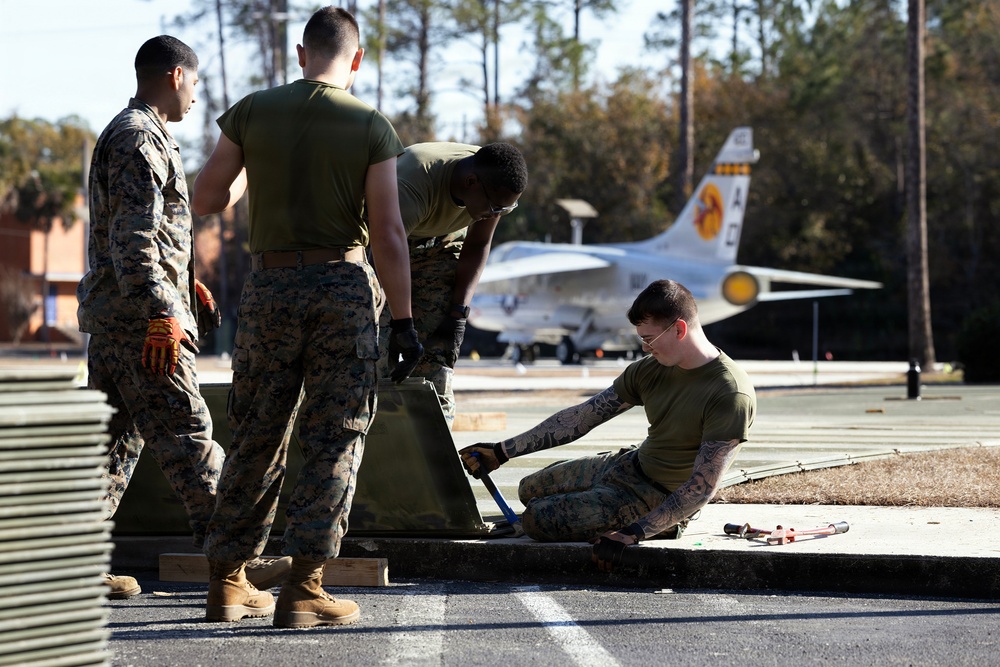
Photo By Dustin Senger | U.S. Marines assigned to Blount Island Command lay aluminum expeditionary airfield...... read more read more
Five Marines assigned to Blount Island Command arrived Feb. 12 at the Chapel of the High-Speed Pass carrying 12 containers of aluminum expeditionary airfield matting normally maintained for Marine Corps prepositioning programs.
They cut the banding from the containers and pulled out olive drab aluminum panels—six-foot sections weighing about 75 pounds each and 12-foot sections weighing roughly 155 pounds—laying them across unimproved ground to create a reinforced pathway.
The matting will support the movement of a restored S-3 Viking aircraft onto the developing Legacy Plaza at the National POW/MIA Memorial and Museum site at Cecil Field in Jacksonville, Florida. The aircraft is scheduled to be towed across the reinforced surface within two days.
Typically staged to enable rapid aircraft and equipment movement during overseas contingency operations, the airfield matting created a stable surface to protect the chapel and plaza grounds. After the aircraft is positioned, the matting will return to Blount Island Command for future prepositioning use.
The effort also provided cross-training. Two expeditionary airfield systems technicians—gunnery sergeants experienced in deploying the matting for rotary- and fixed-wing aircraft—worked alongside three sergeants who had previously managed the interlocking mats only in storage.
Retired U.S. Navy Capt. Ed Turner, executive director of the memorial and a former S-3 pilot who flew the aircraft for nearly 20 years during a 32-year Navy career, said the Viking played a critical role in Cold War and Desert Storm operations.
“It was made to hunt submarines,” Turner said, recalling missions launched from aircraft carriers. “We could detect a periscope — a pipe in the water — from more than 30 miles away. Later, it became a refueler. We could stay up for hours.”
Turner said Marine Corps support reduced project costs.
“What they did with the matting,” he said, “that’s tens of thousands of dollars for a contractor. All that money we’d otherwise pay to a civilian operation can now go directly into the memorial itself.”
The memorial traces its roots to 1971, when Orange Park resident Mary Helen Hoff, whose husband, Navy Lt. Cmdr. Michael Hoff, was missing in action, helped inspire the creation of the POW/MIA flag. Today the site seeks congressional designation as the nation’s POW/MIA memorial, honoring approximately 142,000 U.S. service members captured as prisoners of war since World War II and about 82,000 who remain missing in action or otherwise unaccounted for.
Legislation to grant that designation was introduced by Rep. Aaron Bean of Florida, whose district includes Blount Island Command and the memorial site.
Regional and local support from businesses, civic organizations and more than 1,000 individual donors has generated more than $2 million in funding and in-kind services, with additional partnerships under discussion.
The 26-acre memorial sits at the former Naval Air Station Cecil Field. The renovated base chapel anchors the site along POW-MIA Memorial Parkway.
“It’s been a great relationship,” Turner said. “The Marines are quick to react. Their support and work ethic have been invaluable.”
| Date Taken: | 02.13.2026 |
| Date Posted: | 02.13.2026 15:00 |
| Story ID: | 558146 |
| Location: | JACKSONVILLE, FLORIDA, US |
| Hometown: | JACKSONVILLE, FLORIDA, US |
| Web Views: | 669 |
| Downloads: | 0 |

This work, Marines Lay Expeditionary Matting for POW/MIA Memorial Aircraft Move, by Dustin Senger, identified by DVIDS, must comply with the restrictions shown on https://www.dvidshub.net/about/copyright.


No keywords found.





