
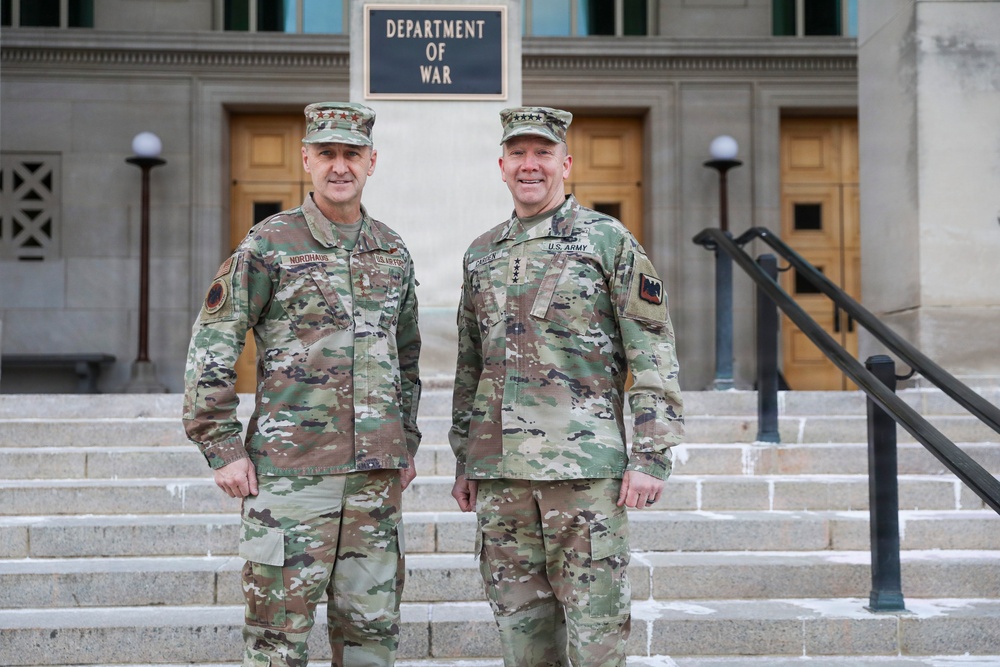
Photo By Master Sgt. Zach Sheely | Air Force Gen. Steve Nordhaus, the 30th Chief of the National Guard Bureau, left,...... read more read more
 Subscribe
WASHINGTON – General Thomas Carden has been appointed as the first four-star Vice Chief of the National Guard Bureau, bringing nearly four decades of experience to the organization that oversees more than 435,000 Soldiers and Airmen.
For Carden, the title 'Vice’ is a familiar one. He explained that, like his previous deputy roles, the position is fundamentally about amplifying the commander’s intent.
“The vice or the deputy doesn’t have his or her own vision for strategy,” said Carden. “They figure out what the chief wants to accomplish in time and space to enable the 54 (states and territories) to do what they do best, and that’s generate readiness, lethality and capability for the joint force.”
Carden’s journey began on a peanut farm in southern Georgia, spanning nearly four decades from his enlistment as a private to the assumption of his current duties. After receiving his commission, Carden’s career was marked by a steady ascent through the ranks of the Georgia National Guard. In 2015, he assumed command of the Ga. Army National Guard and later served as the state's Adjutant General from 2019 to 2024.
Carden credits his success on the teams he has served with and leaders who mentored him.
"First of all, it's emblematic of the Guard as a leadership factory," Carden said. "It's really not about me. It's been about everybody that I've served with, for, and around for almost 40 years. If it had been up to me alone, I would have been lucky to make it through my first enlistment."
Many of his philosophies on leadership come from his experience in the Georgia National Guard, which he says cultivates a unique culture of mentorship, where leaders identify problems and make immediate “course corrections” for one another.
"We've had a culture throughout my career where our leaders... if they saw something that wasn't to standard or that you could do a little bit better…they would pull you aside and help coach you a little bit. It was very much a culture of leadership, not liker-ship,” he said, adding a common military adage: "I’d rather hurt your feelings than go to your funeral.”
In relation to finding mentors, Carden encourages junior leaders to be proactive in seeking out senior leaders to give them honest feedback and guidance.
When Carden was a new rifle platoon leader during a National Training Center rotation in Fort Irwin in the early 1990s, he noticed a commander of an adjacent company named Scott Carter, who carried himself in a way he wanted to emulate. Carden approached him, asked questions, and took notes that proved invaluable during the rotation.
"The lesson I learned," Carden said, "is just don't wait for the organization to assign you a mentor. You go recruit your own mentor." Even now as a four-star general, he says “If I had a hard problem right now, I’d pick up the phone and call Scott Carter.”
He also recommends that leaders take initiative to seek roles that cast them outside their own comfort zones. "If you want to reach your full potential in the Guard, you need an assignment that requires the issuance of and frequent wear of a helmet," he stated. For him, that meant spending 18 of his 40 years with the 48th Infantry Brigade Combat Team, an organization that spends significantly more time in challenging austere locations than in office spaces he refers to as "the land of climate control and ultraviolet light."
Those demanding "helmet jobs" often meant being cast outside his comfort zone. He had just 15 days’ notice before moving to Bucharest, Romania for his first flag officer role outside of Georgia in 2017. “I mailed seven cardboard boxes and took five suitcases,” Carden recalled. His most recently completed assignment at U.S. Northern Command was similar, arriving where he “didn’t know a soul” after a career spent mostly with familiar faces.
“You’ve gotta go out there every day and earn it,” he said.
Carden acknowledges, however, that those assignments came at a cost and encourages that service members seek balance between their work and family life whenever possible. He reflects on how his wife largely raised their two children while he was often away. “Like every other parent with kids out of the house,” he said, “I wish I had been able to spend more time with them when they were little.”
His life and career experiences now drive Carden's mission to oversee strategy for the National Guard. He is responsible for an organization that provides 20 percent of the nation’s joint force on just four percent of the Department of Defense’s budget, with priorities including the war fight, homeland defense, and partnerships, according to its May 2025 posture statement.
Carden believes that the best way to achieve those objectives is by requiring Soldiers and Airmen to master the fundamental requirements of their jobs.
“Soldiers and Airmen have to be fully qualified at the position they are in, and they’ve got to be deployable,” said Carden.
When it comes to domestic missions, Carden draws from learned experiences commanding the Georgia National Guard through hurricane response, civil disturbance security, and a global pandemic that forced the organization to flex its capabilities to meet the unique challenges posed by the COVID-19 outbreak.
“What we had to do was take the capability we had and bend it around the problem,” said Carden. During that time, the Ga. Guard’s largest medical company was deployed to Iraq, so leaders generated new formations from scratch. “We had to start building these medical teams that didn’t exist,” said Carden. This innovation led to the development of infection control teams that spanned across Georgia to sanitize facilities and create safer environments for citizens around the state. The new capability was documented and shared with other military and civilian organizations, who adopted the concepts into their own practice.
Carden credits those teams for saving many lives.
Now that his responsibility has grown to include 53 additional states and territories, he sees other National Guard organizations as “innovation incubators” prepared to provide similar solutions to unique challenges.
Carden’s experience also extends to the National Guard’s third core mission: building global partnerships. As Georgia’s Adjutant General, he oversaw a busy State Partnership Program, fostering key relationships with both the countries of Georgia and Argentina. In his new role, he could potentially lend his expertise to the execution of more than 1,000 events with 155 state partners around the world.
As Carden begins his tenure as the 12th Vice Chief, he is focused on ensuring the Guard is “brilliant at the basics.” But for a leader whose journey is defined by adaptation and mentorship, the ultimate lesson is one of perpetual growth.
“Senior leaders have got to be senior learners,” he said. “If you ever quit learning, you’re going to quit growing and you won’t be able to contribute.”
| Date Taken: | 02.12.2026 |
| Date Posted: | 02.12.2026 16:10 |
| Story ID: | 558068 |
| Location: | WASHINGTON, DISTRICT OF COLUMBIA, US |
| Web Views: | 132 |
| Downloads: | 2 |

This work, National Guard’s First 4-Star Vice Chief Credits Georgia’s ‘Leadership Factory’, by Charles Emmons, identified by DVIDS, must comply with the restrictions shown on https://www.dvidshub.net/about/copyright.

No keywords found.




