
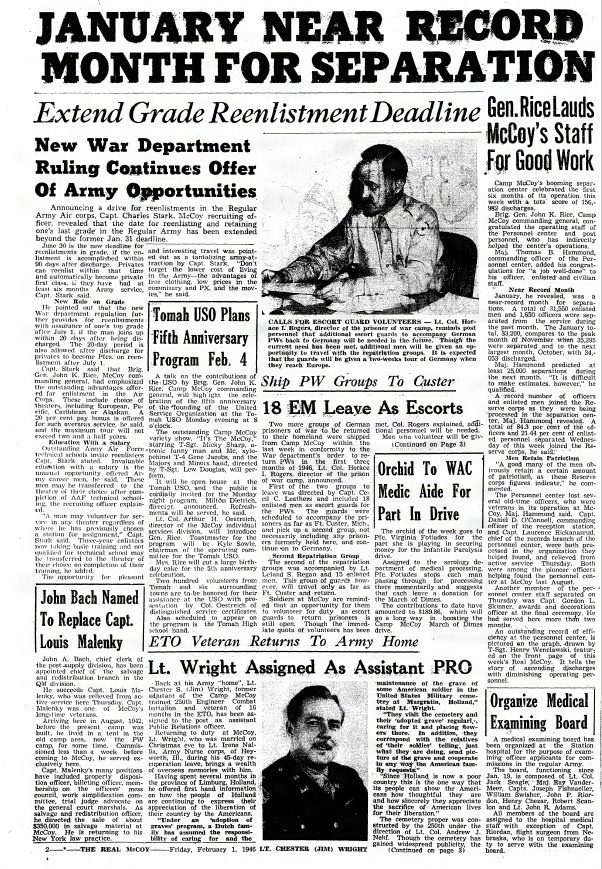
Courtesy Photo | This is a news clip from the Feb. 1, 1946, edition of The Real McCoy newspaper at Fort...... read more read more
 Subscribe
Fort McCoy, Wis., was established in 1909. Here is a look back at some installation history from February 2026 and back.
80 Years Ago — February 1946 FROM THE FEB. 1, 1946, EDITION OF THE REAL MCCOY NEWSPAPER: Gen. Rice lauds McCoy’s staff for good work (By Newspaper Staff) — Camp McCoy’s booming separation center celebrated the first six months of its operation this week with a total score of 156,982 discharges.
Brig. Gen. John K. Rice, Camp McCoy commanding general, congratulated the operating staff of the Personnel Center and post personnel, adding his congratulations for a “job well done” to his officer, enlisted, and civilian staff.
Near record month
January (1946), he revealed, was a near-record month for separations. A total of 31,550 enlisted ment and 1,650 officers were separated from the service during the past month. The January total, 33,200, compares to the peak month of November when 35,295 were separated and to next larger month, October, with 34,053 discharged.
Maj. Hammond predicted at least 25,000 separations during the next month. “It is difficult to make estimates, however,” he qualified.
A record number of officers and enlisted men joined the Reserve Corps as they were being processed in the separation center, Maj. Hammond revealed. A total of 84.3 percent of the officers and 21.44 percent of the enlisted personnel separated Wednesday of this week joined the Reserve, he said.
Men retain patriotism
“A good many of the men obviously retain a certain amount of patriotism, as the Reserve figures indicate,” he said.
The Personnel Center lost several old-time officers who were veterans in its operation at McCoy, Maj. Hammond said. Capt. Daniel D. O’Connell, commanding officer of the reception station, and Capt. Laurence Rickanasrud, chief of the records branch of the personnel center, were both processed in the organization they helped found, and relieved from active service Thursday. Both were among the pioneer officers helping found the Personnel Center at McCoy.
FROM THE FEB. 1, 1946, EDITION OF THE REAL MCCOY NEWSPAPER: Col. Robeson praises nurses; Corps honors 45th year (By Newspaper Staff) — "As we celebrate the 45th anniversary of the Army Nurses Corps on Feb. 2, we are proud that Camp McCoy nurses have played such an excellent part in bringing total victory to the allied forces. Their contribution in care of wounded on battle areas and their hospital services, here and abroad, were among the most outstanding achievements of World War II,” stated Col. David L. Robeson, post surgeon and station hospital commander, on citing the corps’ anniversary.
According to records, over 100,000 nurses have served with the Army Nurses Corps since it was militarized in 1901. Fifty-seven thousand was the peak strength of the corps during World War II. Of this number approximately 4,250 were trained for duty (at Camp McCoy) at the Station Hospital School for Nurses and since have served in all parts of the globe. Of this number, 240 were (black) nurses.
The Station Hospital School for Nurses was organized in July 1943, under the direction of Col. Robeson and Lt. Col. Nellie E. McGovern, chief nurse. Playing a big part in the program was Maj. A. Christine Jensen, training director of the school.
According to the War Department, Army nurses have been the first woman in history to receive many of the War Department decorations including 23 Distinguished Service Crosses, one Purple Heart, and 203 foreign decorations. Thirty-seven McCoy nurses were among those receiving decorations.
Of the 17 nurses who were killed in action, tribute is paid to 1st Lt. Annette Staniszeski of Chicago — first McCoy nurse to lose her life in a combat zone.
And even though the present war crisis seems ended, the nurse is still playing a big part in reconverting to a peace-time basis. They are still on duty wherever American troops are stationed; with the occupation troops in Germany and Japan; and giving aid to civilian population that may jeopardize the health of our American Army; and are still on duty at home with the Soldiers who are fighting to regain health.
FROM THE FEB. 8, 1946, EDITION OF THE REAL MCCOY NEWSPAPER: Blaze causes $5,000 damage; fire guts supply room (By Newspaper Staff) — Fire gutted a separation finance storeroom in Building 1916 early Saturday morning, causing over $5,000 damage to the building alone.
A large stock of mimeograph stencils, paper, envelopes, and other office supplies were damaged beyond use and some material was damaged slightly by smoke and water.
The probable cause of the fire was a cigarette that had been discarded in a cardboard wastebasket in the single story frame building. Capt. Theodore H. Ebert, Utilities Maintenance officer, stated.
Pfc. William McGahn, Service Co. 2, discovered the blaze and reported it immediately to the station fire department. Two engines responded to the call and by the time of their arrival the flames were coming out of all the windows and doors. Utilizing three 2 1/2-inch hoses, the firefighters soon got the blaze under control and cleaned up by using a 1 1/2-inch hose.
Shortly after the fire’s discovery, it had spread to a pile of stationary which caused the blaze to mushroom out of the center of the room. The inside of the building was completely blackened by the intensity of the fire. The windows were all broken, the flooring severely damaged, and much of the wall and ceiling badly burned.
The building, which had been converted into a supply and store room for the finance section, was formerly a mess hall. The station fire department responded to a second call Saturday morning at the Station Hospital where a discarded cigarette had lodged between the flooring and wall and caused the Celotex insulation to smolder. Approximately $15 damage was reported.
40 Years Ago — February 1986
FROM THE FEB. 20, 1986, EDITION OF THE TRIAD NEWSPAPER: Marine recruits observe training (By John Simmons) — This sprawling, snow-capped Army training base played host to 105 United States Marine Corps Delayed Entry Program (poolee) members Saturday, Feb. 8.
Arriving by chartered buses and government automobiles, the high school seniors were greeted by Col. H.W. Baker, chief of staff, 4th Marine Amphibious Brigade (MAB). The poolees were issued cold weather parkas, mittens, and a MRE (Meal, Ready to Eat) to protect them from the wicked Wisconsin wind and cold.
“This is great,” remarked Larry Jones, senior, North High School, St. Paul, Minn. “I didn’t know there was a base this large this close. Are we going to get to ride on anything? What are we going to see? Let's get started.”
The excited Minnesotan and his companions were taken to amphibious assault vehicles (AAV) of the 2nd Assault Amphibian Battalion, Camp Lejeune, N.C., and given a hair-raising ride to the II Marine Amphibious Force's Arctic Survival training site.
Emerging from their tracked taxies, they hastily assembled and were briefed by Maj. W.C. Smith, officer in charge, Arctic Survial Course.
“What you gentlemen will see today,” said Smith, “are shelters that anyone can construct and utilize if they are ever stranded in cold weather without means of rescue. You will see primitive methods of snaring or capturing game to keep you alive when you have no food.”
First stop for one group was the igloo complex where they were told how to build an igloo, when was the best time to use the igloo and how many people could sleep in it.
“Shelter is your primary concern when out in the cold,” said P01 David Sickle, corpsman for the site. “You must get out of the wind and temperatures. Once you get shelter, you can conserve energy and think about what to do next.”
Sickle continued, “After shelter, the next priority is heat.” The poolees were shown different methods of starting fires.
“Next,” said Sickle, “you need water.” He then demonstrated how to melt snow in various vessels.
“Food is the last priority in a cold-weather environment,” he said. “A person can go without food for four to five days, if he is conservative in his activities. In a forest or other remote areas there are many different animals and fish that can provide food to a savvy individual.”
He then led the group through various demonstrations of employing snares, building deadfalls and using fishhooks to catch animals on land. Sickle concluded the tour with the statement, “No one should starve to death in the wild. Always remember the list of priorities and you will have no problem with surviving in the cold.”
“"This is fantastic,” said 18-year-old Brian Williams, a senior from Sparta High School. “I've lived in Wisconsin all my life and played in the cold, but I never knew how to survive in it if I were cast off by myself.”
30 Years Ago — February 1996
FROM THE FEB. 2, 1996, EDITION OF THE TRIAD NEWSPAPER: Positive Force '96 — Exercise to test McCoy’s mobilization capabilities (By Rob Schuette) — Mobilization capabilities will be tested by a unit-level exercise at Fort McCoy from Monday, Feb. 26 to Thursday, March 14.
The exercise, “Positive Force ‘96,” has two major goals. First, it will assess the readiness of 40 units that will participate in the exercise, said Lt. Col. David Thompson, chief of Plans, Mobilization and Operations Division in the Directorate of Plans, Training, Mobilization and Security.
Second, the exercise is an important part of the process to assess Fort McCoy’s role as one of 15 Power-Projection Platforms in the Department of the Army, he said. Representatives of the 40 units will be alerted and deployed to Fort McCoy from Feb. 26 to March 14. The Department of Army-level exercise, which is under Joint Chiefs of Staff control, will run from March 1 to 14.
During this time, the Fort McCoy staff will report data about each unit's readiness.
Maj. Craig Meeusen, DPTMSEC U.S. Army Reserve mobilization planner and Positive Force project officer said some of the key factors of unit readiness that will be evaluated are:
* Unit strength — including determining how many Soldiers are deployable and whether their military occupational specialities match their duties;
* Logistics — including determining whether soldiers have the right equipment, and whether the unit is battle ready;
* Training — including evaluating how prepared commanders believe their units are for deployment compared to how prepared the unit must be to successfully complete a mission.
Positive Force also will test a new computer system, the Mobilization Level Application Software program, Meeusen said. The equipment will permit reserve-component units to transmit a wide range of unit personnel data directly to Fort McCoy during this exercise.
Later, the system will be able to accept logistics and training data from each unit.
“This equipment will allow us an on-line, real-time snapshot of how a unit looks before it arrives at Fort McCoy,” he said. “It should give us a more realistic idea of units’ shortfalls and requirements and how to enhance their readiness posture.”
The data from the exercise will be collected, formatted to meet reporting requirements and sent to Forces Command, Thompson said.
25 Years Ago — February 2001
FROM THE FEB. 9, 2001, EDITION OF THE TRIAD NEWSPAPER: Mobilizing units prepare for Southwest Asia duty (By Newspaper Staff) — Soldiers dressed in desert clothing who were training for duty in Southwest Asia may have looked a little out of place on snow-covered Fort McCoy training sites.
The cold weather helped keep the Soldiers’ minds on the task at hand and provided an incentive to quickly refine their skills. About 200 Soldiers from or attached to C Company, lst Battalion, 168th Infantry Regiment of Denison, Iowa, or from B Company of the 2nd Battalion, 135th Infantry Regiment of Rochester, Minn., went through training from Jan. 22-Feb. 4. The Soldiers are from the Iowa and Minnesota Army National Guard.
The units were the last of three rotations to deploy from Fort McCoy to Southwest Asia to support Operation Desert Spring. The second rotation redeployed as this rotation was deploying. Sgt. 1st Class Brian Nichols of the lst/168th said the Soldiers sailed through the training at the South Post Patriot missile site mock-ups. The personnel were able to learn the basics and concentrated on doing things right.
The unit also was trying to beat the snow that arrived shortly after the PAT site training was completed.
“We used the additional time to do extra training to keep up our edge and get prepared to go,” Nichols said. “The Soldiers are eager to go. Many of them haven't been to a foreign country.”
Sgt. Clay Chickering, an Iowa National Guard Soldier who was attached to C Company of the lst/168th, said he volunteered for the duty and to see a different country.
Although many people think the weather is hot, the temperatures will probably be in the 60s and 70s for highs when the unit arrives for duty, Chickering said.
The high temperatures probably will be in the 120- to 130-degree range before they leave, however.
“For a lot of guys it’s odd to come here to get trained to go to the desert,” Chickering said. “It was good training and was set up right for us to get used to the site conditions in Southwest Asia.”
Spc. Chad Griffin, an Iowa National Guard Soldier attached to C Company of the lst/168th, said the Soldiers trained hard and came together.
“When you do things correctly the first time, you'll be in good stead over there,” Griffin said. “I know we'll do the duty as we trained.”
Pfc. Montgomery Jensen of B Company of the 2nd Battalion/135th Infantry, Rochester, Minn., said training in the colder weather was only a state of mind.
“We see how things would work on the site,” he said. “You have to do the same procedures no matter what the weather is.”
Spc. Greg Bohn of B Company, 2nd/135th said the cold weather gave unit members a two-in-one training mission.
“We had heat classes and were thoroughly informed of the situation of where we’re going in Southwest Asia,” Bohn said. “We may go to someplace where it’s cold so this will help prepare us for that possibility, as well.”
20 Years Ago — February 2006
FROM THE FEB. 10, 2006, EDITION OF THE TRIAD NEWSPAPER: Young Air Assault Strip to be upgraded (By Rob Schuette) — The draft design to expand and lengthen Fort McCoy’s Young Air Assault Strip to serve as a test site to accommodate C-17 aircraft has been approved.
Terry Hoff, Fort McCoy range officer, said he expects the draft design will be fairly close to the final design. An environmental review is under way. The project is expected to be completed in time to allow for testing later this fall.
“The purpose of the test is to determine the requirements for landing C-17s on various airstrips that are unimproved,” Hoff said. “They (military officials) know the airstrip requirements to land it on dry or icy surfaces. They don’t know the requirements for the different conditions in between.”
Fort McCoy is an ideal site for the testing because it has sandy loam features, which is the most common soil type in the world, Hoff said. Fort McCoy also can offer differing climates, including cold weather for the testing. The two other sites chosen for the tests are Fort Hunter Liggett, Calif., and Fort Chaffee, Ark.
The 264th Engineer Group of Chippewa Falls, Wis., is scheduled to do the necessary work at Fort McCoy to upgrade the airstrip as a troop project. Hoff said the runway will be lengthened from 4,300 feet to 6,250 feet.
Hoff said the shorter length will accommodate the C-17 landing under dry conditions, while the longer length will accommodate the C-17 landing under wet conditions.
The runway will be widened from 60 to 90 feet to accommodate the increased wingspan of C-17 aircraft. Young Air Assault Strip will remain open during the work to support training exercises scheduled for June (Patriot Warrior) and July (National Guard Global Patriot), Hoff said.
Work in June will include the expansion of the existing runway and the rerouting of a road. In July, work will include removing the existing runway surface and replacing it with sandy loam. The sandy loam will be transported from several on-post sites, including from a Swamp Pond dredging site and borrow sites, Hoff said.
“The improvement of the runway means the Air Force can bring more aircraft to train at Fort McCoy,” Hoff said. “The Air Force also will have more opportunities to conduct joint training with the Army.”
The Air Force is required to provide air cargo support to Army missions, he said. The C-17s were introduced several years ago to supplement the cargo missions of the C-130s and will come into more common use as more airfields can handle the aircraft.
FROM THE FEB. 10, 2006, EDITION OF THE TRIAD NEWSPAPER: New NCO Academy construction approved (By Newspaper Staff) — A new 84th U.S. Army Reserve Readiness Training Command (84th USARRTC) Noncommissioned Officers (NCO) Academy will be built at Fort McCoy.
The 84th USARRTC NCO Academy offers year-round courses to train enlisted Soldiers in the ranks of specialist/corporal to sergeant major/command sergeant major in courses designed to enhance their NCO and leadership capabilities.
Designs for the new construction have been coordinated through the Army Corps of Engineers, said Dave Gundlach and Roy Brewer.
Gundlach is a project manager for the Directorate of Support Services and Brewer is the Fort McCoy resident engineer for the Fort Crook Area of the Omaha District of the Army Corps of Engineers. Funding for the project will be provided through the Major Construction, Army Reserve program.
The proposed construction will include a 53,210-square-foot training building, a 13,490-square-foot administrative building and a 1,560-square-foot organizational maintenance shop (OMS) building, according to the Army Corps of Engineers.
The OMS has a vehicle maintenance ork bay and storage areas. The facilities will be built with a brick veneer exterior. The NCO Academy has been located at Fort McCoy since April 1988 and officially was activated in a Sept. 14, 1988, ceremony, which designated it as an official unit under the 86th U.S. Army Reserve Command.
The academy has been operating out of World War II-era wood facilities since it came to Fort McCoy.
10 Years Ago — February 2016
FROM THE FEB. 12, 2016, EDITION OF THE REAL MCCOY NEWSPAPER: McCoy institutional-training opportunities growing; new improvements planned (By Scott T. Sturkol) — More areas at Fort McCoy will be dedicated to institutional training use by Fort McCoy tenant organizations, such as Regional Training Site (RTS)-Maintenance or RTS-Medical, said Range Officer Mike Todd with the Directorate of Plans, Training, Mobilization and Security (DPTMS).
According to the Fort McCoy Executive Summary, published annually, the installation provides full-scale support to its customers at each juncture of its training triad — transient, institutional, and exercise. Institutional training fulfills the educational requirements and furthers the career status of its students. Fort McCoy currently offers institutional training opportunities in the leadership, medical, and maintenance fields.
“Institutional Training Areas (ITAs) are areas where school training can take place and these (training) organizations are not competing for space,” Todd said.
“ITAs also provide a space to support individual-level training for units conducting annual or battle-drill training.
“Also, each time we make improvements to these areas, it allows for improved training capabilities for our tenant training organizations,” Todd said.
Training Area D-8 recently was updated and will become an ITA, Todd said. In fall 2015, a new mire pit was constructed there as part of the development of a Vehicle Recovery Site. More work will be done at D-8 as part of a future troop project and through assistance from Land Rehabilitation and Maintenance (LRAM) personnel.
Integrated Training Area Management Coordinator Brent Friedl of DPTMS assists with management of LRAM projects. Friedl said the troop-project work for D-8 is in the initial stages of development. Draft designs of the layout and the planned stations have been drawn up.
Todd said the process to make Training Area D-8 a full ITA likely will take two years.
“There is currently a rough-terrain driving course and an engineer training area at the D-8 site,” Todd said. “Once done, D-8 will serve as the primary training site for vehicle-recovery training and other training as well.”
Training Areas D-10E and D-10W also will expand in the future. “We also are working at creating another emergency services training facility for DES (Directorate of Emergency Services) at D-10W eventually,” Todd said. “That is something that will be closer to where they work. (DES personnel) generally do their training on South Post, but sometimes they get pulled away for real-world activity.
That facility is a future project, and the Directorate of Public Works is working the environmental assessment for that area right now.”
At Training Area D-10E, Todd said plans include the development and construction of a hand-held detector lane for improvised-explosive-device-detection training and more.
“While some of our projects are expected to be done in the next couple of years, the hand-held detector lane we hope to get in by the end of the fi scal year,” Todd said. Range improvements align with the Fort McCoy strategic objectives to continually modernize the infrastructure and to enhance military value through improved training area utilization and land-use initiatives.
5 Years Ago — February 2021
FROM THE FEB. 26, 2021, EDITION OF THE REAL MCCOY NEWSPAPER: Marines, Soldiers graduate from Cold-Weather Operations Course class 21-03 at Fort McCoy (By Scott T. Sturkol) — Both Marines and Soldiers were among the 11 service members who trained in snow and frigid cold temperatures to graduate from Fort McCoy Cold-Weather Operations Course (CWOC) Class 21-03 in early February after 14 days of training.
“Class 21-03 was our smallest class this season, due to COVID-19 reasons,” said CWOC Instructor Hunter Heard, who coordinates training with fellow instructors Manny Ortiz, Brian Semann, and Joe Ernst. All are with contractor Veterans Range Solutions, which works with Fort McCoy’s Directorate of Plans, Training, Mobilization, and Security to complete the training.
“This class got to experience some sub-zero temperatures during a few of their overnights in the field, including one of the thermal shelter nights,” Heard said. “And even with the colder temperatures, the class performed very well throughout the course. This class also experienced one of our coldest days for cold-water immersion. With the wind chill that morning, it was -12 degrees at Big Sandy Lake. And even with that extreme temperature, they kept their morale high for the event.”
Students completed snowshoe and skiing training at Whitetail Ridge Ski Area and on training areas throughout the post. Overall, students completed nearly 40 kilometers of marches during training, Heard said. They also learned how to pack and use ahkio sleds to carry and move gear, and they practiced extensively in building the Arctic 10-person cold-weather tent as well as improvised shelters.
Lance Cpl. Justin Mostillo with the Marine Corps 2nd Air Naval Gunfire Liaison Company of Camp Lejeune, N.C., was one of nine Marines in the course for training. He said he enjoyed learning about knot-tying, proper wear of cold-weather gear, and more.
“Learning how to tie different knots is something I want to bring back to show others at my home station,” Mostillo said. “And skiing was something I have never done before, so it was educational. So was snowshoeing.”
Capt. William Myers, also with the 2nd Air Naval Gunfire Liaison Company, said the small class size allowed each student to receive more individualized instruction, and he said all the instructors are highly knowledgeable and approachable. He said building improvised shelters and the proper wear of cold-weather clothing are skills he can train others on in his unit.
Myers also said Fort McCoy is a great place for cold-weather training. “Fort McCoy mirrors the climate of many of the NATO countries where (our unit) conducts major exercises, thus providing a good exposure to cold weather we might experience in training or conducting operations over there,” he said.
Course objectives include focusing on terrain and weather analysis, risk management, developing winter fighting positions, camouflage and concealment in a cold-weather environment, cold-water immersion reaction and treatment, and injury prevention.
Sgt. 1st Class Michael Losacker with the Fort McCoy Noncommissioned Officer Academy said he believed the skiing and shelter building were some of the best skills he built upon during training.
“The shelter building was the most helpful,” Losacker said. “We stayed warm and dry in our shelters.”
He added, “And since I am stationed at Fort McCoy, all of these skills can be used to better train Soldiers. I enjoyed almost every aspect of the training.”
Cpl. Nina Lear, also with the 2nd Air Naval Gunfire Liaison Company, was appreciative of the training capabilities at Fort McCoy for cold-weather training.
Fort McCoy’s motto is to be the “Total Force Training Center.” Located in the heart of the upper Midwest, Fort McCoy is the only U.S. Army installation in Wisconsin.
The installation has provided support and facilities for the field and classroom training of more than 100,000 military personnel from all services nearly every year since 1984.
Learn more about Fort McCoy online athttps://home.army.mil/mccoy, on Facebook by searching “ftmccoy,” on Flickr at https://www.flickr.com/photos/fortmccoywi, and on X (formerly Twitter) by searching “usagmccoy.”
Also try downloading the My Army Post app to your smartphone and set “Fort McCoy” or another installation as your preferred base. Fort McCoy is also part of Army’s Installation Management Command where “We Are The Army’s Home.”
| Date Taken: | 02.12.2026 |
| Date Posted: | 02.12.2026 13:56 |
| Story ID: | 558044 |
| Location: | FORT MCCOY, WISCONSIN, US |
| Web Views: | 96 |
| Downloads: | 0 |

This work, This Month in Fort McCoy History — February 2026, by Scott Sturkol, identified by DVIDS, must comply with the restrictions shown on https://www.dvidshub.net/about/copyright.


No keywords found.




