
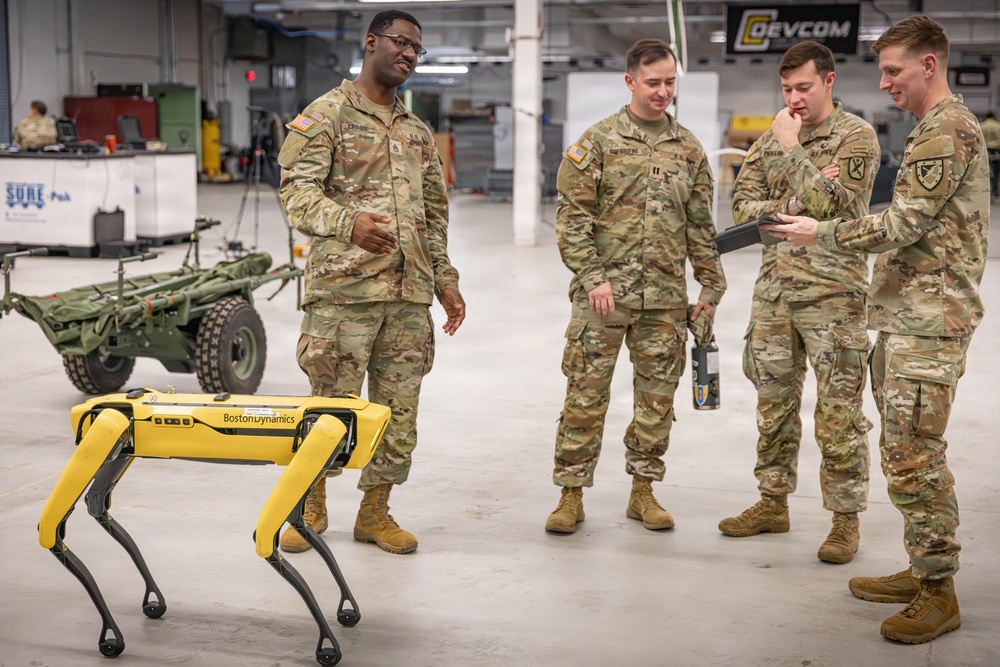
Photo By Capt. Stephanie Snyder | Students participating in the Robotic Autonomous Systems Leader Tactics Course (RASLT)...... read more read more
 Subscribe
FORT BENNING, Ga. – The U.S. Army Maneuver Center of Excellence (MCoE) at Fort Benning launched the first pilot of the Robotic Autonomous Systems Leader Tactics Course (RASLT) yesterday as part of Army-wide Transforming in Contact (TiC) initiatives.
The course will prepare Army leaders for future conflicts where autonomous and robotic systems will play a more prominent role. The course is slated for three pilots in Fiscal Year (FY) 2026. Each pilot will be three weeks long and run five days a week.
Lt. Col. Alan Hastings, commander of the 3rd Squadron, 16th Cavalry Regiment, the unit overseeing RASLT, said this training is critical for Army leaders as the force integrates new robotic and autonomous systems formations.
“What we hope RASLT will provide is a touchpoint within an officer or NCO’s professional military education timeline where they are exposed to this subject matter and they develop a foundation for building proficiency and expertise in planning tactical operations, combining arms with these new capabilities,” Hastings said.
According to Capt. Alison Darby, the RASLT course director, the unit is targeting officers from first lieutenant to major for participation, and enlisted personnel ranked sergeant first class and above. She recommends eligible enlisted personnel graduate first from Scout Leader Course or Battle Staff NCO Course and eligible officers should ideally be Maneuver Captain’s Career Course graduates before attending RASLT.
“We’re looking for leaders (who) are returning to the operational force where there is likely to be one of these robotics and autonomous systems formations integrated at the company, battalion, or brigade level,” Darby said.
The three-week course will follow a structured format.
In the first week, students will have broad discussions to gain understanding of different types of autonomous systems before learning about unmanned ground vehicle (UGV) types and their capabilities. The week will end with a cognitive exercise where students will develop a plan as a company commander within a mobile brigade combat team with RASLT assets attached.
“This is our first chance to test their ability to plan and execute their plan based off the injects they’re getting from the instructor acting as a thinking, adaptive enemy,” Darby said.
In the second week, students will explore small unmanned aircraft system (sUAS) capabilities, limitations, and considerations. They will then learn about electromagnetic spectrum management and the impact of terrain and weather on the systems. Students conclude the second week by conducting a defensive tactical decision exercise (TDE) where they act as an armor company commander with robotics systems attached to their combined arms formation.
During the third week, students will discuss leadership, ethics and other general considerations of robotic and autonomous systems. In a final tactical decision exercise, students must incorporate robotic and autonomous systems to enable an offensive maneuver.
“Graduates of this course should be able to understand the capabilities and limitations of several types of robotic and autonomous systems that are already being implemented in the force or are a proposed idea to add into the force,” Darby said. “Whatever unit they go to, students will have the capability and understanding of how to plan and utilize these systems to enable the maneuver formations.”
The Army is continuously transforming by using the latest technologies for warfighting advantage to remain the most lethal and ready land force in the world. Initiatives like RASLT ensure the Army can deliver trained, cohesive, and lethal teams to meet future challenges in complex operational environments.
| Date Taken: | 02.10.2026 |
| Date Posted: | 02.10.2026 16:57 |
| Story ID: | 557879 |
| Location: | US |
| Web Views: | 181 |
| Downloads: | 0 |

This work, Fort Benning trains Army leaders to integrate robotic and autonomous systems in combat, by Daniel Murnin, identified by DVIDS, must comply with the restrictions shown on https://www.dvidshub.net/about/copyright.


No keywords found.




