
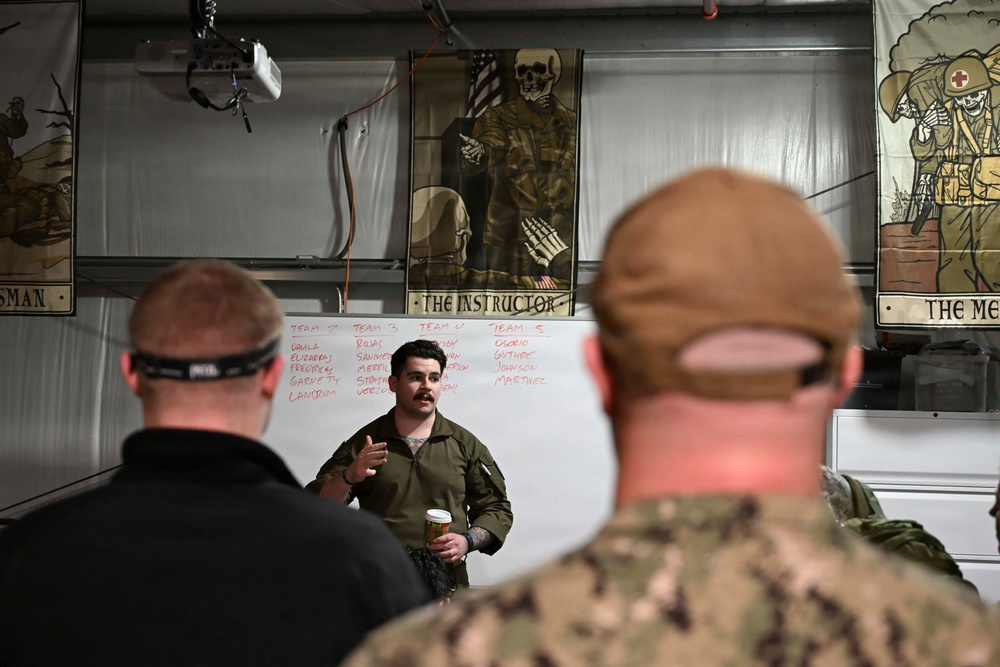
Photo By Petty Officer 2nd Class Alec Kramer | BETHESDA, Md. (Dec. 08, 2025) – Hospital Corpsman 2nd Class Evan Selinger, Navy...... read more read more
NMRTC Bethesda Tests Sailors’ Expeditionary Medical Readiness During TCCC Training U.S. Navy story by Mass Communication Specialist 2nd Class Alec Kramer BETHESDA, Md. (Feb. 2, 2026) — Tactical Combat Casualty Care (TCCC) is the Department of Defense standard for battlefield trauma care and a critical component of expeditionary medical readiness across the U.S. Navy. At Navy Medicine Readiness and Training Command (NMRTC) Bethesda, TCCC training supports the ability of Sailors and medical personnel assigned to Walter Reed National Military Medical Center to provide lifesaving care in combat, austere, and forward-deployed environments. “TCCC is designed for the worst day imaginable, the most severely injured patient, in the most challenging environment,” said Hospital Corpsman 2nd Class Evan Selinger, NMRTC Bethesda’s Tactical Emergency Medical Care program manager. “It gives service members the tools and decision-making framework to keep someone alive long enough to get them off the battlefield.” Developed from lessons learned during decades of combat operations, TCCC integrates evidence-based medical practices with small-unit tactics to reduce preventable battlefield deaths. The program focuses on treating casualties at the point of injury, often under fire and with limited equipment, while maximizing survivability until higher levels of care are reached. The Navy implements TCCC through a standardized, role-based training structure consisting of four tiers, each aligned to operational responsibilities and mission requirements. Tier 1, All Service Member training, provides non-medical personnel with foundational lifesaving skills such as bleeding control, casualty movement, and self-aid and buddy care. This level ensures every Sailor has the ability to respond immediately to life-threatening injuries before medical help arrives. Tier 2, Combat Lifesaver Training, is intended for designated non-medical personnel who may be required to provide enhanced care during sustained operations. Combat Lifesavers serve as an extension of medical capability within units, bridging the gap between initial care and trained medical providers. Tier 3 training applies to Navy corpsmen and other medical personnel and prepares them to manage complex trauma at the point of injury. This tier emphasizes advanced hemorrhage control, airway management, blood transfusion procedures, prolonged field care, and mass-casualty response. Tier 4, the most advanced level, is designed for personnel expected to provide prolonged and advanced resuscitative care in isolated or maritime environments, including independent duty corpsmen and select providers supporting special operations or search and rescue missions. The guidelines are developed and continuously updated by the Joint Trauma System Committee on Tactical Combat Casualty Care and form the foundation of trauma care across the Department of Defense. These guidelines directly influence medical equipment, training standards, and scope of practice at every level. “Changes to TCCC guidelines can significantly impact survivability,” Selinger said. “For example, tourniquets were once discouraged, but research and battlefield data proved they save lives, and now they’re standard issue.” Training at NMRTC Bethesda incorporates scenario-based instruction designed to replicate expeditionary and operational conditions, reinforcing the Navy’s requirement for standardized, role-appropriate TCCC certification prior to deployment. “TCCC is the bread and butter of corpsmen, and our reputation is built on providing care in forward-deployed environments,” said Hospital Corpsman 3rd Class Nolan Reese, a course participant. NMRTC Bethesda’s mission is to maximize warfighter performance through optimized medical readiness tailored to operational requirements; enhance the readiness of the medical force to sustain expeditionary medical capability; and train and develop the Navy Medicine Force.
| Date Taken: | 02.02.2026 |
| Date Posted: | 02.10.2026 14:22 |
| Story ID: | 557852 |
| Location: | MARYLAND, US |
| Web Views: | 221 |
| Downloads: | 0 |

This work, NMRTC Bethesda Tests Sailors’ Expeditionary Medical Readiness During TCCC Training, by PO2 Alec Kramer, identified by DVIDS, must comply with the restrictions shown on https://www.dvidshub.net/about/copyright.


No keywords found.





