
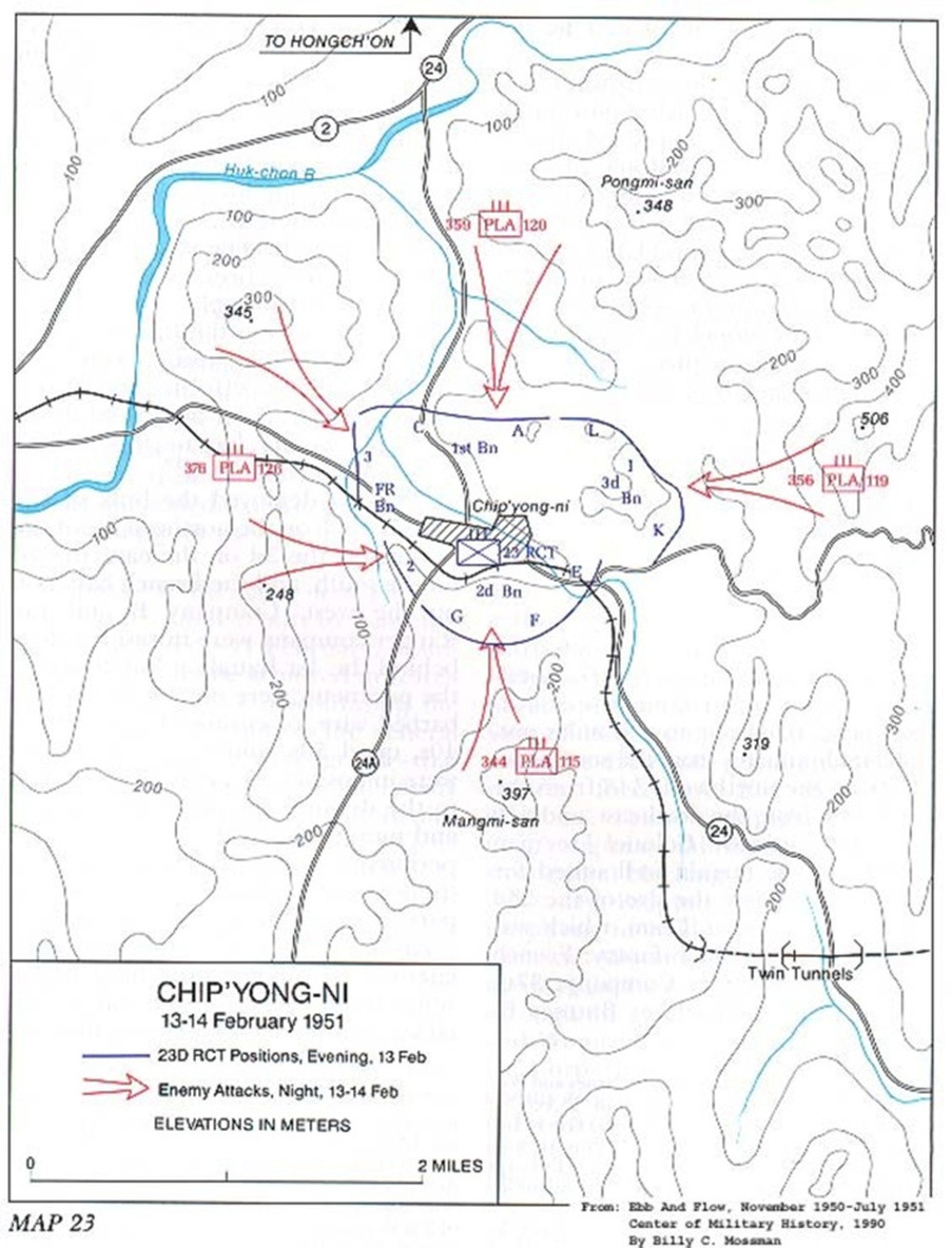
Courtesy Photo | Map graphic of the Battle of Chiyong-ni (Jipyeong-ri) as the battle was fought...... read more read more
 Subscribe
The Battle of Chipyong-ni (Jipyeong-ri) was a decisive battle between the US 23rd Infantry Regiment, of the 2nd Infantry Division, and various units of the Chinese People's Volunteer Army (PVA) around the village of Chipyong-ni that resulted in a United Nations Command victory. The battle, along with the Third Battle of Wonju, has been called "the Gettysburg of the Korean War".
Chipyong-ni was a small cross-roads town situated on a singletrack railroad with several brick or frame buildings, many reduced to rubble by previous fighting in the town. The town controlled key routes that were essential for the movement of troops, equipment, and supplies through the mountainous terrain of central Korea. For United Nations Command, holding Chipyong-ni was necessary to prevent a collapse of the entire front line. For the Chinese, capturing the crossroads would have opened a direct path to continue their southward advance toward Wonju and potentially drive UNC forces off the peninsula.
After meeting Chinese forces at the Battle of Twin Tunnels on Jan. 31, the 23rd (US) Regimental Combat Team (RCT), with the French Battalion and ROK troops attached, was ordered to secure Chipyong-ni. On Feb. 3, the 23rd RCT moved to Chipyong-ni and established a defensive position. Although the surrounding hills offered superior defensive terrain, the 23rd RCT Commander, Col. Paul Freeman, determined he did not have the forces to hold all the hills or form a continuous perimeter between the hills. Instead, he elected to form a tight perimeter surrounding the village for all-round defense. Over the next 10 days, the RCT dug in, conducted security patrols in the surrounding hills, and stockpiled food and ammunition.
On Feb. 11, the Chinese opened their 4th Phase Offensive by attacking and overrunning X (10th) Corps units at Hoengsong, northeast of Chipyong-ni. By Feb.13, the 23rd RCT identified large Chinese forces approaching Chipyong-ni. To avoid encirclement, the X Corps Commander ordered the 23rd RCT to withdraw south to Yoju. This order was reversed by Lt. Gen. Ridgeway, the 8th Army Commander, who ordered the 23rd RCT to stand and hold Chipyong-ni.
Throughout Feb. 13, the 23rd RCT kept attacking Chinese at bay with artillery and air strikes, but communist forces were able to surround the perimeter by evening. Between 2200 and 2300 hours (10:00pm and 11:00pm), Chinese small arms and mortar fire impacted the perimeter from the northwest, north, and southeast, before Chinese infantry attacked from the south. They were driven off, but another intense mortar and artillery barrage hit just before 2400 (midnight), followed by a concerted infantry attack from the north, west, and south. Freeman's tight defensive formation prevented the Chinese outflanking his positions.
February 14 opened with a sharp fight. At 0200 (2:00am) a Chinese platoon attacked the French Battalion, closing to within one hundred yards before launching their attack which was repulsed by a ferocious French defense. Air strikes kept the Chinese away during daylight hours, but the French and Americans were running dangerously low on ammunition. At dusk, artillery fire rained down on the perimeter, followed by infantry assaults. Throughout the night of Feb. 14-15, C-47 Skytrain transports dropped flares to provide illumination.
A Chinese assault at 0315 (3:15am) forced defenders out of their positions on the southern sector and broke the defensive perimeter. Freeman ordered a counterattack at dawn on 15 Feb to seal the breach, but it was driven back. A second counterattack was pinned down by Chinese fire.
In response to the critical situation, the IX (9th) Corps Commander ordered Task Force Crombez, a tank-infantry force from the 5th Cavalry Regiment of the 1st Cavalry Division, to break through the Chinese forces and relieve the 23rd RCT. Departing at 1545 (3:45pm) on Feb. 15, TF Crombez fought through intense communist fire, supported by air and artillery strikes, as they advanced ever closer to Chipyong-ni.
In Chipyong-ni, under pressure from counterattacks and air strikes, and aware of TF Crombez approaching, the Chinese gave up their positions inside the perimeter at 1400 (2:00pm). Initially moving to the surrounding hills, the Chinese soon began a complete withdrawal north to their own lines. When Task Force Crombez arrived at 1725 (5:25pm), the Chinese had withdrawn, and the fight for Chipyong-ni was over.
The bravery and sacrifice of the American, French, and ROK soldiers at Chipyong-ni were instrumental in halting the Chinese advance and shifting the momentum of the war. The successful defense of this isolated outpost demonstrated that the Chinese forces were not invincible and that a determined and well-supported UNC force could defeat them.
| Date Taken: | 02.08.2026 |
| Date Posted: | 02.10.2026 02:39 |
| Story ID: | 557800 |
| Location: | GYEONGGIDO [KYONGGI-DO], KR |
| Web Views: | 216 |
| Downloads: | 0 |

This work, The Battle of Chipyong-ni, February 1951, must comply with the restrictions shown on https://www.dvidshub.net/about/copyright.

No keywords found.




