
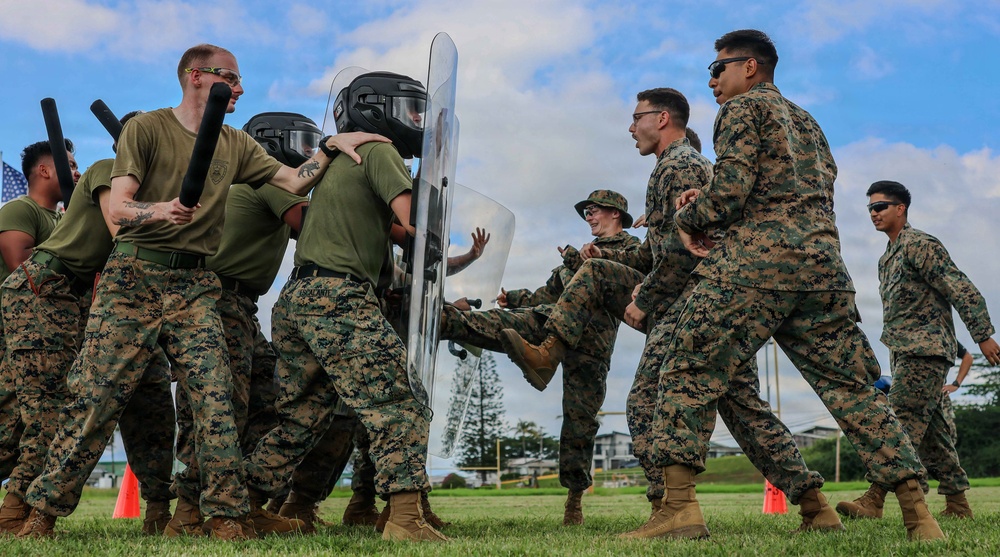
Photo By Lance Cpl. Roger Annoh | U.S. Marines with Headquarters and Service Battalion, U.S. Marine Corps Forces,...... read more read more
 Subscribe
CAMP H.M. SMITH, Hawaii – U.S. Marines with Headquarters and Service Battalion, Marine Corps Forces, Pacific participated in non-lethal weapons training led by Headquarters Battalion, Provost Marshal’s Office, Marine Corps Base Hawaii, instructors to strengthen civil disturbance response capabilities and installation security.
The training enhanced Marines’ readiness to assist law enforcement during complex security scenarios that may arise, which test installation defense, command and control, and interagency coordination.
“I think it’s very pertinent that people, service members in general, understand how to deal with civil disturbance,” said U.S. Marine Corps Staff Sgt. EdwinJared Caoili, PMO training staff non-commissioned officer in charge. “So, in the event that something happens here or down in Kaneohe Bay, your Marines are able to help facilitate the security posture.”
The instruction focused on non-lethal techniques commonly employed during civil disturbance operations, including impact baton employment, riot shield formations, and exposure to Oleoresin Capsicum (OC) spray.
“I think I never really understood the full effects of OC or pepper spray until I experienced them for myself,” said U.S. Marine Corps Lance Cpl. Daniel Grimes, administrative clerk, Headquarters and Service Battalion, MARFORPAC. “The spray messes with your cognitive ability to react because of the intense outside stimulus.”
“We did impact baton,” said Caolili. “We taught those techniques to them, one, how to utilize a nightstick, a baton, in a crowd, in a riot crowd environment, for security posture and for gaining compliance.”
Marines were also trained in proper detainee handling procedures using flexi-cuffs, reinforcing accountability once an individual is taken into custody.
“If you detain someone, you’re ultimately responsible for the well-being of their safety,” said Caolili. “Just because you’re detaining someone for X, Y, and Z doesn’t mean that you can cause harm to them when they’re in your custody.”
As part of the training, Marines learned civil disturbance formations and movement techniques designed to adapt to varying environments. While these movements may look seamless from the outside, Grimes noted the internal difficulty of maintaining a line.
“It takes more effort than people really put into the amount of cohesiveness that you have to have with the person to your left and right of you,” said Grimes. "The teamwork and the amount of effort that you have to put into following your peers... becomes chaotic very, very quickly".
The training also addressed methods for identifying and isolating key individuals within a crowd to reduce escalation.
“By capturing the ringleader, right, it’ll help de-escalate that crowd,” said Caolili.
Non-lethal capabilities provide commanders additional options to manage security challenges while supporting de-escalation.
“It isn't a one-man effort, it's a group effort, and if one man is lacking, that will just lead to the downfall of the people around me,” said Grimes.
The training further enhances the importance of coordination with local law enforcement, a key component evaluated during large-scale exercises. Marines with Headquarters and Service Battalion improve their ability to support PMO and installation leadership while maintaining discipline, accountability, and readiness.
| Date Taken: | 02.06.2026 |
| Date Posted: | 02.06.2026 20:47 |
| Story ID: | 557671 |
| Location: | CAMP H.M. SMITH, HAWAII, US |
| Web Views: | 100 |
| Downloads: | 0 |

This work, Marines Sharpen Non-Lethal Response, by LCpl Roger Annoh, identified by DVIDS, must comply with the restrictions shown on https://www.dvidshub.net/about/copyright.


No keywords found.




