
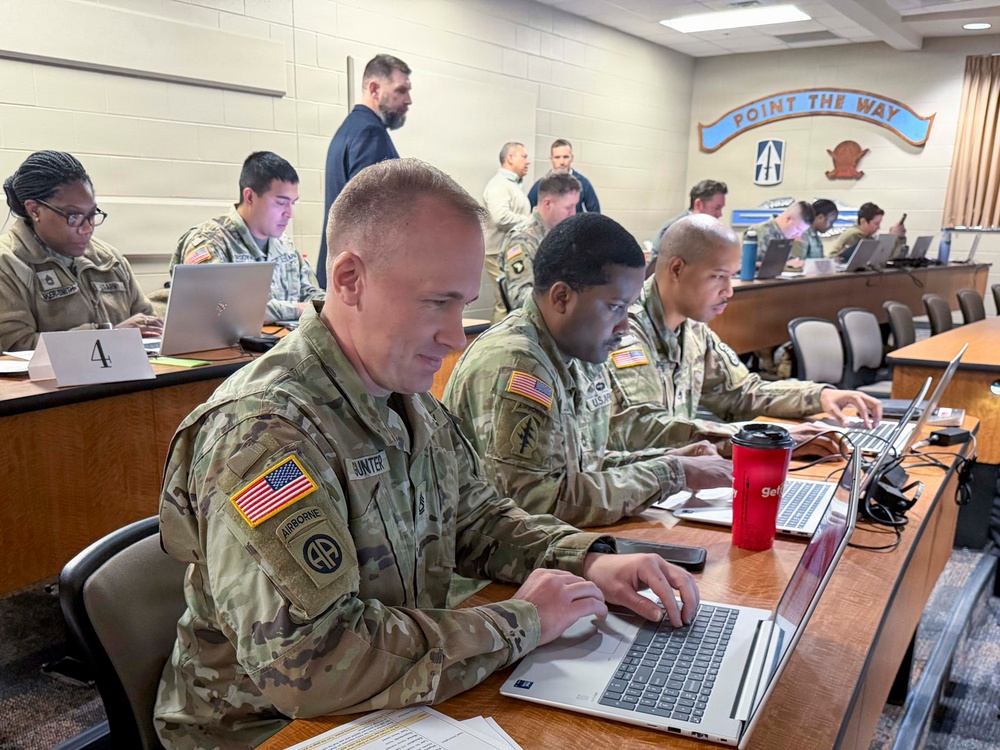
Photo By Joseph Jobin | (From left to right) Sgt. 1st Class Thomas Gunter , Indy North station commander, Sgt....... read more read more
 Subscribe
INDIANAPOLIS — The U.S. Army is bridging the gap between software development and recruiting to modernize how the nation's next generation of Soldiers enters the force.
Developers from the Army Software Factory embedded with Recruiters from the Indianapolis Recruiting Battalion Jan. 29-30 to conduct a Soldier-Centered Design Exercise for the Accessions Information Environment. The collaboration brought together a joint team from the USAREC AIE Functional Team, the AIE Program Executive Office, Deloitte, and the Army Software Factory to ensure the Army’s digital transformation works for noncommissioned officers in the field.
The goal is to streamline operations and secure more future Soldiers into the accession pipeline. For Maj. Donald Ingham, product manager for the FutureSoldier.com component of AIE, the mission of this new program is to address "enlistment apprehension."
"If the user experience we’re giving to these 18-to-24-year-olds is more similar to something from the 1950s than a modern company, it leads to fewer people following through," Ingham said.
AIE is designed to replace the legacy Army Recruiting Information Support System. By creating a singular, retrievable record, the Army hopes to decrease the redundancy of applicants re-entering data multiple times.
Operating out of Austin, Texas, the Army Software Factory relies on rapid, iterative development. Ingham noted that while his team usually interviews local Recruiters in Texas, the unique rollout of AIE required a boots-on-the-ground approach in Indiana.
"Having regular touchpoints with users helps you level-set between what you think you're supposed to be doing and what you're actually supposed to be doing," Ingham said. "I've never been a Recruiter or a company commander. Consistently interacting with the people using our products helps them be useful."
While previous development focused on the applicant, the team is now pivoting to perfecting the Recruiter's experience. This includes a management dashboard that allows station commanders to view their population in "batches" rather than individual files.
Sgt. 1st Class Thomas Gunter, station commander for the Indy North Recruiting Station, said the shift toward automation is overdue. He noted that AIE is designed to recognize qualification levels faster and reduce manual entry through new document-upload features.
"The ingenuity of this system allows us to recognize applicant qualification levels much faster than before,” Gunter said. “It’s time for us to have a system that not only does a lot of the work for us but works for us to alleviate the time spent on processing.”
As the exercise concluded, the consensus among the developers and recruiters was clear: collaboration is the only way to deliver a finished product.
"It’s been great to see so many developers come in, train us, and then stay for our involvement throughout the entire process," Gunter said. "I'm excited to see where this goes."
The AIE system remains in a phased refinement period as developers continue to integrate feedback from Recruiters across the force. The platform is scheduled to have the enlisted mission requirements operational later this year, marking a total shift in how the Army identifies and enlists the next generation of Soldiers.
| Date Taken: | 02.06.2026 |
| Date Posted: | 02.06.2026 14:49 |
| Story ID: | 557642 |
| Location: | INDIANAPOLIS, INDIANA, US |
| Web Views: | 107 |
| Downloads: | 0 |

This work, Modernizing the front door: Developers, Recruiters refine AIE in Indianapolis, by Zoran Raduka, identified by DVIDS, must comply with the restrictions shown on https://www.dvidshub.net/about/copyright.


No keywords found.




