
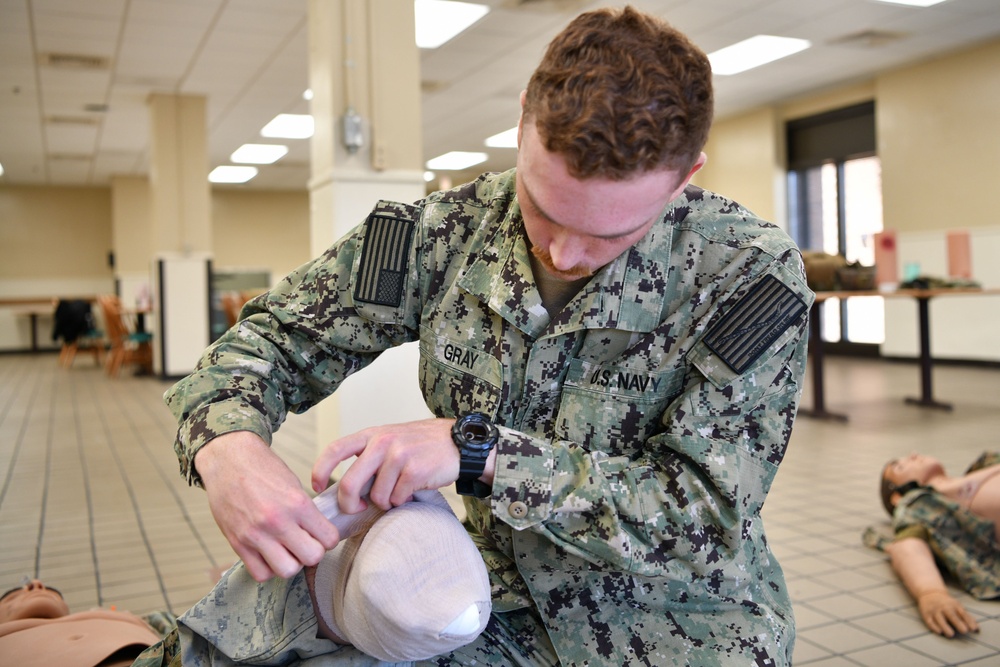
Photo By Seaman Apprentice Jon Jezreel Andres | 250917-N-AT8860-1131 Pensacola, Fla., Sept. 17, 2025. Hospitalman Jack Gray assigned...... read more read more
 Subscribe
JOINT BASE SAN ANTONIO-FORT SAM HOUSTON, Texas - Navy Medicine is bolstering the operational readiness of the joint force by accelerating the implementation of Tactical Combat Casualty Care (TCCC) across the U.S. Navy and Marine Corps, ensuring warfighters have the critical life-saving skills needed on any battlefield.
In the first year under the direction of Naval Medical Forces Development Command (NMFDC), the program significantly surpassed its original training objectives. NMFDC, led by U.S. Navy Rear Adm. Walter Brafford, exceeded its goal for training hospital corpsmen by 44 percent, training 2,557 personnel. Most notably, the command produced 350 percent more TCCC Tier 4 instructors than initially planned, creating a sustainable, organic capability for the fleet and Fleet Marine Force to train and certify their own personnel.
This achievement directly supports the "One Team/One Fight" mantra, integrating medical capabilities between the Navy and Marine Corps.
“The accelerated rollout and exceeding of TCCC training goals directly enhance the readiness and survivability of Sailors and Marines by equipping them with critical life-saving skills, aligning the force with modern combat realities, and fostering greater confidence and cohesion within units,” said U.S. Navy Cmdr. Thomas Sather, the Navy’s director for TCCC. “This initiative not only saves lives but also strengthens the overall operational effectiveness and resilience of the Navy and Marine Corps.”
TCCC was developed by the Committee on Tactical Combat Casualty Care, a joint body of 42 voting members from the U.S. Army, Navy, Air Force, and Marine Corps. The committee uses evidence-based research and battlefield data to establish best practices for point-of-injury medical response.
The Navy's $57 million TCCC program is designed to equip 36,000 active-duty and 7,000 Navy Reserve medical personnel with the critical skills to save lives in high-threat environments. The training moves beyond basic first aid, focusing on provider-level skills for managing hemorrhage, airway emergencies, and other immediate life threats in realistic, high-stress scenarios.
The integration of TCCC has been a key focus for "green side" medical planners, ensuring Marine Corps units are supported by proficient medical personnel.
"The TCCC training pipeline serves as the foundation of Marine Corps operational readiness," said U.S. Navy Lt. Cmdr. Joseph Strahan, the Marine Corps' director for TCCC. "This tiered system equips every Marine and particularly, every embedded Navy corpsman with the skills, confidence, and tactical mindset necessary to address the three leading causes of preventable battlefield death: massive hemorrhage, airway compromise, and tension pneumothorax."
Strahan also said, like the Navy, every Marine will receive TCCC Tier 1 (All Service Member) training, rendering basic interventions such as tourniquet application and wound packing. Select Marines advance to Tier 2 Combat Lifesaver (CLS) certification, with units maintaining a minimum of two CLS-qualified Marines per corpsman, establishing a distributed network of capable first responders throughout every fire team, squad, and platoon.
“Corpsmen are certified to TCCC Tier 3 standards, typically beginning at Hospital Corpsman Basic (HCB) school with subsequent training at Field Medical Training Battalion (FMTB) East or West,” said Strahan. “This qualification enables them to perform advanced airway management, needle decompression, fluid resuscitation, and prolonged casualty care. Select providers advance to Tier 4 [Combat Paramedic/Provider] for enhanced capability.”
This tiered structure aims to cultivate operational confidence through repeated, high-fidelity training under realistic combat stressors noise, smoke, movement, limited visibility, and suppressive fire. Marines and corpsmen develop the ability to perform life-saving interventions while maintaining combat effectiveness, producing stress inoculation significantly reducing hesitation during critical moments.
“This integrated approach yields enhanced unit cohesion, sustained operational tempo, and measurably improved survivability,” said Strahan. “Marines operate with confidence knowing their team possesses comprehensive medical capability; Corpsmen execute their mission knowing they command distributed medical assets throughout the formation.”
A crucial element of this success is the establishment of new training sites within Navy Medicine Forces Atlantic (NMFL) and Navy Medicine Forces Pacific (NMFP). The massive increase in certified Tier 4 instructors empowers U.S. Fleet Forces Command (USFFC), U.S. Pacific Fleet (PACFLT), and the U.S. Marine Corps to conduct their own training and certification across all tiers of TCCC. Teams at NMFL and NMFP have been vital in creating and forming these new training sites.
“There were many challenges Navy Medicine faced in establishing new TCCC training locations,” said Chris Kesgard, deputy director, Education and Training, NMFP. “First and foremost, was operating in a budget-constrained environment. Effectively, we stood up a college-level campus with 4,500 students across three continents utilizing only the existing material already onsite. Navy Medicine has supported the effort, flawlessly starting from ground zero to 27 separate training locations. Getting the instructors up to speed was a major obstacle as well.”
Kesgard said this effort required a cadre of more than 120 instructors worldwide to be certified.
“All of these certifications took place in less than a year through the expertise provided by the instructor-driven training model,” said Kesgard. “This model will enhance medical readiness throughout the Navy and Marine Corps as it will standardize training delivery regardless of location. This effort also expands the capacity from 600 seats in 2024 to over 4,000 by next year [2026] as we continue to grow our capability. The opportunity for our members to learn these lifesaving skills continue to expand exponentially.”
The successful expansion of the TCCC program ensures that from a shipboard casualty to a combat zone, Navy medical personnel are equipped and ready to provide the highest standard of care to increase survivability for every warfighter.
“The continued partnership between the Marine Corps and Naval Medical Forces Development Command in standardizing early corpsman certification and sustaining CLS proficiency across the force represents a critical collaborative effort,” said Strahan. “This shared commitment ensures Marines and Sailors maintain medical readiness, survivability, and operational effectiveness.”
NMFDC is the headquarters element designated within the Bureau of Medicine and Surgery as a direct subordinate to the Surgeon General of the Navy, charged with leading and managing all medical training, education, professional development, and instruction to produce highly trained and ready medical personnel.
| Date Taken: | 02.02.2026 |
| Date Posted: | 02.04.2026 09:39 |
| Story ID: | 557363 |
| Location: | FORT SAM HOUSTON, TEXAS, US |
| Web Views: | 313 |
| Downloads: | 0 |

This work, NMFDC Exceeds TCCC Training Goals, Enhancing Joint Force Medical Readiness, by PO1 Shayla Hamilton, identified by DVIDS, must comply with the restrictions shown on https://www.dvidshub.net/about/copyright.

No keywords found.




