
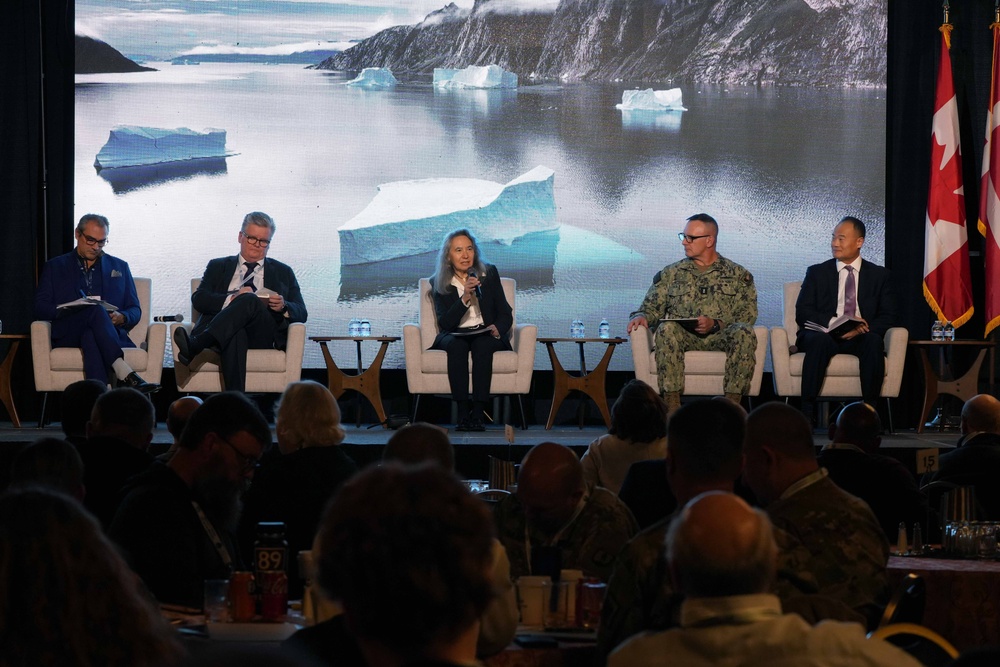
Photo By Amber Kurka | Dr. Dalee Sambo Dorough, University of Alaska-Anchorage, speaks to audience members...... read more read more
The Ted Stevens Center for Arctic Security Studies launched a new Regional Security Dialogues program Jan. 29 to create a standing, operationally focused forum that connects warfighters, planners and security practitioners across the Arctic in support of homeland defense, deterrence and allied burden sharing.
The enduring program links digital and in-person engagements across four Arctic sub-regions and is designed to translate strategy into practice by giving defense professionals recurring access to partner perspectives, regional expertise and mission-relevant security discussions. Center leaders say the Dialogues directly support Department of War priorities and the National Defense Strategy by strengthening practitioner networks, improving shared awareness and accelerating practical cooperation across the Arctic operating environment.
Through regionally focused discussions covering the Arctic Pacific, North American Arctic, Transatlantic Arctic and European High North, the Dialogues align expert insight with operational audiences and real-world security requirements.
“The purpose of the dialogues is to foster a sub-regional community of practice of Arctic security practitioners across the U.S., our partners, and our allies in government and military,” said Maddox Angerhofer, engagement programs coordinator for the TSC’s Strategic Engagement Division. “To essentially come together and discuss the biggest issues in Arctic security affecting both the circumpolar Arctic and specific sub-regions.”
TSC officials say the structure supports the National Defense Strategy’s emphasis on defending the homeland, strengthening cooperation with allies and partners, and improving the effectiveness of the joint force in strategically important regions.
Turning strategy into practitioner-level engagement
The Regional Security Dialogues program is built to move Arctic security engagement from periodic conferences to continuous professional exchange. Webinars, podcasts, written analysis and in-person dialogues are organized into a recurring cycle so practitioners can follow developments, compare approaches and stay connected across regions and institutions.
The regional framework is central to the design. Each sub-region faces different operational conditions, infrastructure limits and threat considerations. By organizing discussions geographically, the program keeps conversations tied to operational reality and decision needs rather than abstract policy debate.
“It’s a geographic framework used to look at different issues across the Arctic, all the components that go into Arctic security,” Angerhofer explained.
Some Dialogue sessions are invitation-only to support senior leader exchange, while others are open-access and built for broad practitioner participation across government, military and partner organizations.
“We’re looking now towards an integrated operational plan that brings together those digital programs with in-person programming to make sure that the dialogue is as productive as possible,” she said.
Supporting homeland defense and deterrence in the North
Program discussions are tied to defense priorities that emphasize homeland defense, early warning, operational preparedness and coordinated action with allies and partners across the Arctic. Organizers say the Dialogues help connect policy direction with field-level understanding by putting operators, planners and regional experts into the same recurring forums.
Participants include personnel and planners from multiple combatant commands, including United States Northern Command, United States Indo-Pacific Command and United States European Command, along with interagency and international partners.
“These events help warfighters first by informing them,” Angerhofer explained. She noted the Dialogues also give operational personnel a channel to raise field-driven concerns and emerging risks. “It provides them to raise key issues that they’re identifying from the front line as challenges in Arctic security.”
Because Arctic operations often involve multiple nations, long distances and limited infrastructure, faster coordination and better shared understanding can directly affect response timelines and mission success. Program leaders say recurring contact across practitioner networks helps reduce friction during crises and improves day-to-day planning.
Strengthening allies, partners and burden sharing
A core objective of the Dialogues program is to strengthen cooperation with allies and partners and improve burden sharing across the Arctic security community. Sessions will regularly include international participants and regional experts who outline national capabilities, constraints and priorities.
“The number one line of effort that the regional security dialogues help advance is our initiatives to enlist and expand our allies,” Angerhofer said.
By helping participants understand where partner strengths and capability gaps exist, the Dialogues support more realistic planning and more efficient distribution of effort across missions. That approach reinforces deterrence by demonstrating coordination, capability awareness and collective resolve across the Arctic region.
Program discussions also examine how partner capabilities in areas such as maritime operations, infrastructure, technology and emergency response can complement U.S. efforts and contribute to shared security outcomes.
Advancing Arctic security through networks and solutions
Beyond information sharing, the Dialogues are intended to produce practical outcomes by connecting the people responsible for Arctic missions and security decisions. Organizers say that practitioner networks built through recurring engagement often become first points of contact during fast-moving events.
The Dialogues advance Arctic security by “developing networks of security practitioners that can be the first line of contact in the event of an Arctic crisis,” Angerhofer explained. “It puts people in touch with one another and creates that kind of connective tissue between countries.”
Upcoming topics will include operational challenges, technology adoption, partner coordination and region-specific risks tied to Arctic conditions and access. Discussions will also include stakeholders such as North American Aerospace Defense Command and other security organizations and militaries involved in northern operations.
“You’ll see a focus on homeland defense and the North American Arctic’s role in that,” Angerhofer said. “There will definitely be an emphasis on innovation and partnering with private sector to accelerate the adoption of new technologies into the Department of War and our warfighting capabilities in the Arctic.”
Continued engagements
Future sessions will continue across each Arctic sub-region, culminating annually in the Anchorage Security and Defense Dialogue. Program webpages allow practitioners and partners to follow region-specific tracks and receive updates on upcoming engagements.
For more information about upcoming dialogues, visit the Ted Stevens Center website and the Regional Security Dialog pages, and sign up for region-specific updates through the official registration form.
| Date Taken: | 01.30.2026 |
| Date Posted: | 01.30.2026 20:15 |
| Story ID: | 557236 |
| Location: | JOINT BASE ELMENDORF-RICHARDSON, ALASKA, US |
| Web Views: | 120 |
| Downloads: | 1 |

This work, TSC launches new Regional Security Dialogues program to strengthen Arctic homeland defense and deterrence, by Amber Kurka, identified by DVIDS, must comply with the restrictions shown on https://www.dvidshub.net/about/copyright.

No keywords found.





