
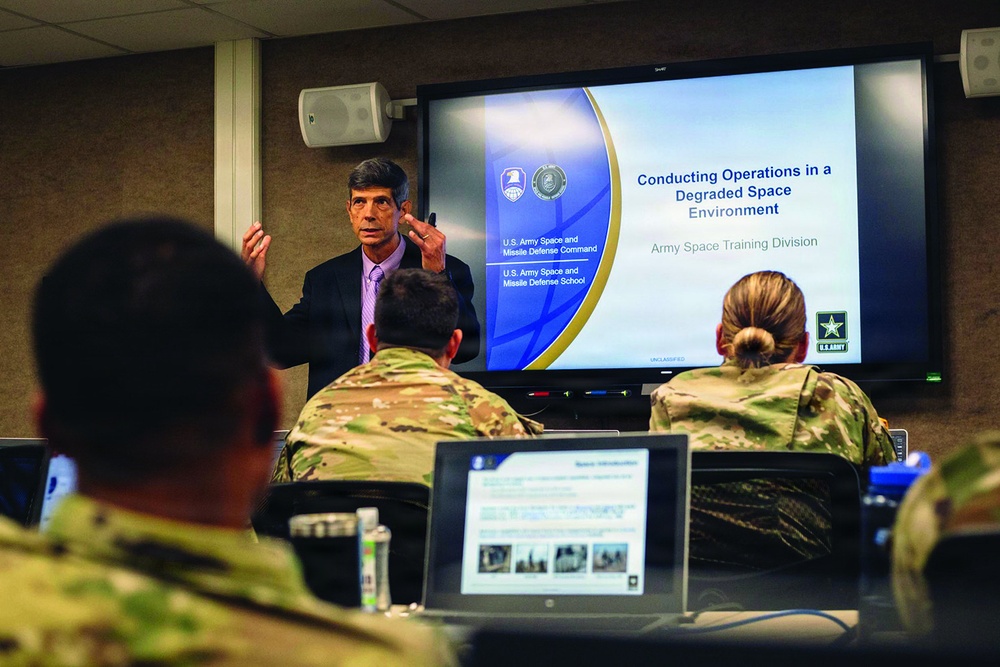
Photo By Dottie Henderson | J.K. Chesney, Army Space Training Division, Space and Missile Defense School, teaches...... read more read more
 Subscribe
By Jon L. Trawick and David A. Mikkelson
USASMDC
Education is vital to a Soldier’s development as a warfighter. For Soldiers to continue their education, they need a supportive command that promotes continued growth and optimizes the schooling opportunities available to them.
According to AR 350-1, the Army institutional training and education system provides members with the attributes and competencies required to operate successfully in any environment. This article will discuss the elements of an effective Army organizational-level school management program.
The first action an organization must take is to assign a school representative. According to AR 350-10, this position is formally titled Army student manager and serves as the point of contact for all administrative schooling actions within the organization. Although the Table of Organization and Equipment (TOE) or the Table of Distribution and Allowances (TDA), which specify the personnel and equipment requirements for an Army unit, does not list an Army student manager, assigning one is a common practice. Their rank is typically that of a junior noncommissioned officer, but can be of a junior officer rank, and will increase commensurately at higher echelons.
Often, an organization faces conflicting priorities and a shortage of personnel, resulting in a small pool of candidates for the student manager position. This small pool of candidates can cause an organization to choose whoever is available at the time of need, but it benefits an organization to take time in deliberately selecting its representative.
When practicing deliberation in its choice-making, an organization should consider specific attributes when selecting its student manager. Although not an exhaustive list, the person chosen for this position (in addition to Army basics such as a passing Army Fitness Test score, meeting height and weight standards or displaying a good attitude) ideally would have six or more years of Army experience and 12 to 24 months of staff time. That experience facilitates practical communication skills and the ability to collaborate with command teams and higher headquarters. Additionally, candidates should be available without frequent temporary duty assignments (TDY) or other extended or frequent absences and have 24 to 36 months’ retainability for the position. If an organization screens for these attributes and can find someone who meets most of them rather than simply filling the billet with the next available Soldier, the organization’s school program has a much higher chance of success.
The student managers must attend technical training for the position to help them understand how to navigate the Army Training Requirements and Resources System, or ATRRS. Those courses are essential for equipping student managers with the skills and knowledge to use ATRRS effectively for training management and resource allocation.The courses ATRRS-101, ATRRS-300, ATRRS-301, ATRRS-302 and ATRRS-303 provide the education needed for the role.
Army student managers should begin their tour by obtaining a roll-up of the MOSs existing within their assigned organization. Once they have a list of those MOSs, they will need to cross-reference it with DA PAM 600-25 Smart book, available at https://www.army.mil/g-1#org-g-1-resources. The smart book lists all training that complements each Army MOS by grade. Student managers should also be aware of any additional organizational duties. The title of a Soldier’s assigned additional duty is usually in the title of the course they need for that duty.
The Army’s Continuing Education System, or ACES, is one of the systems that supports a Soldier’s educational needs. According to AR 621-5, the ACES mission is to provide lifelong learning, readiness and resilience through flexible, high-quality education programs, services and systems in support of the total Army. ACES courses are commonly referred to as Troop Schools, and student managers enroll Soldiers (or civilians in some cases) in these courses through ATRRS. Only people with an official reason for access should have ATRRS rights to limit the number of negligent enrollments that would result if any Soldier could sign up for a course they desire without command approval or student manager oversight.
A student manager’s expertise is critical in reducing organizational stress related to enrollment and serves as a bridge, ensuring that Soldiers can meet the requirements of attending courses and gain the education they need to become effective warfighters. The student manager is the organizational point of contact for lower echelons, ensuring that the Soldier selected to attend school meets all prerequisites, including paperwork requirements. A student manager must track the request from the moment the request is made, past reservation, ensuring that the student completes any remaining course pre-requisites, and that the student receives all pertinent information guaranteeing attendance, including the start date, time and location.
The student manager resides in the operations section at the battalion and higher levels. A field-grade officer leads the operations section, paired with a senior NCO usually titled the operations NCO. The Army student manager works with lower echelons at the direction of the operations NCO. Operations NCOs are fundamental in managing unit training, which, amongst other duties, include overseeing their organization’s school program.
According to ADP 5-0, planning involves thinking about ways to influence the future. Furthermore, FM 7-0 states that long-range preparations include identifying training resources requiring long-lead times for coordination. ACES schools are a good example of a finite resource requiring coordination. A laissez-faire attitude towards these Troop Schools allows Soldiers to sign up for courses at their leisure, which can be beneficial, but falls short of a well-thought-out strategy – an operations NCO who plans schooling opportunities for the upcoming year results in a healthier organizational program. Once the program matures, an operations NCO will begin looking beyond one-year out and consider an organization’s needs up to three years out.
A method for operations NCOs to gain clarity on their organization's schooling requirements is to hold a training resources meeting with their peers at lower echelons. Armed with the student manager’s crosswalk of the DA-PAM 600-25 Smart Book and the additional duty schooling requirements report, operations NCOs can lead the discussion with their view of the organization's needs. The lower-level representatives will then validate or recommend modifications to the operations NCO’s ideas. Furthermore, input from lower-echelon representatives generates buy-in. The last thing operations NCOs want is to find themselves unable to fill the school slots they secure, making buy-in prudent. Following the meeting, both sides will need to obtain command approval, after which a contract will be established. Following the plan's approval, operations NCOs can begin securing the schooling slots that Soldiers in their organization need. The training resources meeting should be held at least quarterly to ensure program fidelity.
While the operations NCO is concerned with the number of slots needed for the organization, lower echelons will need to keep a by-name list of candidates for each school. This Order of Merit List will be critical when filling slots throughout the year. The OML lists candidates not only by name but also in order of priority for attendance. As slots for each course become available to the organization throughout the year, the lower echelons will then choose a Soldier to fill each slot. The OML allows stakeholders to track candidates and fill courses with ready Soldiers as slots become available. The Soldier who ends up attending the course may not have the highest priority, but they are the highest priority Soldier available on that list at the time the slot opens. The OML provides flexibility, allowing organizations room to maneuver to meet the intent of filling the open school slot, even when the Soldier most desired to attend is unavailable. Many unforeseen reasons will prevent a Soldier from attending school throughout the year, such as taking emergency leave.
In conclusion, a command that encourages continued learning and maximizes educational opportunities for their Soldiers through the ACES increases their unit’s readiness by educating individuals about the technical aspects of their duties, an education vital to a Soldier’s development as a warfighter. Following the guidelines outlined in this article puts an organization on the path of successfully supporting and optimizing the educational needs of its warfighters.
| Date Taken: | 01.30.2026 |
| Date Posted: | 01.30.2026 17:38 |
| Story ID: | 557228 |
| Location: | PETERSON AIR FORCE BASE, COLORADO, US |
| Web Views: | 110 |
| Downloads: | 0 |

This work, Op-Ed: Optimizing Soldier education: The essential role of Army student managers in enhancing organizational readiness, must comply with the restrictions shown on https://www.dvidshub.net/about/copyright.

No keywords found.




