
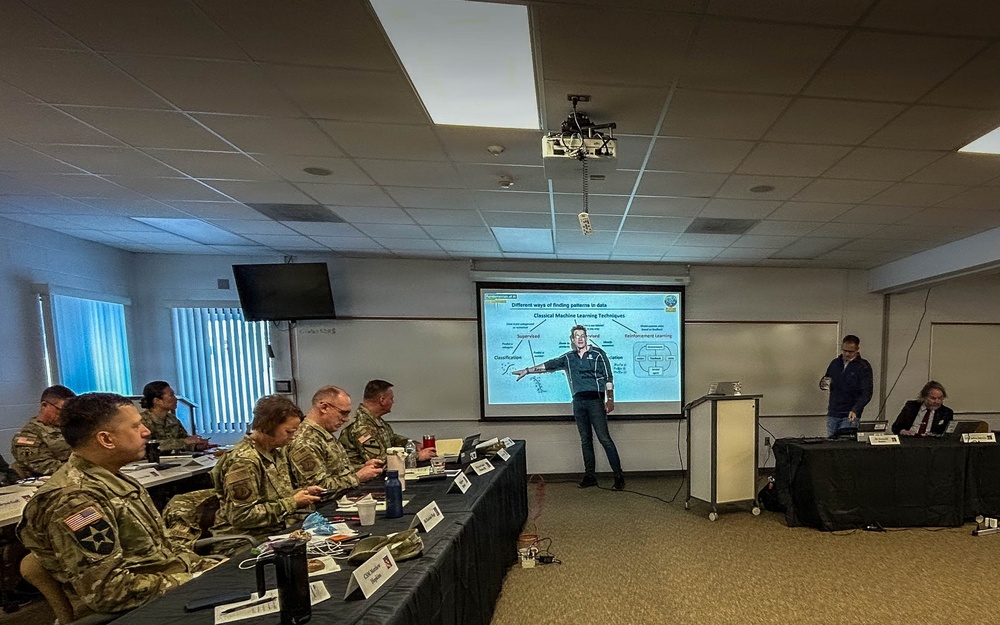
Photo By Maj. Megan Breen | Michigan National Guard Army and Air members, along with Michigan Department of...... read more read more
 Subscribe
CAMP GRAYLING, Mich. — More than 40 senior leaders from the Michigan National Guard’s Army and Air components gathered at Camp Grayling in January for a three-day course designed to demystify artificial intelligence and prepare commanders to integrate emerging technologies into military readiness and leadership.
The Michigan National Guard Artificial Intelligence Leader Course brought together officers and senior enlisted leaders from across the state to learn from subject matter experts on how AI is shaping modern defense operations. The training was facilitated by Chief Master Sgt. Erik Wolford, the Michigan National Guard’s senior enlisted leader for initiatives, and featured presentations from the Office of Naval Research and the Air Force Research Laboratory.
The course followed the release of the Department of War’s Artificial Intelligence Strategy, which directs military components to adopt AI technologies to maintain an advantage over potential adversaries. For traditional Guardsmen, who balance civilian careers with military service, the technology offers an opportunity to increase efficiency without adding to an already demanding workload.
“The technology itself is not going away, so it is time to get comfortable with it,” said Marine Corps Lt. Col. John ‘Jack’ Long of the Office of Naval Research. “Like it or hate it, our job as leaders is to recognize the enemy gets a vote.”
Long emphasized that AI is not a replacement for human decision-making but a tool to enhance performance. “You are not going to lose your job to the calculator,” he said. “But the engineer that uses the calculator to do calculations faster is going to be more efficient than the engineer who is doing math by hand.”
Participants began the course with a foundational overview of artificial intelligence, tracing its origins back more than a century. In the late 1950s, the U.S. Navy developed one of the earliest learning machines, known as the Perceptron, a five-ton computer capable of rudimentary pattern recognition. The history lesson underscored a key theme of the course: AI is not new, and it is not sentient.
“Don’t be scared of the technology,” Long told the group. “This is just another in a long line of technologies that get developed and incorporated into warfighting.”
Speakers stressed that modern generative AI systems are only as effective as the inputs they receive. Poor data or vague prompts lead to poor results, a limitation leaders must understand before relying on AI-enabled tools. Instructors also explained the difference between “human-in-the-loop” systems, which require human oversight, and fully automated systems — emphasizing that ethical judgment and command authority remain firmly in human hands.
“The name ‘AI’ gets people to come in and be potentially nervous or scared,” said Dr. Jeffery Hunter Johnson of the Air Force Research Laboratory. “Check your assumptions at the door.”
The course introduced leaders to GenAI.mil, a Department of War–approved generative AI platform launched in late 2025 and designed to handle controlled unclassified information. Johnson said the technology could help leaders remove administrative obstacles that distract from core responsibilities.
“What is keeping you from doing the part where we are leveraging your expertise, your intelligence, your passion?” Johnson said. “Let’s move that out of the way.”
Stephanie Townsend, digital adoption lead at Air Force Materiel Command, described AI as an “energy management” tool that allows leaders to redirect time and focus toward mission-critical tasks. Tasks that once took hours — such as drafting reports or summarizing information — can often be completed in a fraction of the time with AI assistance.
Despite its potential as a force multiplier, instructors cautioned that AI cannot replace the human elements of leadership. The technology cannot mentor service members, build unit cohesion, or make ethical decisions in complex situations. Adoption, they said, must be deliberate and led from the top.
“If your leadership does not believe in the technology, it is not going to trickle down,” Johnson said.
As the digital landscape continues to evolve, Michigan National Guard leaders left the course with a shared message: artificial intelligence is not a future concern, but a present reality — and leadership in the modern force requires learning how to use it responsibly and effectively.
| Date Taken: | 01.12.2026 |
| Date Posted: | 01.30.2026 12:44 |
| Story ID: | 557193 |
| Location: | CAMP GRAYLING, MICHIGAN, US |
| Web Views: | 69 |
| Downloads: | 1 |

This work, Michigan National Guard Trains Senior Leaders to Harness Artificial Intelligence, by MAJ Megan Breen, identified by DVIDS, must comply with the restrictions shown on https://www.dvidshub.net/about/copyright.


No keywords found.




