
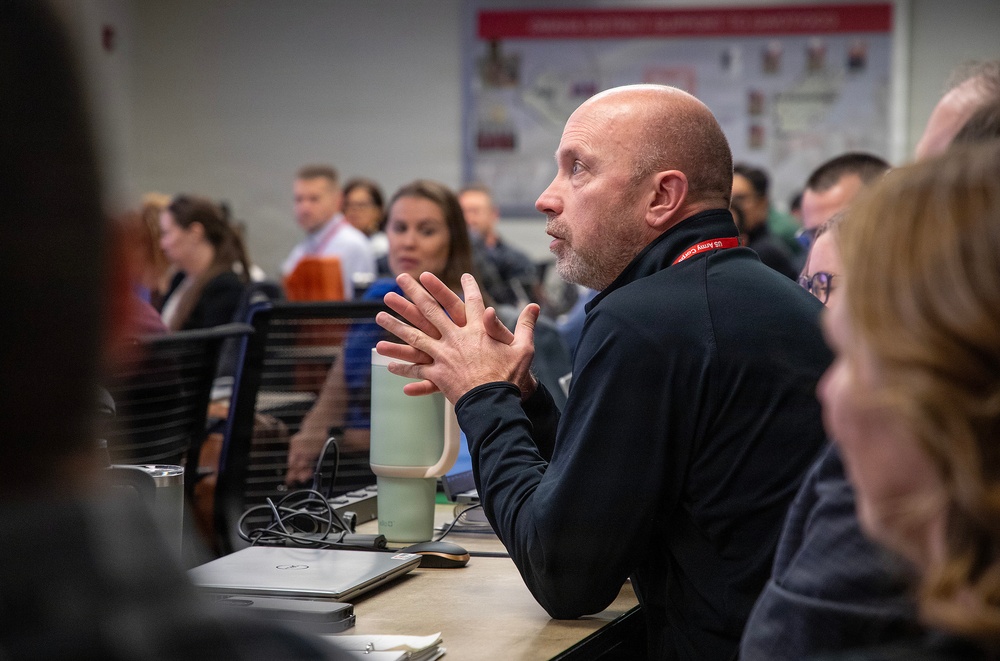
Photo By Delanie Stafford | Matthew Bradley, U.S. Army Corps of Engineers, Omaha District, Military Programs...... read more read more
OMAHA, Neb. — A three-day workshop was held at the U.S. Army Corps of Engineers, Omaha District headquarters building, Jan. 21–23, that brought together more than 40 professionals from across the USACE Northwestern Division to strengthen collaboration and understanding of the design-build to budget project delivery method.
Participants represented the Omaha, Kansas City and Seattle districts, NWD and USACE headquarters, and included professionals from contracting, legal, engineering, construction and military programs, reflecting the cross-functional nature of design-build project delivery.
Design-build establishes performance-based requirements while giving industry partners flexibility to develop innovative solutions. Benefits of the approach include reduced project timelines, early cost certainty, improved constructability and a single point of responsibility for both design and construction.
“Design-build to budget has a very clear path that is realistic and uses a design-build, two-phase, best-value process already being utilized by USACE,” said Chad Jungman, Omaha District project manager. “This workshop introduces new methods but is also a great refresher for those already familiar with it.”
Instructors led discussions and exercises focused on improving how USACE teams plan, procure and execute design-build projects, a delivery method that places design and construction under a single contract.
“Design-build to budget means the government discloses the design and construction cost limitations to industry so teams know exactly what they are pursuing,” said James Ropelewski, a certified Design-Build of America instructor who co-led the workshop along with Clay Benson and Matt Ellis, retired senior resident engineer and contracting officer with the USACE Omaha District. “That allows design-builders to align their scope and proposals to that budget and focus on delivering the most value within it. It works best when everyone — from contracting to engineering to construction — understands their role and how decisions impact the entire project lifecycle.”
The course included sessions on best practices, risk management, acquisition strategies and collaboration techniques tailored specifically to federal and USACE projects. Case studies and interactive discussions allowed participants to examine real-world challenges and lessons learned from previous design-build efforts.
Ropelewski said the design-build to budget approach avoids overdesign, reduces the risk of budget overruns and delivers better outcomes for both taxpayers and stakeholders.
“The goal isn’t to focus on the cheapest price proposal,” Ropelewski said. “The idea is to optimize the budget by delivering the most value such as lower maintenance costs, longer life cycles and longer warranties - all within the disclosed budget - so the government can make a true best-value award.”
USACE officials emphasized that successful design-build delivery depends on strong alignment between technical requirements, contracting strategies and legal considerations. By including representatives from multiple specialties, the workshop reinforced the importance of integrated teams throughout project planning and execution.
“It makes sure we are all on board and buy in,” Jungman added. “Each discipline can use their expertise to improve project delivery and avoid future problems.”
Matthew Bradley, USACE Omaha District, Project Management Office, Military Programs Branch, southern tier section chief, said he appreciated the emphasis on the importance of early and continuous collaboration, especially during acquisition planning and request for proposal development.
“Design-build to budget is not a new delivery method,” Bradley said. “When properly executed, design-build can improve schedule by overlapping design and construction and reducing redesign cycles. Quality can also improve when performance-based requirements allow industry to propose innovative, constructible solutions rather than prescriptive designs. Performance-based requirements also shift much of the risk to the design builder.”
Bradley said there were many takeaways from the training.
“This training gave me the foundational understanding of what Design-Build Done Right looks like and the tools I need to advocate for this delivery method when it aligns with my project’s requirements,” he said. “Bottom line is USACE has a full set of tools to choose from to ensure we deliver our customer’s requirements.”
| Date Taken: | 01.30.2026 |
| Date Posted: | 02.02.2026 09:08 |
| Story ID: | 557192 |
| Location: | US |
| Web Views: | 134 |
| Downloads: | 0 |

This work, Workshop emphasizes budget-driven design-build project delivery, by Delanie Stafford, identified by DVIDS, must comply with the restrictions shown on https://www.dvidshub.net/about/copyright.


No keywords found.





