
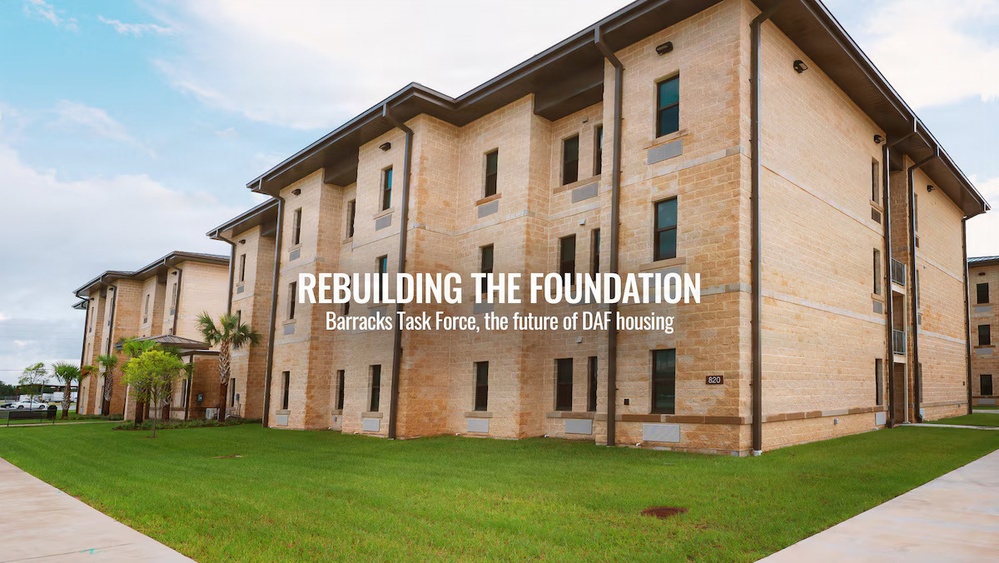
Photo By Travis Burcham | Under the Barracks Task Force initiative, Civil Engineers are leading the Department...... read more read more
 Subscribe
At the heart of the Air Force’s mission are the Airmen and Guardians who execute it. Their readiness depends on a simple, yet critical promise: having access to a clean, comfortable, and safe place to call home.
In October 2025, the Secretary of War established the Barracks Task Force with a clear mandate: ensure every warfighter’s home meets the highest standard, reinforcing the principle that caring for our people is fundamental to mission success.
By 21 Oct, Commanders across the Department of the Air Force had conducted comprehensive, enterprise-wide inspections of Air Force dormitories to assess conditions and identify areas needing improvement. These inspections gave leaders clear visibility into needed repairs, quick fixes, and a small number of cases where Airmen and Guardians required relocation.
The DAF’s approach to tackling dormitory improvements is focused on improving the facility conditions and operations which are led by its Civil Engineers. As Col. Ryan Howell, Chief of the Asset Management Division, noted, a core CE mission is to sustain the installation as war fighting platforms, which includes making sure first-term Airmen and Guardians reside in clean, comfortable, and safe conditions.
Drawing from this principle, CE spearheaded the DAF-level response to the Secretary’s 30-day deadline. They formed a cross-disciplinary working group, bringing together subject matter experts from various career fields. The team was tasked with developing a unified investment plan with Airmen and Guardians at the center of their mission. They ensured recommendations were comprehensive, resourced, and ready for execution.
To fuel this effort, the task force launched a multi-layered funding strategy. The initial push began with $41.5 million to address small quick-fix requirements, followed by $105 million for larger barracks improvements projects funded by OSW. This funding, split between the Air Force and Space Force—$85 million and $20 million respectively—was directed toward large-scale facilities sustainment, restoration, and modernization projects prioritized for rapid execution. These investments coincide with the funds the DAF had already planned for this year to improve both technical training facilities and permanent-party dormitories.
The Air Force Installation and Mission Support Center manages the prioritization and distribution of funds. According to Lt. Col. John Marshall, Chief, Requirements Development, Program Management, and Policy Division, the initial focus was on initiatives with rapid “execution timelines and immediate impact.”
Building upon current maintenance efforts at the installation level, base CE squadrons are executing the mission, turning funding into revitalized living spaces. For 1st Lt. Luke Allison at Luke Air Force Base, the task force “speeds that process along for us to open more rooms for more Airmen.” It empowers local CE teams to tackle quality-of-life projects that might have otherwise been deferred, like installing much-needed ceiling fans to combat the Arizona heat.
This investment goes beyond infrastructure and is ultimately about people. “If you’re not comfortable in your house, how can you be focused on anything else?” asks Allison, noting that distractions at home can affect performance and deployment readiness. As Maj. Chrystopher Nicholson, Chief of Unaccompanied Housing, explains, returning to a substandard room after a 12-hour workday “can be demoralizing,” with real consequences for morale and retention.
Chief Master Sgt. Steven Millerd, Chief of Enlisted Matters, explained that dorms offer reliable access to services and proximity to the mission. “With power, location, and a clean, safe space, Airmen and Guardians can rest and focus on being ready for work—without worrying about long commutes,” Millerd said.
Dormitories play an important role in Airmen and Guardian’s daily readiness and development. In the training environment, this focus is a strategic imperative. With two decades of experience with dormitory infrastructure, Col. George Nichols, the Civil Engineer for Air Education and Training Command, weighs in on this effort. “It’s more than just their home in the training world, it’s their mission platform to become better,” Nichols said.
By improving foundational living conditions, the DAF reinforces a clear message: Airmen and Guardian’s well-being is a priority.
The task force is also focused on overcoming long-standing hurdles. To bridge the communication gap and make it easier for dorm residents to share maintenance needs, a digital work order solution is under development to streamline the process and ensure issues stay visible. In parallel, there are efforts to address more immediate quality-of-life improvements, such as working to invest in free Wi-Fi for Airmen and Guardians living in the dorms.
The Barracks Task Force is a comprehensive and enduring commitment to the DAF’s most valuable asset: its people. “The objective is simple: take care of our Airmen and Guardians. A secure home base ensures they are ready for the mission today and fully prepared for whatever comes tomorrow,” said Brig. Gen. Christopher Leonard, Director of Civil Engineers. By providing quality housing, leaders at HAF, AFIMSC, and local CE squadrons are reinforcing a culture of care and striving to give Airmen and Guardians a safe, clean, and comfortable foundation.
| Date Taken: | 01.29.2026 |
| Date Posted: | 01.29.2026 13:00 |
| Story ID: | 557062 |
| Location: | US |
| Web Views: | 503 |
| Downloads: | 1 |

This work, Rebuilding the Foundation: The Barracks Task Force and the Future of DAF Housing, must comply with the restrictions shown on https://www.dvidshub.net/about/copyright.


No keywords found.




