
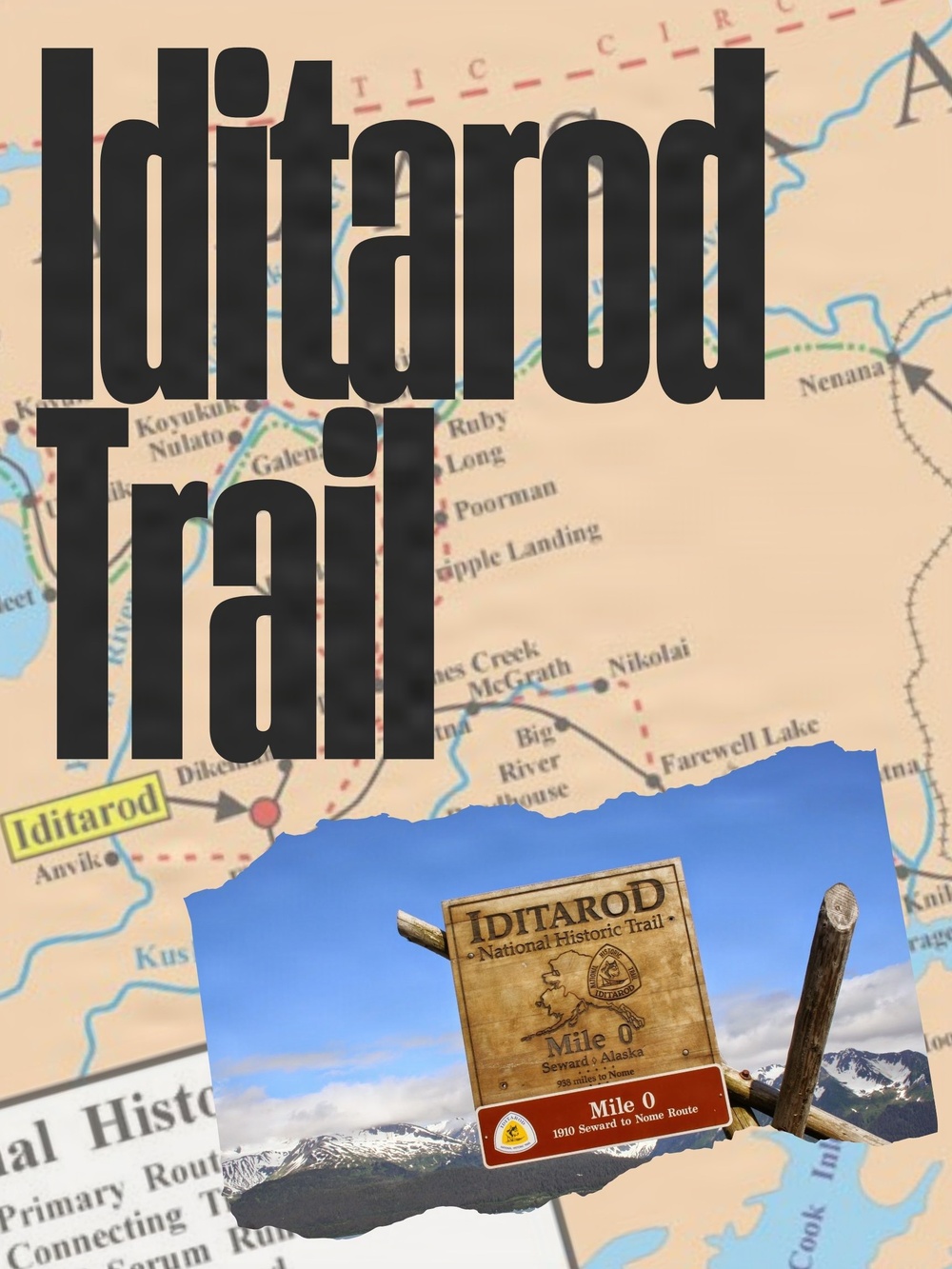
Photo By Airman 1st Class Owen Davies | The Iditarod National Historic Trail is a that runs through the state of Alaska and...... read more read more
 Subscribe
Beyond the contiguous United States, in the farthest northern reaches of the country, exists the 49th state, Alaska — the Last Frontier. Its expanse of 586,000 square miles of land is home to many species of unique wildlife and features some of the most extreme and diverse natural phenomena. Weaving through the valleys and mountains is a trail over 2,000 miles long. It's called the Iditarod Trail, and it runs straight through Joint Base Elmendorf-Richardson.
Starting in Nome, a remote city just 140 miles south of the Arctic Circle, the historic legacy of the Iditarod Trail began. In 1898, a group of prospectors, originally there for a previous discovery of silver, found swaths of gold in what is now called the Cape Nome Goldfields. This was the birth of the city and the start of the Gold Rush. By 1900, thousands of people would arrive to dig the “Golden Sands of Nome”. They followed on the established Native trail south until they could reach a port along the coast that wasn’t frozen.
The Iditarod Trail was less of a distinct line and more of a highway that included many intersecting off-shoots. Archeological research shows this network of Native routes carved through nearly every region of Alaska as it travels south eventually reaching the Kenai Peninsula, specifically the port city of Seward. Seward is near the Cook Inlet and seldom freezes over, making it useful for exporting gold and importing people and supplies during the Gold Rush.
Before the trail makes its way to Seward, it first passes through what is now JBER. The trail has been around longer than the U.S. Air Force or even the U.S. Army Air Corps and was used to move military equipment through the installations in Alaska.
“When the installation was being built, the trail between [Seward] and Elmendorf Field had already been upgraded to a wagon road and the military transported all the equipment, supplies, and building materials on that road,” said Margan Grover, JBER installation archeologist. “They were also using some of the old homestead cabins and barns for housing and offices. They were able to quickly build the base because the infrastructure was already there.”
Leading up to World War II, there was a rising tension between the U.S. and Japan. There was concern Japan might try to seize control of the Aleutian Islands chain and Alaska as a whole. A request for funding was proposed to the House of Representatives in 1934 to set up defense forces in Alaska. U.S. Army Brig. Gen. William “Billy” Mitchell believed that by establishing a military presence in the state, the U.S. could better defend the Pacific.
“Alaska is the most central place in the world for aircraft and that is true either of Europe, Asia, or North America,” said Mitchell. “I believe in the future, he who holds Alaska, holds the world, and it is the most important strategic place in the world.”
In 1935, the Wilcox Bill was introduced by congress and was passed. It authorized the construction of six air base expenditures which included Alaska. Funds were appropriated later and in 1940 Fort Richardson and Elmendorf Field were established as defensive positions during WWII.
A big part of the trail's history involves dog mushing. The original Alaskan Native dog sled was made to carry possessions with the owner leading at the front and guiding their dog team along a route or trail. Russian Naval Lt. Lavrentiy Alekseyevich Zagoskin, in his 1840s accounting of his expedition to Alaska, wrote that Russian influence introduced new methods of harnessing the dogs to be single-file or in pairs at the front, modifying it to what is commonly recognized today. Zagoskin spoke of improvements to the design itself such as guide poles and handlebars that would be attached in the rear of the sled to help steer, push and balance weight. It is speculated that this practice was also used by the U.S. Army when construction on Fort Richardson began.
In 1925, the U.S. Army and local mushers used dog sleds to bring the diphtheria serum to Nome after they were hit with an epidemic that required outside help, inspiring the 1995 animated film Balto. The serum was carried by twenty mushing teams and was brought 674 miles to Nome in just over 127 hours, ending the epidemic.
“In my research, mushing was an arctic survival skill that the military taught its personnel along with skiing and snowshoeing,” said Grover. “It would have been a good option for transporting personnel, equipment, and material in areas where there wasn’t road or runway access.”
Today, the portion of the trail that runs through JBER has been paved over and renamed Fairchild Avenue, and is located behind the flight line. It serves as an artery of travel for the many service members, civilians, and families who work and live on the installation. It is believed by installation archaeologists that the road even follows almost the exact original path that was used by the Alaskan Natives as well as Russian settlers and traders for thousands of years prior to Alaska’s statehood.
The Iditarod Trail has had a rich history not only affecting JBER, but the whole state of Alaska and its history spans back thousands of years. Understanding that history helps create a better understanding and appreciation of the installation.
“Having a physical connection between today's mission, the historical mission, and Alaska’s history can give military personnel and families a better sense of purpose and belonging,” said Grover. “It’s also something unique to being stationed in Alaska.”
| Date Taken: | 01.28.2026 |
| Date Posted: | 01.28.2026 19:51 |
| Story ID: | 556994 |
| Location: | JOINT BASE ELMENDORF-RICHARDSON, ALASKA, US |
| Web Views: | 69 |
| Downloads: | 0 |

This work, Traveling through time on the Iditarod Trail, by A1C Owen Davies, identified by DVIDS, must comply with the restrictions shown on https://www.dvidshub.net/about/copyright.


No keywords found.




