
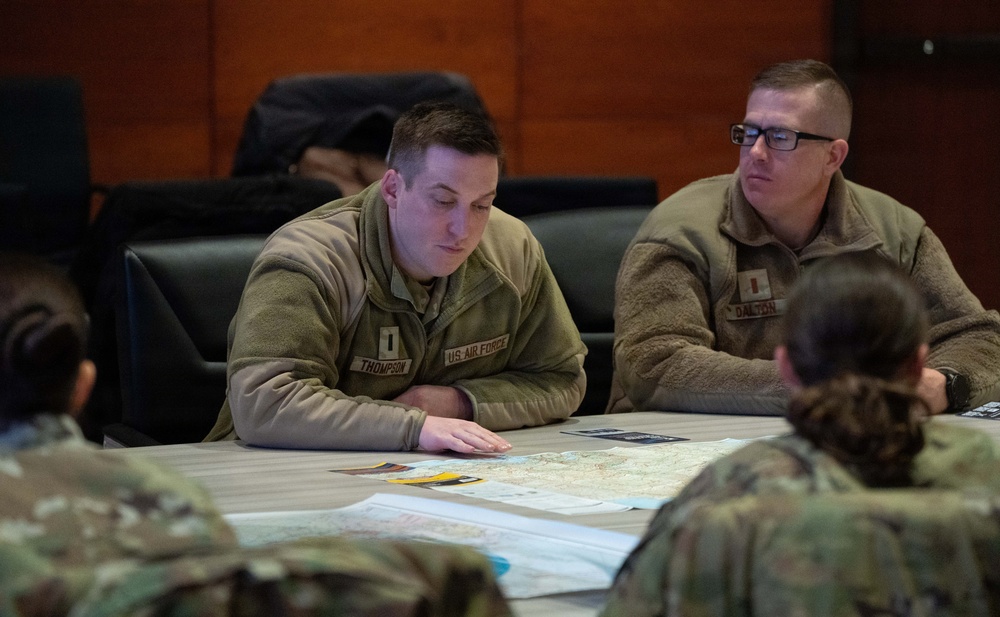
Photo By Amber Kurka | Officers from the 3rd Maintenance Group take part in a map exercise during an Arctic...... read more read more
In the Arctic, deterrence does not begin at the point of contact. It begins with logistics.
That message framed an executive education course hosted by the Ted Stevens Center for Arctic Security Studies on Jan. 22, as Airmen from the 3rd Maintenance Group examined how distance, infrastructure and sustainment shape the United States’ ability to operate and deter in the Arctic.
The two-hour session, held at the Arctic Warrior Event Center, brought together 37 maintenance officers and senior noncommissioned officers ranging from E-7 to O-5. Requested by 3rd MXG leadership as part of its professional development program, the course was designed to connect Arctic strategy directly to the operational realities faced by warfighters responsible for generating and sustaining combat power in Alaska.
“The goal is to help people understand how the Arctic affects their missions and how they can operate more effectively in this environment, particularly here in Alaska,” said Matthew Bell, dean of the School for Arctic Security Studies.
Why logistics matter in the Arctic
Faculty emphasized that Arctic security is shaped less by individual capabilities than by the ability to sustain forces across vast distances, limited infrastructure and extreme conditions. For maintenance Airmen, those constraints are not abstract. They directly affect aircraft readiness, sortie generation and operational endurance.
During a map exercise, Bell asked Airmen to place their hands over Anchorage on maps of Alaska to visualize how vital resources are distributed across the state. As participants did so, their hands also covered Fairbanks, illustrating how closely Alaska’s primary infrastructure hubs are clustered.
“When you put your hand over Anchorage, you are accounting for 85 percent of the infrastructure in the state,” Bell said. “Roads, rail, major ports, defense infrastructure, it’s all right there.”
The exercise demonstrated how quickly access and redundancy diminish beyond those hubs, not only across Alaska, but throughout the North American Arctic.
Bell explained that while the concentration of infrastructure around Anchorage and Fairbanks enables operations, it also creates vulnerability. Beyond those hubs, distance, access, and limited redundancy quickly dominate planning and execution.
For maintenance Airmen, those structural constraints translate directly into daily decisions on the flight line. When parts flow is limited, cold weather accelerates wear, and access to higher-level maintenance is constrained by distance, readiness is sustained not by abundance, but by prioritization and tradeoffs.
Faculty walked the Airmen through how sustainment flows into Alaska, noting that most materiel arrives by a small number of ports before moving inland by rail or road—often across long timelines with limited alternatives. For maintenance Airmen, the takeaway was clear. In the Arctic, sustainment is not a supporting consideration. It is the foundation of operational capability.
“Logistics is not a supporting function here,” Bell said. “It’s central to whether we can operate at all.”
From Alaska to the circumpolar Arctic
While the discussion was grounded in Alaska, faculty expanded the lens to the broader Arctic, where similar constraints shape competition and deterrence across the circumpolar region.
“The broader strategic inferences on why the Arctic matters, we try to bring that down to a practical exercise and why it matters to us who live here in the state,” Bell said. “Then we look at how those same challenges scale across the Arctic.”
As participants worked through infrastructure, access and sustainment challenges, faculty emphasized that distance and geography affect every domain, particularly air operations.
“If deterrence fails, what does a potential conflict in the Arctic region look like?” Bell asked. “Is it air, land, maritime, or all domains?”
He noted that maintenance depot vs. location tyranny of distance make airpower central to Arctic operations.
“It’s probably going to be air, just because the tyranny of distance and the lack of infrastructure,” Bell said.
Dr. Kelsey Frazier, associate director of the Research and Analysis Division, reinforced that operating in the Arctic requires confronting risk rather than assuming it will diminish.
“There’s a perception that somehow, with reducing sea ice extent, this is going to be a great environment to move goods and cargo and humans through,” Frazier said. “There will always be challenges, search and rescue, recovery.”
“It doesn’t necessarily reduce the risk,” she said. “It just presents new risks.”
Education grounded in operational reality
Faculty used the session to broaden the discussion from Alaska’s sustainment challenges to the strategic context in which Arctic operations take place. As maintenance Airmen considered how distance, parts flow and environmental conditions affect aircraft readiness, instructors emphasized that those same constraints shape deterrence across the wider Arctic.
Dr. Matthew Rhodes, professor of international security, framed Arctic operations within the alliance structures that underpin deterrence, particularly across the European Arctic. He emphasized that no single nation operates alone in the region and that interoperability and shared standards are essential to operating effectively in a geographically unforgiving environment.
“The best convention, the best agreement, the best alliance in world history is NATO,” Rhodes said.
Rhodes’ discussion reinforced how alliances influence everything from access and basing to sustainment and operational endurance. For maintenance Airmen, those considerations translate directly into aircraft availability, recovery timelines and the ability to sustain airpower over distance.
Faculty emphasized that deterrence in the Arctic depends on more than presence or advanced platforms. It relies on the ability to keep aircraft mission-ready and operating despite environmental constraints, limited infrastructure and long supply lines.
“The distance is the same. The weather is a challenge. The atmospherics are a nightmare,” Bell said. “We’ve gotten better with technology, but a lot of this hasn’t changed.”
Sustainment as a deterrence advantage
For maintenance Airmen in the 3rd MXG, the course underscored that aircraft readiness in Alaska is shaped long before a sortie is generated. Distance, infrastructure constraints and environmental conditions influence whether forces can respond quickly, sustain operations and maintain credible deterrence in the Arctic.
“When we talk about homeland defense, we have to start with how the environment affects operators and shapes competition in the region,” Bell said. “That understanding has to come first.”
Faculty emphasized that Arctic deterrence is not defined by isolated capabilities, but by the ability to keep aircraft mission-ready over time in an environment where redundancy is limited and recovery options are few.
The TSC supports that effort through education, research, and engagement focused on the Arctic as an operational environment. By grounding strategic context in real-world constraints, the center helps prepare warfighters and security practitioners to operate effectively where readiness and sustainment are inseparable.
As strategic attention on the Arctic continues to grow, leaders emphasized that helping warfighters understand the operational environment they support is essential to defending the homeland and reinforcing deterrence in the Arctic.
| Date Taken: | 01.28.2026 |
| Date Posted: | 01.28.2026 14:29 |
| Story ID: | 556980 |
| Location: | JOINT BASE ELMENDORF-RICHARDSON, ALASKA, US |
| Web Views: | 104 |
| Downloads: | 0 |

This work, TSC hosts Arctic executive education course for 3rd MXG leaders, by Amber Kurka, identified by DVIDS, must comply with the restrictions shown on https://www.dvidshub.net/about/copyright.


No keywords found.





