
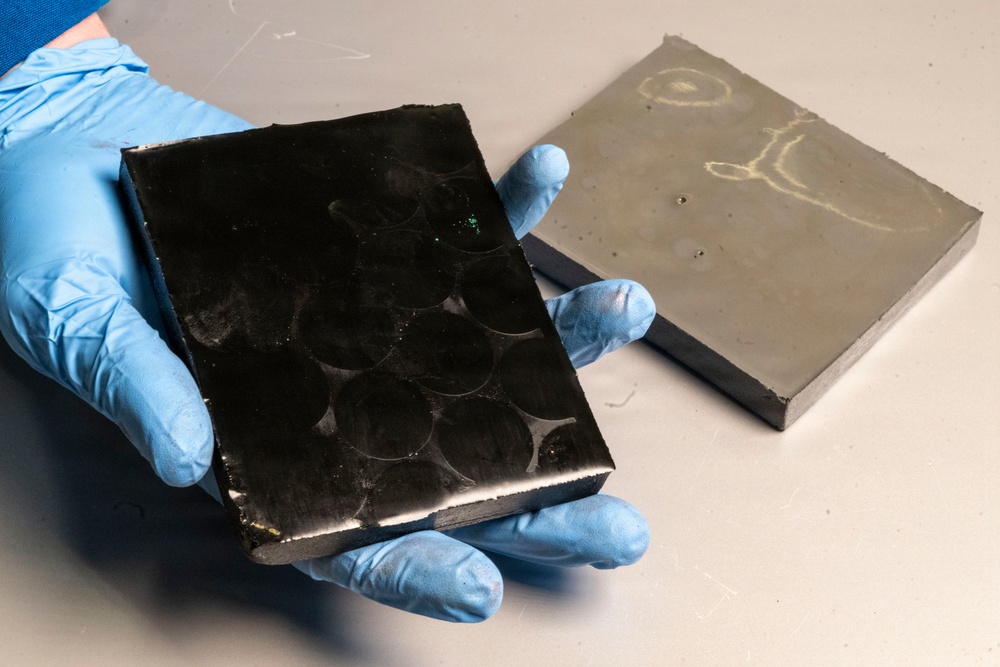
Photo By Jonathan M Sunderman | Featured are composite fuel slabs at the U.S. Naval Research Laboratory’s (NRL)...... read more read more
Scientists at the U.S. Naval Research Laboratory are developing the next generation of solid-fuel ramjet (SFRJ) propulsion, addressing one of the field’s most persistent challenges: understanding and predicting what happens inside an operating combustor.
NRL scientists have figured out how to “see inside” one of the most extreme engines ever built, turning guesswork into knowledge and making future long-range, high-speed flight more achievable than ever before.
A solid-fuel ramjet is an air-breathing engine that uses solid fuel instead of liquid fuel, offering high energy density and mechanically simple propulsion by burning fuel with oxygen from the air to produce thrust. By drawing oxygen from the atmosphere rather than carrying oxidizer onboard, SFRJs can carry more fuel in the same space and fly farther than traditional rocket systems.
“If you replace all the oxidizer and instead use oxygen from the air to burn your fuel, you can increase range by up to 200 to 300% in the same form factor,” said Brian Bojko, Ph.D., a combustion scientist at the U.S. Naval Research Laboratory (NRL).
Despite that promise, widespread adoption has been slowed by the extreme internal environment of SFRJs, where high temperatures, soot, and rapidly evolving flow structures prevent traditional probes from accessing critical data. Unlike liquid or gaseous fuels, solid fuels release energy through surface regression and often produce a complex mixture of fuel products consumed during combustion, making it far more difficult to control burning rates and predict performance. This is why understanding and predicting what happens inside an operating combustor is so important.
“In solid-fuel ramjets, you don’t have direct control over the mass flow rate like you do with liquid systems,” Bojko explained. “The heat from combustion actually drives the gasification of the solid fuel, so pressure, temperature, and airflow all feed back into how the engine behaves.”
Without detailed measurements of flame temperature, fuel regression, and fuel-vapor transport, designers have historically relied on trial-and-error approaches. “A lot of the design has been kind of Edisonian,” Bojko said. “You take a guess, test it, and iterate. But without seeing the physics inside the combustor, it’s hard to know if you’re getting the right answer for the right reason.”
At the same time, computational approaches such as Reynolds-Averaged Navier–Stokes (RANS) and Detached Eddy Simulation (DES) have been limited by a lack of high-quality experimental data for validation.
RANS, DES, and LES represent increasing levels of physical realism in turbulence simulation, where more turbulent structures are directly resolved rather than modeled. Moving from RANS to DES to LES brings simulations closer to the true flow physics, especially for unsteady flows, but at a significantly higher computational cost. RANS models most turbulence and is computationally efficient but less accurate for unsteady flows. DES resolves large turbulent structures while modeling smaller ones, balancing accuracy and cost. LES resolves most turbulent motion directly, offering the highest accuracy at the highest computational expense.
“With only a few pressure or temperature points, you can match a simulation to an experiment and still be wrong,” Bojko noted. “Optical access lets us validate the flame structure, recirculation zones, and combustion species directly.”
Seeing Flame Temperature in Real Time
To address these gaps, researchers employed optical diagnostics capable of operating in the harsh, particle-laden environment of an SFRJ combustor. Measuring flame temperature is especially important, Bojko said, because models often assume combustion efficiency rather than measure it.
“These diagnostics give us new data we simply didn’t have before,” said David Kessler, Ph.D., a senior computational scientist at NRL. “They allow us to measure gas-phase species and temperatures in an environment where traditional probes just don’t work.”
The chemistry behind how solid fuels decompose and feed the flame is just as important as measuring the flame itself, according to researchers. As heat from the flame feeds back into the fuel surface, the solid polymer undergoes phase change and chemical breakdown, releasing a complex mixture of gaseous hydrocarbons that sustain combustion.
“You have this continuous feedback loop,” said Brian Fisher, Ph.D., a combustion research engineer at NRL. “The flame heats the fuel, the fuel decomposes into gas-phase species, and those species then mix with the air and keep the flame going. It’s a coupled thermal, chemical, and fluid-dynamic process, and that’s what makes solid-fuel ramjets both powerful and challenging to predict.”
Mapping Fuel Regression and Validating Models
Understanding how quickly the solid fuel surface recedes, known as fuel regression, is critical because it directly governs thrust and performance. The team combined experimental diagnostics with high-fidelity simulations to resolve heat feedback to the fuel surface, a key driver of regression.
“One of the biggest things you need to capture is the heat transfer back to the solid fuel,” Bojko said. “RANS can give you an okay answer, but it doesn’t resolve the fundamental processes as well as DES or large-eddy simulation. Those higher-fidelity approaches cost more computationally, but they give you a much better picture of what’s happening.”
Visualizing Fuel Vapor Before It Burns
For the first time, the researchers also visualized fuel vapor released from the solid surface before ignition, revealing how complex hydrocarbon species mix and evolve prior to combustion. Solid-fuel ramjets commonly use hydroxyl-terminated polybutadiene (HTPB), a long-chain polymer that breaks down into many different gaseous species.
“When HTPB decomposes, you don’t know what species are coming off the surface, and those species dictate the combustion mechanism,” Bojko said. “They change with temperature, pressure, and heat flux, so being able to characterize them is critical to understanding the underlying mechanisms across different flight conditions.”
In parallel, NRL researchers are also investigating advanced composite fuels designed to increase how much energy can be stored in the same volume of solid fuel.
“We’re interested in adding energetic additives, like metal particles, into polymer fuels to increase their energy density,” said Clayton Geipel, Ph.D., a combustion research engineer at NRL. “As the fuel burns, those particles are released into the flame and ignite, giving you more energy from the same volume of fuel. That directly translates into greater potential range for future systems.”
“You want to jam as much energy content into that block of fuel as you can while still having a reasonable rate of combustion that’s the challenge,” said Albert Epshteyn, Ph.D., materials scientist at NRL.
Although metals can have slightly lower energy per unit mass than hydrocarbons, their much higher density allows more total energy to be packed into the same volume, a critical advantage for compact, long-range systems.
Reducing Risk and Accelerating
Together, these diagnostics and simulations transform SFRJ combustion from a largely inferred process into a measurable, predictable system. The validated models allow researchers to conduct design iterations computationally before moving to costly experiments.
“Our main objective is to reduce risk,” Bojko said. “If we have validated computational models, we can do design iterations much more efficiently in terms of cost and time and narrow down the physics before we ever go to full-scale testing.”
Kessler emphasized the broader impact: “NRL is developing technologies that help accelerate the transition of solid-fuel ramjets, technology that can significantly increase the range of next-generation high-speed systems.”
Building on that foundation, the team is now focused on bridging the gap between small-scale laboratory experiments and real-world propulsion systems.
“All of our work right now happens at small-scale facilities in idealized, optically accessible geometries,” Geipel said. “That’s what allows us to make detailed measurements, but there are still important questions about how those results apply to a full-scale, enclosed ramjet.”
While small-scale experiments reveal detailed physics, scaling those results to full-size engines remains one of the central uncertainties in the field. The next phase of the research will focus on extending these validated tools and models to larger, more representative test configurations, an intermediate step that preserves diagnostic access while introducing greater geometric and physical realism. That progression is designed to ensure the physics and chemistry observed in the lab translate reliably to operational propulsion systems.
By integrating optical diagnostics, detailed chemistry, and validated simulations across multiple scales, the research provides the propulsion community with tools to reduce uncertainty, shorten development timelines, and enable future high-speed air-breathing propulsion technologies.
About the U.S. Naval Research Laboratory
NRL is a scientific and engineering command dedicated to research that drives innovative advances for the U.S. Navy and Marine Corps from the seafloor to space and in the information domain. NRL, located in Washington, D.C. with major field sites in Stennis Space Center, Mississippi; Key West, Florida; Monterey, California, and employs approximately 3,000 civilian scientists, engineers and support personnel.
NRL offers several mechanisms for collaborating with the broader scientific community, within and outside of the Federal government. These include Cooperative Research and Development Agreements (CRADAs), LP-CRADAs, Educational Partnership Agreements, agreements under the authority of 10 USC 4892, licensing agreements, FAR contracts, and other applicable agreements.
For more information, contact NRL Corporate Communications at mailto:NRLPAO@us.navy.mil.
| Date Taken: | 01.28.2026 |
| Date Posted: | 01.28.2026 12:05 |
| Story ID: | 556960 |
| Location: | WASHINGTON, DISTRICT OF COLUMBIA, US |
| Web Views: | 164 |
| Downloads: | 0 |

This work, Breakthroughs in Testing Solid-Fuel Ramjets Advance Research, by Jameson Crabtree, identified by DVIDS, must comply with the restrictions shown on https://www.dvidshub.net/about/copyright.


No keywords found.





