
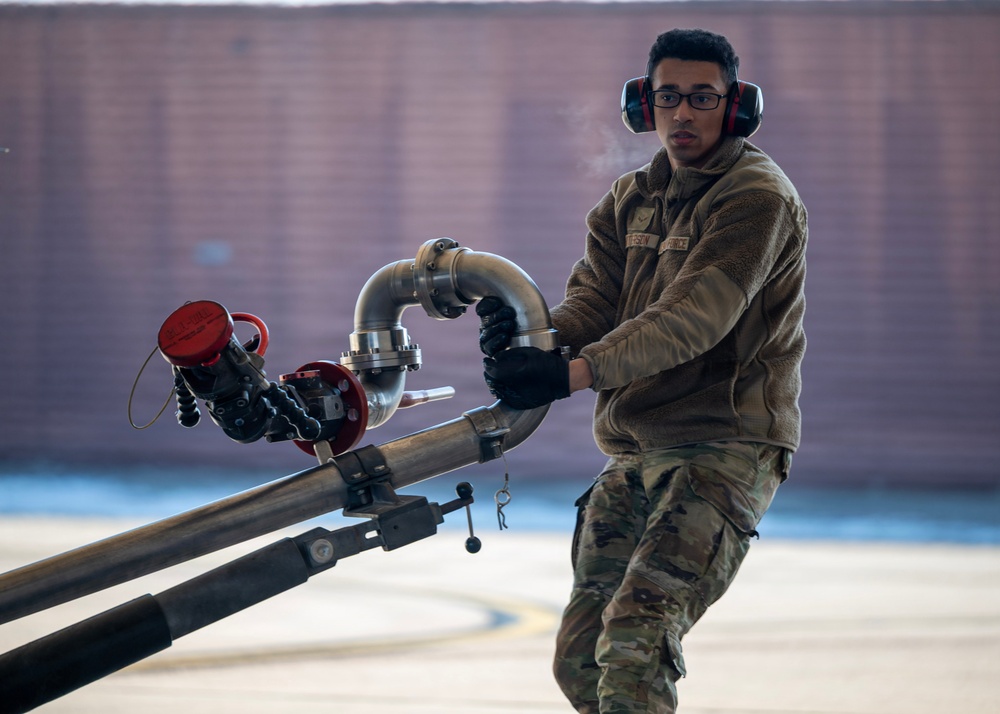
Photo By Staff Sgt. Sarah Williams | U.S. Air Force Airman 1st Class Benjamin Patterson, 51st Logistics Readiness Squadron...... read more read more
 Subscribe
OSAN AIR BASE, Republic of Korea – On the flight line at Osan Air Base, minutes matter. As F-16 Fighting Falcons launch, land, and return to flight, the ability to refuel aircraft without shutting down engines has become a determining factor in sustaining combat power for the 7th Air Force’s Super Squadron test.
With the full integration of the 35th Fighter Squadron alongside the 36th Fighter Squadron, Osan’s operational tempo increased by more than 50 percent. The surge placed added pressure on logistics Airmen to keep aircraft moving while operating with the same amount of resources.
To meet the increased demand and maintain Osan’s Fight Tonight mission, Airmen from the 51st Logistics Readiness Squadron partnered with 51st Maintenance Squadron to expand hot-pit refueling operations. Hot-pit refueling allows aircraft to refuel while engines remain running, significantly reducing ground time and enabling pilots to return to the air within minutes.
“Hot-pits allow aircraft to land and refuel in about five to seven minutes, getting back in the air almost immediately,” said U.S. Air Force Staff Sgt. Michael Lucas, 51st LRS fuel service supervisor. “Without this capability, you’re looking at delays that could add hours before that jet is airborne again.”
Traditionally, refueling required fuel trucks to be dispatched after aircraft landed, a process that could take 15 to 30 minutes before fueling even began. By pre-positioning personnel and using fixed fuel hydrant systems, hot-pit operations eliminate much of that delay.
“What hot-pits do is eliminate that entire waiting period,” stated Lucas. “We’re already in position before the jet lands, so when it pulls in, we’re fueling immediately. It cuts down roughly 80 percent of the time it takes to get fuel on the jet.”
To support the expanded operations, the 51st LRS increased the number of Airmen qualified to conduct hot-pit refueling from two to more than two dozen, ensuring coverage 24/7. The effort required close coordination with maintenance leadership and a deliberate training plan to certify Airmen through multiple qualification phases.
“Our goal is to make sure everyone from our newest Airmen all the way to the Superintendent is capable of executing the mission,” said Lucas. “Hot-pits give us the flexibility to respond at a moment’s notice, no matter the shift or the situation.”
That flexibility depends not only on the trained personnel, but also on meticulously maintained fueling infrastructure.
“Every day, our team inspects the fuel pits for leaks, system issues, and fuel quality,” explained Tech. Sgt. Darian Chenault, 51st LRS noncommissioned officer in charge of fuels hydrants. “If something isn’t right, it could slow down an aircraft that needs to be back in the air within minutes. Our job is to make sure that never happens.”
The Super Squadron test has significantly increased demand on Osan’s fuel hydrant systems, making the base one of the highest-utilization locations in the Air Force. Unlike fuel trucks, hydrant systems provide a continuous fuel supply directly from base storage, enabling repeated refueling without interruption.
“With the increased tempo, hydrant systems are a force multiplier,” said Chenault. “They don’t run out of fuel like trucks do, and that allows us to sustain high-volume operations while preserving our vehicle fleet for when it’s needed most.”
Beyond efficiency, expanded hot-pit operations directly contribute to deterrence and regional stability by enabling U.S. and allied forces to rapidly generate airpower and respond decisively to emerging threats across the Korean Peninsula.
“This isn’t just about exercises,” Lucas stated. “In real-world scenarios, being able to launch, refuel, and relaunch aircraft quickly could be the difference between mission success and failure. Fuel powers the fight.”
By expanding hot-pit refueling capabilities, Osan Air Base has strengthened its ability to project combat power, support allied operations, and remain ready to fight tonight.
| Date Taken: | 01.28.2026 |
| Date Posted: | 01.28.2026 01:57 |
| Story ID: | 556932 |
| Location: | OSAN AIR BASE, GYEONGGIDO [KYONGGI-DO], KR |
| Web Views: | 124 |
| Downloads: | 0 |

This work, Fueling the Fight: Hot-Pit Refueling Sustains Combat Airpower at Osan, by SSgt Sarah Williams, identified by DVIDS, must comply with the restrictions shown on https://www.dvidshub.net/about/copyright.


No keywords found.




