
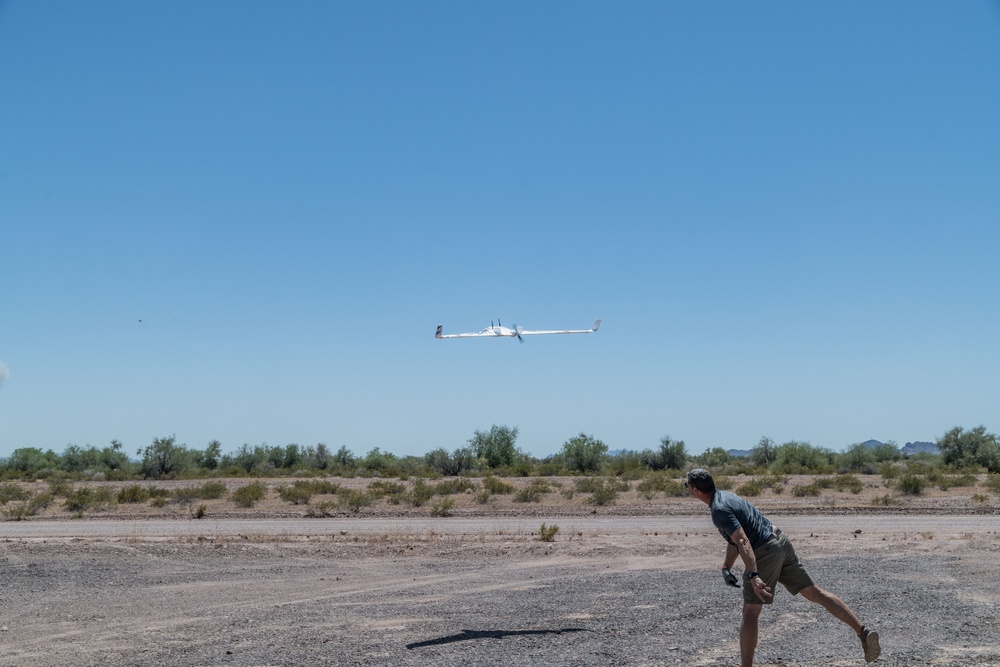
Courtesy Photo | Since the establishment of Joint Interagency Task Force 401 by Secretary of War Pete...... read more read more
 Subscribe
With eight decades of experience conducting developmental testing of drones, U.S. Army Yuma Proving Ground (YPG)’s institutional knowledge is unmatched in the Department of War.
The U.S. military has used unmanned aircraft for decades to perform dangerous reconnaissance and attack missions that save lives, and the importance of small, unmanned aircraft systems (sUAS) grows with each passing year.
As the technology proliferates, drones’ use in warfare has become significant, necessitating robust counter-sUAS (C-sUAS) defenses for use anywhere American forces may be deployed.
Since the establishment of Joint Interagency Task Force 401 by Secretary of War Pete Hegseth last August, U.S. Army Yuma Test Center has been designated as the primary, dedicated interagency C-sUAS test and training range. The designation means specifically that YPG will primarily focus on Class I and II small UAS, while larger Class III through V systems will continue to primarily be tested at White Sands Missile Range, YPG’s larger sister installation.
“We’ve been working this mission since the Army Rapid-Equipping Force came here for Desert Chance in 2015 where we needed to see what industry had to offer to counter drones,” said Ross Gwynn, YPG Technical Director. “We have different instrumentation and test methodologies that we have developed in-house along with analytical processes to show how these systems are performing. This is a new designation to speed up this process and focus these test efforts in a single location to pull all of these stakeholders together across different services.”
“I expect the workload to be so great that we’ll continue to use multiple test centers to be able to accomplish that mission at the speed and scale with which the Department of War is trying to move,” added James Amato, Executive Technical Director for the Army Test and Evaluation Command.
YPG’s vast size also includes nearly 2,000 square miles of restricted airspace, with clear, stable air and an extremely dry climate where inclement weather is a rarity. These factors make the post highly coveted for aviation testing, and senior leaders are readying for higher demand.
“We anticipate a pretty significant increase in workload,” said Gwynn. “As industry is asked to demonstrate capabilities that will solve gaps for the military, we’re going to see industry partners and contactors that want to come out and get opportunities to test their systems in restricted airspace.”
“The subject matter experts and culture that YPG has will make sure that we can enable them to go faster in whatever they need to get after this counter-UAS fight,” added Omar Silva, YPG Chief of Staff. “We always make things happen, but there is an opportunity here to make sure that we can leverage this designation to get some infrastructure to provide data faster.”
In addition to its regular UAS-related test workload, YPG has hosted semiannual industry demonstrations of the latest C-sUAS technology for most of the current decade. The methods to detect, track and identify threats differed by vendor, as did their specific defeat mechanisms. Some vendors provided kinetic weapon systems that shoot a target out of the sky, while others brought electronic warfare systems or combined aspects of other mechanisms. YPG’s expertise enabled the rigorous testing of all comers.
“They were really, really pleased with the opportunity to be able to bring their systems out to this type of environment where we’ve got the extended range and all the support required to be able to let them demonstrate what their system can do,” said Amato. “They don’t have the capability to do this anywhere else.”
“Counter-UAS efforts are so important now due to the proliferation of drones in the battle space,” added Col. John Nelson, YPG Commander. “In the Department of War, the Army is the lead agency for counter-UAS development and in the Army test community YPG is the center of excellence for testing C-sUAS. We’re turning over solutions for the warfighter every day.”
Since the days of testing technologies to defeat remote-controlled roadside bombs used by insurgents in Iraq and Afghanistan, YPG has been able to simulate the electronic ‘background noise’ present in a given location that includes everything in the electromagnetic spectrum, from radio and television signals to radiation emitted from microwave ovens. A realistic radio frequency background environment is critical when testing counter drone technology, and many feel YPG’s ability to reproduce a variety of electromagnetic environments from around the world is the best in the Department of War.
“Counter-UAS has a lot to do with electronic warfare, and the counter-improvised explosive device mission was at YPG for two decades during the War on Terror,” said Nelson. “That really lent our range to presenting contested environments for the counter-UAS mission.”
The designation is already garnering YPG additional attention from the highest levels of government. U.S. Senator Kevin Cramer, Chairman of the Senate Armed Services Subcommittee on Airland, visited in January for an in-depth look at the post’s extensive C-sUAS testing capabilities.
“The committee and certainly the Department of War has taken base security especially to heart and has tried to incentivize as much private sector innovation as possible,” Cramer said. “When I learned that Yuma Proving Ground was the tip of the spear on a lot of that testing, that is what prompted me to come here.”
Cramer said he was impressed by the post’s efforts and its personnel.
“What I have learned is very encouraging to me,” Cramer said. “Our Army facilitates real innovation at the speed of our adversaries, and we’re quite advanced at it.”
| Date Taken: | 02.18.2026 |
| Date Posted: | 02.18.2026 12:06 |
| Story ID: | 556911 |
| Location: | YUMA PROVING GROUND, ARIZONA, US |
| Web Views: | 305 |
| Downloads: | 0 |

This work, New CsUAS designation for U.S. Army Yuma Proving Ground, by Mark Schauer, identified by DVIDS, must comply with the restrictions shown on https://www.dvidshub.net/about/copyright.

No keywords found.




