
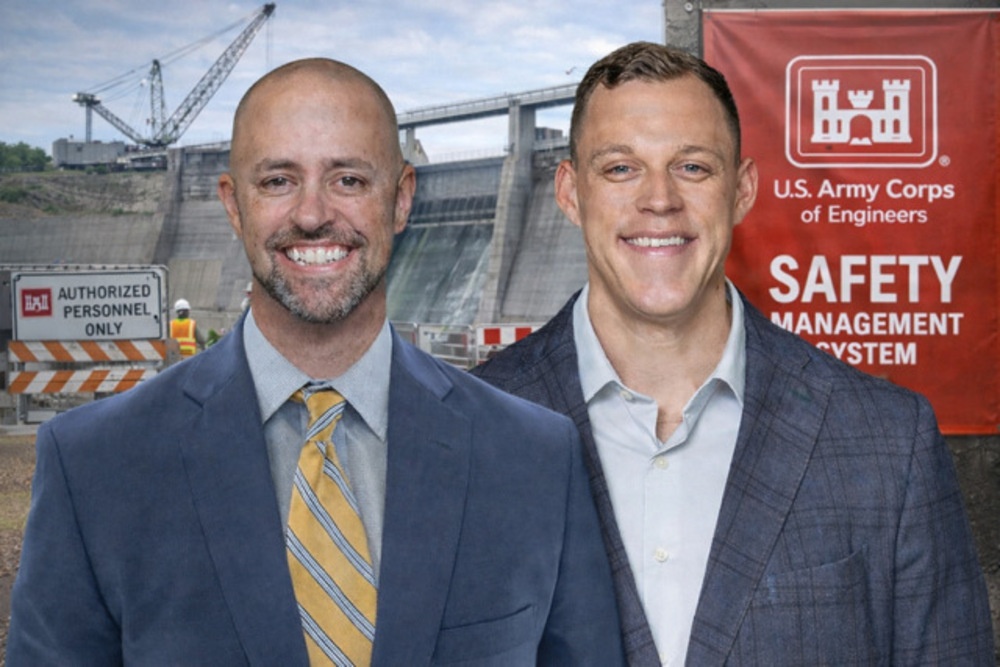
Photo By William Farrow | Utilize academic methods to validate and advance safety field practices, the duo...... read more read more
REDSTONE ARSENAL, Ala. -- Jeremy McCranie\, Huntsville Center Safety and Occupational Health Manager\, doesn’t see himself as an academic. He has his Bachelor of Science degree\, more than a decade working in the safety and occupational health field for the Navy and the U.S. Army Corps of Engineers and holds more than 150 specialized training certificates.
He feels he’s at his best working with people to ensure their wellbeing.
“I see myself as more of a 'boots on the ground' Safety and Occupational Health (S&OH) practitioner," McCranie said.
However, McCranie does utilize academic methods to validate and advance field practices and is the co-author of a doctoral-level case study published in the International Journal of Construction Management.
The Journal’s focus is ‘Advancing the knowledge of construction management, including topics on built environment, construction economics, property law and risk management.’
The paper, titled Investigating the Impact of Army Safety and Occupational Health Management System Implementation on Safety Performance Indices: Case Study of a U.S. Army Corps of Engineers District, was submitted to IJCM in November 2024 and after peer review, accepted and published to the journal July 2025. “The case study was a rigorous, 18-month endeavor completed entirely on our own time,” McCranie said.
“The scientific data gathered is crucial for substantiating and advancing the Army Safety and Occupational Health Management System (ASOHMS/CE-SOHMS), affirming the importance of the safety protocols being implemented across the Army and the Corps of Engineers.”
It was by chance McCranie became involved in the research. He was Honolulu District’s Safety and Occupational Health chief when co-writer Josh Moskowitz was assigned to Honolulu District as a USACE fellow.
“He (Moskowitz) previously interned with the Honolulu district as a Project Manager through the fellow's program,” McCranie said. “It was during his rotation in the safety office with me that his passion for safety truly ignited.”
Moskowitz, enrolled in a doctoral program with Capitol Technology University, a Science, Technology, Mathematics and Engineering (STEM)-focused academic institution in Maryland, became so interested in the SOH career field that he changed focus from project management to SOH.
Under McCranie’s guidance, he met all training requirements for the Professional Certificate in Safety and Occupational Health (PCSOH/CP-12), in addition to earning three other professional certifications in emergency management, explosives safety, and industrial safety.
“I originally became interested in the impacts of ASOHMS/CE-SOHMS while rotating through the District’s Safety Office as part of the Army Fellows Program,” Moskowitz said.
“At the time, only three Districts had successfully implemented CE-SOHMS and there was still some uncertainty surrounding its usefulness to benefit safety outcomes in the workplace and USACE project sites.”
That’s when McCranie and Moskowitz began collaborating on the impact of the Army Safety and Occupational Health Management System (ASOHMS). The U.S. Army Corps of Engineers Safety and Occupational Health Management System (CE-SOHMS) is the USACE counterpart of ASOHMS.
They wanted to understand whether putting the (ASOHMS) into practice actually improves safety in a real Army work environment, so they focused on Honolulu District as a case study, scientifically investigating potential relationships between progress in implementing the system and accident rates among USACE employees and contractors.
Correlations discovered between implementation progress and contractor accident rates on USACE projects were completely unexpected and ended up becoming a major focus of the study.
"This research contributes valuable insights to the USACE enterprise and broader safety community," McCranie said.
Moskowitz said one single certainty coming from the research is that there needs to be more research.
“Future studies need to be conducted to assess if the same impacts are being seen across the USACE, the Army, and other DOD agencies. As part of continuous improvement, we will be aiming to further our research to identify causation and greater empirical evidence of this relationship.”
Although McCranie and Moskowitz are now sitting in different locations several time zones away, they are still focused on improving CE-SOHMS and are currently conducting further research on another case study of Huntsville Center.
McCranie said they are using a similar research methodology and design but are using Huntsville Center data with hopes to have their latest paper published before this summer.
“Since Huntsville Center and Honolulu District are similar in that the majority of the work is done by contractors, I expect the results will mirror each other,” he said.
“What will be interesting is when Josh begins his research on the USACE enterprise as the data will include wage-grade USACE employees.”
Moskowitz’s dissertation work aims to investigate the impacts of CE-SOHMS across a larger sample size to include all 12 USACE suborganizations that have achieved Army SOH Star status with an emphasis on change management and safety performance trends during the implementation period.
| Date Taken: | 01.27.2026 |
| Date Posted: | 01.27.2026 10:26 |
| Story ID: | 556862 |
| Location: | HUNTSVILLE, ALABAMA, US |
| Web Views: | 39 |
| Downloads: | 0 |

This work, Duo improving safety through research, by William Farrow, identified by DVIDS, must comply with the restrictions shown on https://www.dvidshub.net/about/copyright.

No keywords found.





