
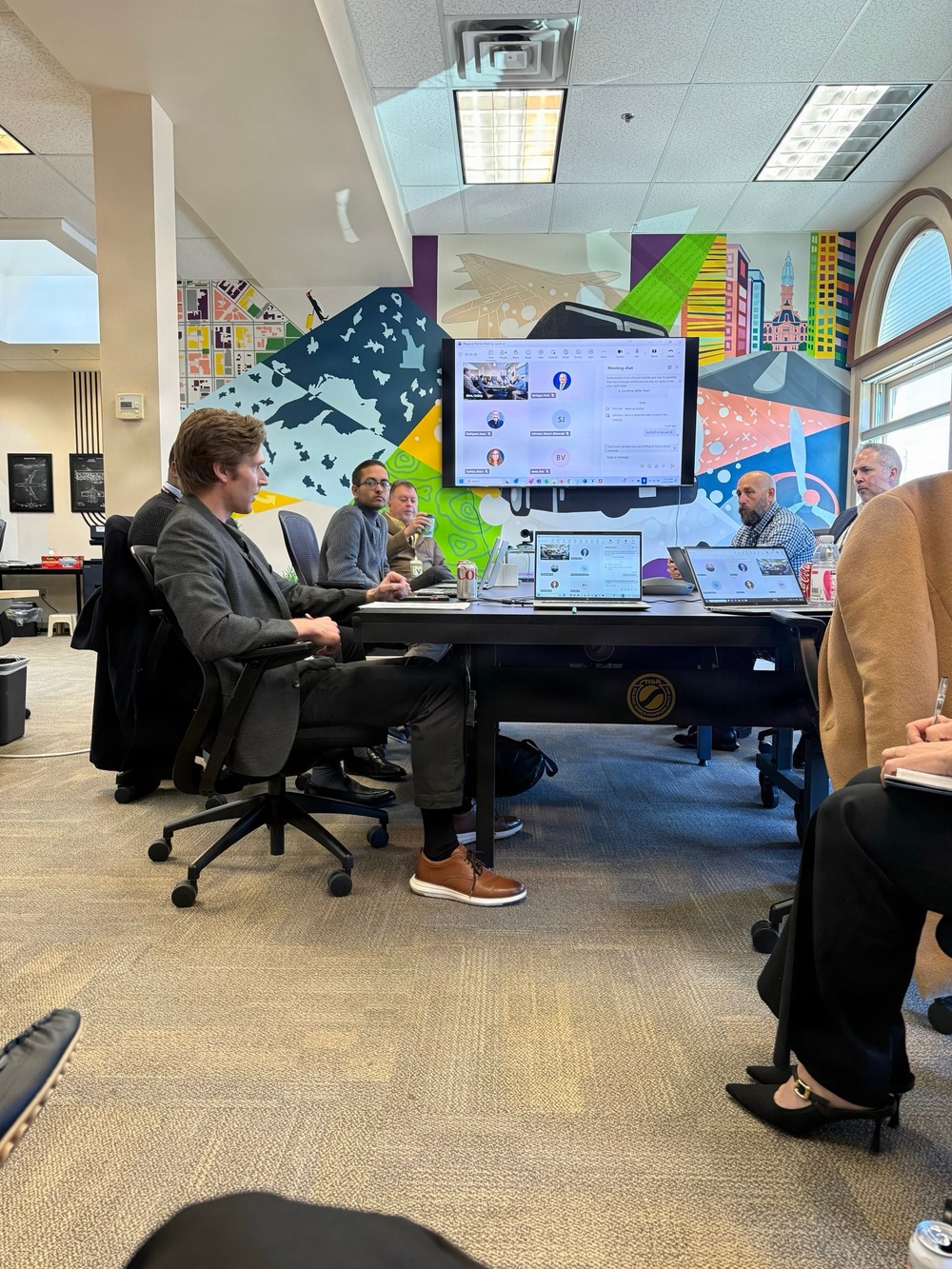
Photo By Pedro Rodriguez | ARLINGTON, VA - Multiple airlines security and Irregular Warfare Center experts...... read more read more
ARLINGTON, Va. — In a move to harden the nation's skies against evolving global threats, the Irregular Warfare Center (IWC) recently collaborated with American Airlines during a high-level strategic security meeting with regional airline partners and specialists, January 15, 2026. The summit shifted the focus from traditional security protocols to the complex realities of irregular warfare (IW), specifically addressing the proliferation of unmanned aerial systems (UAS) and their potential to disrupt domestic aviation and transportation infrastructure.
The engagement, requested by industry leaders, provided a platform for expert-level discussions on how lessons learned from active conflict zones are translating to domestic aviation risks. Security experts from the IWC detailed the global UAS and counter-UAS (C-UAS) landscape, highlighting how state and non-state actors are increasingly modifying commercially available drones to conduct asymmetric campaigns. By framing these issues through the lens of irregular warfare, the session underscored the "gray zone" threats that operate below the threshold of conventional conflict but pose significant risks to airline resilience and risk mitigation.
“The discussion was interactive and tailored to airline operational realities, emphasizing practical relevance rather than theoretical threat descriptions,” said Dr. Robert Redding, Ph.D., COL(R), USA, IWC Contractor, Deputy Regional Advisor NORAD/NORTHCOM/Homeland.
The dialogue moved beyond theoretical descriptions to address the "operational realities" of the airline industry. Participants examined the growing intersection between insider threats, supply chain vulnerabilities, and UAS-enabled disruptions.
Significant discussion focused on the legal challenges of operating in a permissive domestic environment where regulatory constraints often hamper the deployment of effective countermeasures near airports. Airline security leaders expressed heightened concern regarding third-party vendors and cargo security, particularly how emerging technologies could be used to exploit gaps in traditional screening. “In aviation, security is not static, it’s a living system. As leaders in multimodal operations, we have a responsibility to constantly learn, adapt, and improve to stay ahead of an evolving threat environment,” said Mohamad Mirghahari, Chief Security Officer Landline, IWC Contractor. “Integrating irregular warfare into aviation security discussions adds critical value because threats don’t distinguish between aircraft, airports, or ground transportation, and neither can our defenses. The challenge is that adversaries adapt at a pace that often outstrips regulation, funding, and training cycles, as we’ve seen in real time in places like Ukraine.”
The session identified a critical need for ongoing education and a structured dialogue to bridge Department of War threat analysis with civilian aviation practices.
“It is critical for the aviation industry to continuously engage in these discussions because the threat environment is constantly evolving. We must remain proactive - learning, adapting, and improving our security posture to ensure operations remain secure, resilient, and safe,” said Mirghahari. Participants showed their appreciation for the discussion by saying "the instruction illuminated key gaps in understanding of the unmanned warfare threat, and how global trends in unmanned warfare present challenges to commercial aviation."
Mirghahari added that these conversations enable them to anticipate emerging risks, share best practices, and maintain the highest standards of aviation security in an increasingly complex global landscape.
Following the success of the meeting, regional partners and American Airlines leaders provided "explicitly positive" feedback, calling the IW-informed threat framing "extremely valuable."
“Including irregular warfare in aviation security planning is essential because modern threats extend beyond conventional aviation risks,” said Mirghahari. “Whether involving aircraft, airports, or ground transportation, our operations must adapt not only to changes in technology and travel patterns, but also to non-traditional and asymmetric threats. Irregular warfare introduces tactics that exploit gaps across domains, making it vital that aviation security frameworks account for these evolving methods to remain effective and relevant.”
The discussion reinforced the relevance of IWC expertise in addressing emerging homeland threats that fall below the threshold of traditional military conflict, while offering tangible benefits to private-sector partners responsible for national transportation systems.
For more news and Information about the IWC follow us on the links below:
Linked In https://www.linkedin.com/company/irregularwarfarecenter/?viewAsMember=true
X https://x.com/IrregularWarCtr
Check out our website https://irregularwarfarecenter.org/news/
| Date Taken: | 01.15.2026 |
| Date Posted: | 01.27.2026 10:44 |
| Story ID: | 556861 |
| Location: | ARLINGTON, VIRGINIA, US |
| Web Views: | 291 |
| Downloads: | 0 |

This work, Aviation Leaders and Defense Experts Convene to Tackle Emerging Drone Threats in Commercial Aviation Security, by Pedro Rodriguez, identified by DVIDS, must comply with the restrictions shown on https://www.dvidshub.net/about/copyright.


No keywords found.





