
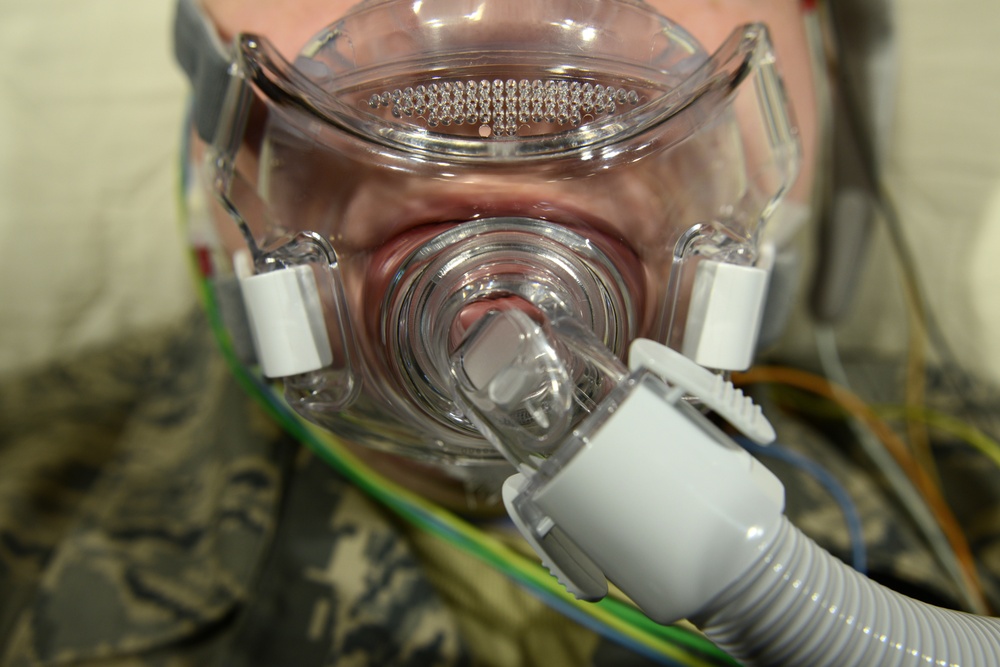
Photo By Airman 1st Class Christopher Morales | An Airman wears a continuous positive-air pressure mask in the 673d Medical Group...... read more read more
 Subscribe
Getting regular restorative sleep on a regular basis is essential to good health — yet studies have shown that lack of sleep has left the military less combat ready. To address this urgent issue, the Department of Defense and the Department of Veterans Affairs revised the Clinical Practice Guideline for the Management of Chronic Insomnia Disorder and Obstructive Sleep Apnea on July 29, 2025.
The lack of restorative sleep is known as chronic insomnia disorder. Obstructive sleep apnea is characterized by repetitive snoring, choking, and awakenings. These two conditions often go together, resulting in sleepiness that affects service member duty performance and overall readiness, and can lead to serious physical and mental health consequences.
The CPGs are designed to help primary care health professionals use the most up-to-date and evidence-based disease identification and treatment options. They are revised as new information comes in and are created by a working group of cross-functional health care experts in the CPG’s particular topic.
The 2025 guidelines combine discussions of insomnia and apnea sleep disorders “because they’re important individually, but there’s often overlap,” said Col. (Dr.) Matthew Brock, a physician and chief of the Sleep Disorders Center at the U.S. Air Force’s Wilford Hall Ambulatory Surgical Center, Joint Base San Antonio, Texas.
The 2025 CPG’s updates include:
The CPG recommends more training of front-line providers in sleep medicine and better understanding of the cause of chronic insomnia disorder.
For sleep apnea diagnosis, the CPG recommends in-lab sleep testing, the current gold standard, but at-home testing can be used in certain circumstances.
Those recommendations are in line with what is commonly accepted and used in the civilian sector and are consistent with other guidelines on the topic with few exceptions, said Col. (Dr.) Vincent Capaldi, a U.S. Army physician and psychiatry department chair at the Uniformed Services University in Bethesda, Maryland, who worked on the CPG.
Patients with both insomnia and sleep apnea report worse symptoms of fatigue, judgment and reaction impairment, and psychiatric disorders compared to those with insomnia or sleep apnea only, according to the CPG.
Insomnia causes more combined illnesses and health conditions than sleep apnea “despite very few people being on profiles or duty limitations for insomnia,” Brock explained, adding that insomnia and sleep-related breathing disorders are “vastly under-addressed.”
Treating insomnia traditionally has focused on finding the initial cause or underlying condition. “We really wanted to focus on insomnia as its own condition that needs to be addressed without an underlying cause being considered,” Brock said, adding that with the updated guidelines, “any patient with sleep complaints is screened for both [conditions] as opposed to assessing for each individually.” Screening separately has led to the under-reporting of insomnia, he noted.
Health care providers should integrate these screenings into routine assessments, “particularly for individuals presenting with symptoms of sleep disturbance, excessive daytime sleepiness, or conditions linked to sleep disorders such as hypertension and obesity,” according to the CPG.
The guidelines include nine new recommendations for insomnia medications, with cognitive behavioral therapy — problem-solving specific misconceptions about sleep thoughts and behaviors — remaining as a priority treatment.
The CPG also recommends sleep medications for those who have tried and failed cognitive behavioral therapy, Capaldi said. These include daridorexant (brand name Quviviq), the tricyclic antidepressant doxepin, eszopiclone (Lunesta), and zolpidem (Ambien).
Positive airway pressure given via PAP machines that cover the nose or face, and mandibular advancement devices, or mouthguards, are first-line therapies for mild to moderate OSA, according to the 2025 guideline.
The CPG “uniquely suggests the use of educational, behavioral, and supportive interventions to improve PAP adherence, including telehealth and in-person appointments,” Brock pointed out.
The guideline’s working group added weight management for sleep apnea along with other OSA treatments, recommending primary care professionals follow the Clinical Practice Guideline for the Management of Adult Overweight and Obesity.
Military service itself may lead to distinct types of insomnia, apnea, or combined sleep disorders in men and women to similar degrees, the working group suggested.
In a select group of service members and veterans reported in 2021, 16% said they had symptoms consistent with insomnia disorder. Service members in combat have reported insomnia symptoms as high as 41%, as have 25% of those not deployed, according to a 2016 study cited in the CPG.
Preparing for deployment also can cause insomnia. A 2016 study found 19.9% of service members reported insomnia as referenced in the CPG.
| Date Taken: | 01.22.2026 |
| Date Posted: | 01.22.2026 09:12 |
| Story ID: | 556510 |
| Location: | US |
| Web Views: | 397 |
| Downloads: | 0 |

This work, New clinical practice guideline recognizes insomnia and sleep apnea can occur together, by Janet A. Aker, identified by DVIDS, must comply with the restrictions shown on https://www.dvidshub.net/about/copyright.

No keywords found.




