
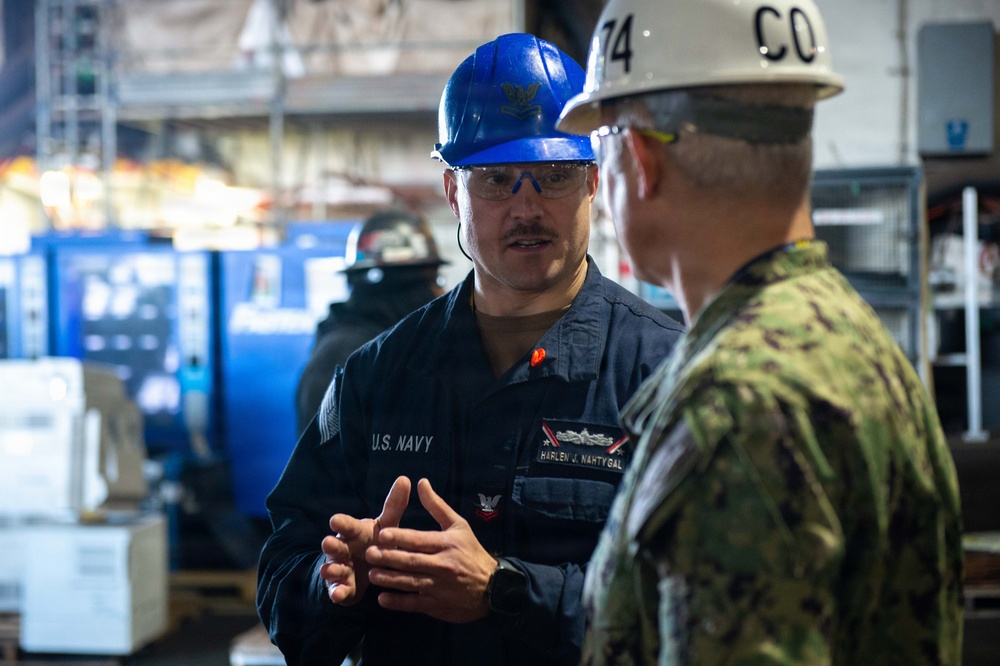
Photo By Seaman Oliver McCain Vieira | 251229-N-VA510-1184 NEWPORT NEWS, Va. (Dec. 29, 2025) Machinist’s Mate 2nd Class...... read more read more
 Subscribe
NEWPORT NEWS, Va. Machinist’s Mate Petty Officer 2nd Class Harlen Nahtygal, assigned to the Nimitz-class aircraft carrier USS John C. Stennis (CVN 74), is charting new territory for the Navy’s engineering community. Nahtygal has become the first conventional Machinist’s Mate accepted into the Naval Nuclear Power Training Command (NNPTC) to cross-rate as a Machinist’s Mate (Nuclear), a milestone that could reshape future career paths for conventional engineers.
Nahtygal was presented the opportunity in July after his chain of command recognized he was already operating at the level of a seasoned nuclear trained mechanic.
“MM2 Nahtygal exemplifies what it means to make the most of a naval career,” said Capt. Crystal Miller, Stennis’ reactor officer. “He has consistently worked to break down perceived barriers for conventional Machinist’s Mates within the Reactor department.”
For Nahtygal, the prospect was daunting, but he did not hesitate.
“As soon as I was approached, I knew I had to get started immediately,” he said. “This wasn’t something you could put off.”
Cross-rating into the nuclear community is more demanding than a typical rate conversion. The nuclear pipeline carries some of the Navy’s most stringent academic, medical and psychological requirements, making the process both time-consuming and tedious.
Before he could even apply, Nahtygal underwent multiple physical assessments, mental health evaluations and extensive medical screenings to determine his eligibility. The process tested his patience and resolve. “I had to complete so much just to get my package started,” Nahtygal said.
Once medically cleared, he faced another significant hurdle: proving his academic capability. Nahtygal retook the Armed Services Vocational Aptitude Battery, or ASVAB, earning the highly competitive scores required for nuclear training. Only then was his application eligible for review. After months of examinations, paperwork, and waiting, his acceptance into the program was confirmed.
Upon reporting to NNPTC, Nahtygal will complete a rigorous sequence of training that includes nuclear power school and prototype training despite having already completed conventional Machinist’s Mate instruction earlier in his career. The entire process, from application to completion of the nuclear training pipeline, is expected to take approximately two and a half years.
For Nahtygal, the decision to cross-rate is about more than professional advancement. It reflects his drive to seek out challenges, expand his knowledge, and leave a lasting impact on the Navy.
“I love pushing myself and taking on difficult opportunities,” he said. “I’m competitive by nature, and I want to set myself apart, but I also want to make a difference.”
Making a difference is inevitable: because there is no established precedent for conventional Machinist’s Mates transitioning into the nuclear community, Nahtygal now could potentially serve as a blueprint for future Sailors considering the same path. His experience provides leadership with valuable insight into both the challenges and potential benefits of opening the nuclear pipeline to conventional engineers.
By embracing an unprecedented challenge, Nahtygal is not only shaping his own career but also influencing the future of the Navy’s engineering community, proving that initiative, perseverance, and ambition can open doors once thought closed.
| Date Taken: | 01.20.2026 |
| Date Posted: | 01.20.2026 15:09 |
| Story ID: | 556416 |
| Location: | US |
| Web Views: | 935 |
| Downloads: | 0 |

This work, Conventional Gone Critical: From MM to MMN, by SA Rebekah Cook, identified by DVIDS, must comply with the restrictions shown on https://www.dvidshub.net/about/copyright.


No keywords found.




