
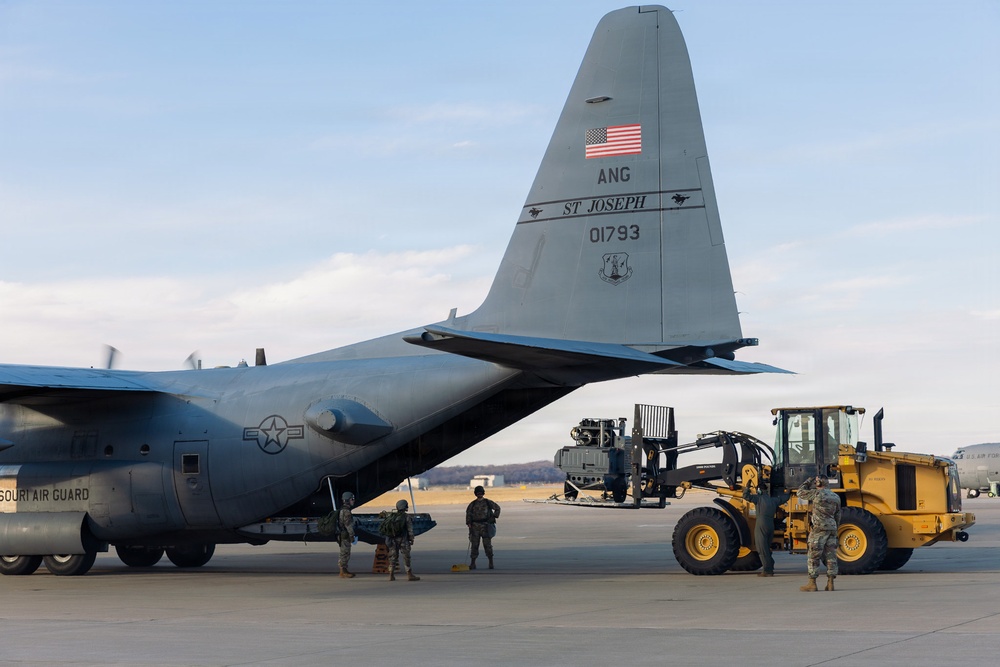
Photo By Staff Sgt. Marcelo Arias | Airmen assigned to the 139th Airlift Wing use a forklift to load cargo on a C-130H...... read more read more
The 139th Airlift Wing conducted a combat readiness inspection Jan. 9–11, 2026, at Rosecrans National Guard Base, testing the wing’s ability to deploy and operate in a contested environment.
More than 50 inspectors and evaluators from Air Mobility Command converged on Rosecrans to assess how effectively the wing could generate forces, employ assets and sustain operations while facing realistic threats expected in a deployed setting.
“You are charged to generate, employ, and sustain based on readiness driven by your doc statements…and exercise objectives,” said Col. Andrew Milligan, the lead inspector from Air Mobility Command.
Throughout the inspection, Airmen were evaluated by the 139th Wing Inspection Team across multiple mission sets, including aircraft generation, base defense, and command and control operations. Those WIT members were evaluated by AMC inspectors.
Scenarios challenged Airmen with simulated chemical attacks, drone threats, degraded communications and cyber disruptions designed to mirror real-world combat conditions.
Dubbed Operation Waverunner, 175 Airmen processed through a personnel deployment function line to ensure they met all deployment requirements before boarding a C-130 Hercules aircraft.
“All of this was accomplished in degraded operations, forcing our Airmen to utilize nonstandard manual methods,” said Capt. Meredith Barnette, plans officer for the 139th Airlift Wing. “Our Airmen had to adapt and think outside of the box to get the mission done.”
In one scenario, computers and phones were taken offline, requiring Airmen to rely on runners to relay critical information and maintain command and control across the installation.
“Degrading communications put wing leadership and senior staff at a severe disadvantage,” said Barnette, “placing them in a position where they had to rely on their command structure within the units to make decisions as well.”
Post-attack reconnaissance teams also played a critical role during the exercise. Following simulated attacks, these teams conducted ground assessments to identify unexploded ordnance, locate casualties and provide commanders with a comprehensive picture of the installation’s operational status.
According to Barnette, the CRI showcased the wing’s mental toughness, a key expectation set by Col. Barrett Golden, commander of the 139th Airlift Wing, who charged the wing to “have an absolute warrior mentality.”
Squadrons across the wing also used the inspection to maximize training opportunities, said Barnette. Security forces Airmen conducted driver training and weapons qualification while wearing mission-oriented protective posture gear. Firefighters responded to a simulated aircraft fire, using a fog machine to replicate heavy smoke and reduced visibility.
Communications Airmen established a Joint Incident Site Communications Capability, providing mobile internet and voice services during simulated outages. Additionally, the 241st Combat Air Operations Squadron stood up a mobile tactical air navigation equipment to provide approach and landing guidance in a degraded airfield environment.
Barnette worked closely with the 139th Operations Support Squadron’s intelligence flight to build scenarios for the exercise.
Over the past 20-plus years of the Global War on Terror, the force has grown less accustomed to operating in contested environments, said Capt. Joshua Owen, chief of information, 139th OSS.
An exercise like this puts Airmen in a situation where air superiority is uncertain, freedom of movement is challenged, and Airmen must respond dynamically to threats beyond their organic capabilities, Owen said.
“This was a total-wing effort, and every section contributed seamlessly,” said Golden. “Preparation and execution validated our status as a premier C-130 wing in the Air National Guard.”
| Date Taken: | 01.20.2026 |
| Date Posted: | 01.20.2026 14:33 |
| Story ID: | 556415 |
| Location: | ST. JOSEPH, MISSOURI, US |
| Web Views: | 80 |
| Downloads: | 0 |

This work, 139th Airlift Wing demonstrates readiness during combat readiness inspection, by Michael Crane, identified by DVIDS, must comply with the restrictions shown on https://www.dvidshub.net/about/copyright.

No keywords found.





