
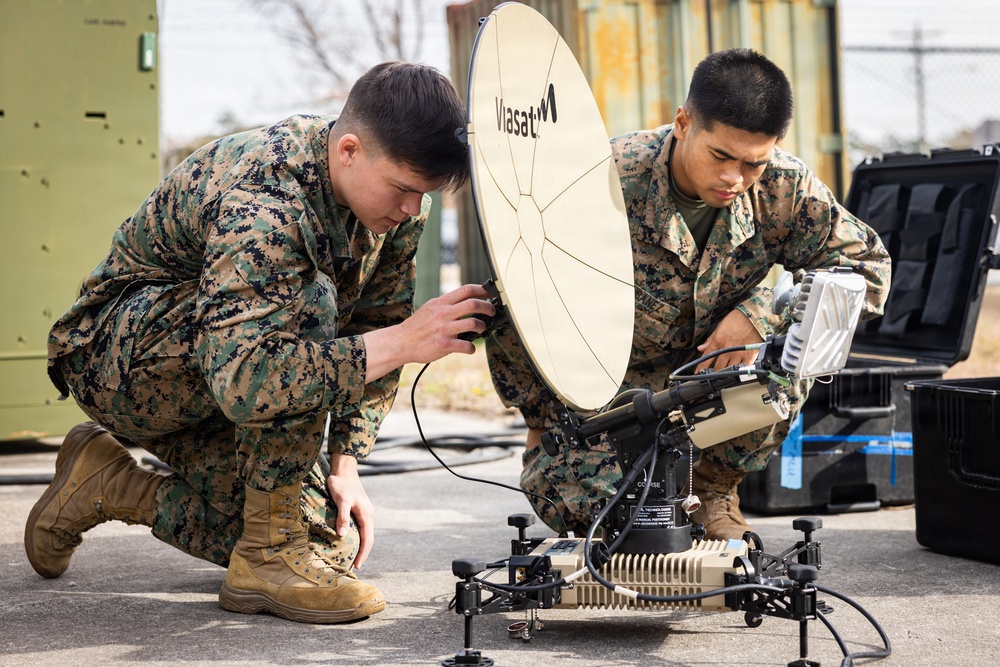
Photo By Staff Sgt. Gavin Umboh | U.S. Marines from around II Marine Expeditionary Force receive training on the...... read more read more
 Subscribe
MARINE CORPS BASE CAMP LEJEUNE, N.C. –A new course facilitated by 2nd Marine Logistics Group is teaching Marines the skills required to operate the next generation of satellite equipment, directly addressing the need for in-depth training on new commercial off-the-shelf systems are not yet part of the formal schoolhouse curriculum. The Commercial Satellite Communication Operations Course, created by a collaboration of experts across II Marine Expeditionary Force, is designed to educate Marines on the new equipment and enhance communication modernization initiatives within the Fleet Marine Force.
The initiative to create a course was started after II MEF leadership identified a potential gap in training for advanced satellite systems already being fielded. Marines were arriving at their Units having to learn new systems, hindering effectiveness and efficiency. To prevent this gap, a team of subject-matter experts developed a hands-on course to ensure Marines could effectively operate the gear they receive, rather than learning on the job. The third iteration of the course was recently held at the Communication Training Center 2 located at Marine Corps Base Camp Lejeune, N.C., from December 16 to 20, 2025.
U.S. Marine Corps Cpl. Gavin Bee, a satellite transmissions system operator with 6th Marine Regiment, 2nd Marine Division, helped put the course together after noticing the lack of training for Marines working with newer gear. “We were all kind of doing our own thing, and it was very unorganized,” said Bee. “People across base were trying to do the same thing and that's when we really started pushing for this course to happen.”
For U.S. Marine Corps Gunnery Sgt. Joseph White, chief instructor at Communication Training Center 2, the course is about readiness.
“All this gear that we currently teach is not taught at the schoolhouse; you get to your unit, and then you have to learn from there,” said White. “The purpose of the course is to train Marines on the upcoming gear, the commercial off-the-shelf gear that we have, so that they can understand the equipment.”
The first iteration of thecourse took place from December 16 to December 20, 2024. Although the course itself is four days with a final test on the fifth day, it’s a two-week process. The week prior to the course, Marines with the CTC ensure that all the gear is functioning and up to date on all its firmware, and the following week is when the students begin the course. “The course is broken into two groups,” explained White, “One for Viasat, then the other is Kymeta, Litecoms, and Starshield. After two and half days, the students switch. The course is 40 hours total and out of the 40 hours only eight are classroom lectures and PowerPoints, the other 32 hours are hands-on time with the equipment.”
For students like U.S. Marine Corps Lance Cpl. Warren Saunders, a satellite transmission operator with 8th Communication Battalion, II Marine Expeditionary Force Information Group, II MEF, the training offered him the opportunity to advance his skills further.
“I feel like a lot of Marines just kind of think it's all just plug and play, but they don't really dive into the further complexities of what you have to do to commercial gear,” Saunders explained.
When asked what Saunders expected to learn from the course, he spoke about how he hoped to learn how to operate the systems more effectively and bring that advanced knowledge back to his unit.
This "train-the-trainer" mentality is part of the course's design. With a limited capacity, the program relies on its graduates to act as force multipliers. The intent is for each student to return to their unit and spread their newly acquired knowledge with their units.
The course curriculum emphasizes hands-on training that allows even more utility from the gear. Saunders noted that while many operators can plug in a terminal like a Starshield and establish a connection, the course teaches them to go further. “They don’t think ‘oh I can get on the Graphical User Interface and potentially move the satellite to this spot’ so communications are better than they were before,” he said. This focus on maximizing the equipment's potential is a key takeaway for the students.
This hands-on access to new technology is a significant draw. “My favorite part about this course was setting up new gear,” Saunders said, admitting his unit doesn't get new systems often.
This enthusiasm also comes from what Saunders is witnessing firsthand. As the Marine Corps moves away from heavy legacy systems toward lighter, more agile commercial equipment,Saunders feels he is on the front line of a major evolution in his field.
“It's really like I'm watching one generation fade out, and a new generation fade in, and I’m part of that, so that’s really cool,” Saunders reflected.
According to White, the program's development was not easy. The biggest challenge was navigating each unit’s conflicting Training, Exercise, and Employment Plans (TEEP), which dictates when Marines will be available to seek out new skills. “The first iteration that we did was kind of, hey, grab all the equipment we possibly can, throw a bunch of names on a roster, and see what we can do,” said White. “Then the second one, we kind of built some structure around it.”
Leaders overcame the conflicting TEEPs by communicating directly with major subordinate commands to find a workable schedule. Now in its third iteration, the course has a solidified structure that has even been used at Camp Hansen, Okinawa, Japan, with III MEF.
“This third (course) that we just conducted here at II MEF kind of solidified and gave us a really good structure of how future commercial satellite communication courses are going to be ran,” shared White. “III MEF has had one iteration where they have been able to have some students learn some of the Viasat gear and also some of the Kymeta terminals but that was only one iteration that they were able to perform.”
As it continues to develop, the goal is to have this course taught across all three MEFs. To achieve this, the course is briefed weekly to Communication Training Battalion in 29 Palms, California, where the goal of the battalion is to train Marines in all forms of communications.
“We believe that the next commercial SATCOM course that we have is going to be far better,” said White. “It's going to have a great structure, and we’re going to be able to facilitate, hopefully a little bit more Marines than we did this time.”
The ultimate benefit, White noted, is for commanders across the force. “This training is going to benefit commanders by allowing them to send their Marines here to get educated on the gear,” he said. “That way, when they receive the equipment, they don’t have to run around and try to figure things out themselves.”
Bee felt this course was not only an opportunity, but a requirement for the future. “This training is necessary because it's our job,” he stated, “Our job is to communicate as efficiently as possible, and the more efficient you become with communications, the more lethal you become as a fighting force.”
For the instructors, the mission is personal. “I believe it is a great privilege to be able to train Marines on this new gear,” White said. “I am honored to be able to train and mentor Marines so that they can be more lethal on the battlefield.” Although the course has limited capacity, often hosting 20 students at a time, the intent of the course is to teach a few Marines, and return them to their unit to spread their newly gained knowledge.
For the students, it’s about being ready for that future battlefield. The rapid innovation, Saunders said, is exciting. “It's almost like being in a video game. The way communications are evolving, things are getting smaller and more man-packable,” Saunders concluded. “All this new advanced gear is coming out, and seeing it actually applied in the field is really interesting. It really makes me excited for what could be implemented further.”
“The feedback has been pretty positive, units are happy to get Marines trained on the gear and biggest issue they have is that the course is not held more often,” White clarified. “It has greatly impacted the 06XX field by giving the Marines the knowledge and training they need to better operate the gear that is currently being used in the MEF and to allow them to meet the standards of force design.”
By directly addressing the lag between fielding new equipment and formal schooling, the Commercial SATCOM operations course is accomplishing more than just teaching technical skills. It is fostering a new generation of communicators who are not only proficient with the latest technology but are energized by its potential. This course ensures that as communication capabilities improve and become faster, lighter, and more complex, Marine operators are prepared not just to keep pace, but to innovate, driving the Corps’ strategic advantage well into the future.
| Date Taken: | 01.14.2026 |
| Date Posted: | 01.15.2026 16:32 |
| Story ID: | 556297 |
| Location: | MARINE CORPS BASE CAMP LEJEUNE, NORTH CAROLINA, US |
| Web Views: | 160 |
| Downloads: | 1 |

This work, Know Yourself and Seek Self Improvement: 2nd MLG Helps Create Commercial Satellite Communications Course for 06xx Marines, by Sgt Rafael BrambilaPelayo, identified by DVIDS, must comply with the restrictions shown on https://www.dvidshub.net/about/copyright.


No keywords found.




