
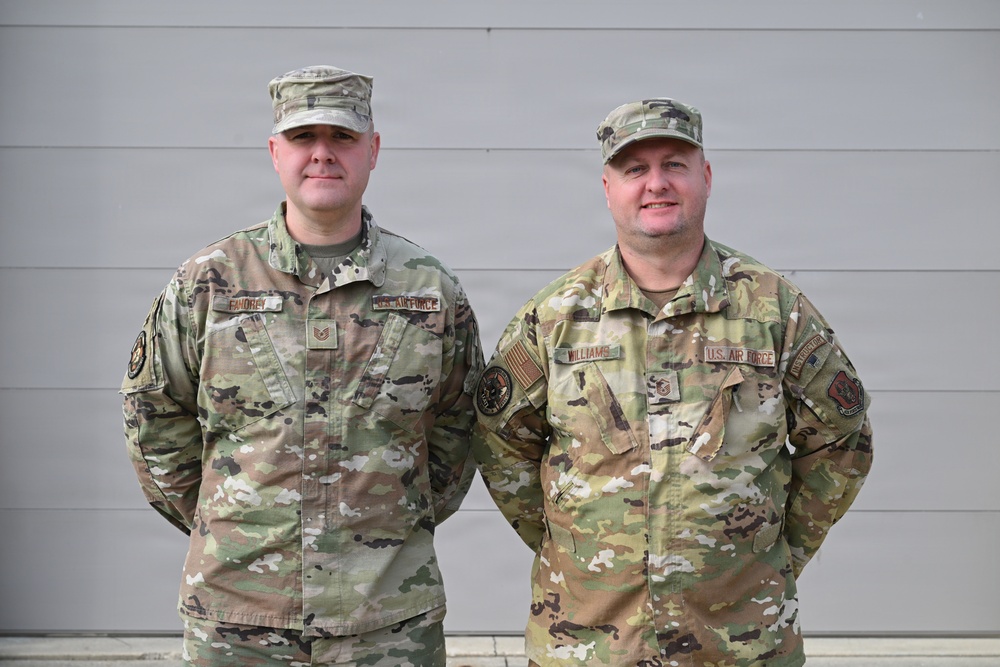
Photo By Senior Airman Angela Jackson | U.S. Air Force Tech. Sgt. Darin Fandrey, left, 445th ASTS medical technician, and...... read more read more
On a quiet backcountry road stretching between Indiana and Ohio, a routine drive turned into a moment of crisis – and a powerful reminder of why preparation saves lives.
Master Sgt. Danny Williams, a 445th Aeromedical Staging Squadron Critical Care Air Transport Team respiratory care practitioner, was driving along the rural stretch when the car in front of him began swerving erratically. Within seconds, it flipped and rolled down the roadway.
“When I saw the vehicle, I knew immediately this wasn’t something I could just drive past,” Williams said. “You think about the person who needs help.”
Williams didn’t hesitate.
“First, I ensured the scene was safe, stabilizing the vehicle before approaching the victim,” he said.
Drawing on nine years of medical training, Williams conducted a rapid assessment, checking for life-threatening injuries and signs of shock.
“The biggest thing is staying calm,” he explained. “If you panic, the patient panics. Training kicks in, and you focus on what needs to be done right now.”
He went to work providing first aid – bandaging visible wounds, splinting an injured limb and starting an IV to help stabilize the victim while emergency services were en route.
“I always keep a first aid kit in my truck,” Williams said. “You never expect to need it, but I’ve learned that being prepared isn’t optional; it’s a responsibility.”
As they waited for first responders to arrive, Williams stayed with the young man, offering reassurance and closely monitoring his condition.
“Sometimes the most important thing you can give someone is your presence,” he said. “Letting them know they’re not alone can make a real difference.”
When emergency crews arrived and assumed care, Williams briefed responders and quietly stepped back, continuing on his way once he knew the victim was in capable hands.
This wasn’t just one case of an ASTS Airman being in the right place at the right time.
Tech. Sgt. Darin Fandrey, a 445th ASTS medical technician, faced a crisis just as unexpectedly.
In Newark, Ohio, on his way to unit training assembly, Fandrey stopped for gas while his wife waited in the car. Inside the convenience store, he noticed a growing commotion outside – someone shouting for an Automated External Defibrillator.
“I knew something was wrong immediately,” Fandrey said. “You don’t hear that word unless it’s serious.”
An elderly woman sat in a car with her daughter, complaining of chest pain. Moments later, she became unresponsive. Fandrey rushed to the vehicle, assessed her condition and checked for a pulse. There was none.
With no medical equipment available and seconds slipping away, Fandrey pulled the woman from the car and began CPR in the snow-covered parking lot.
“As a civilian paramedic and Air Force medical technician, my training took over,” Fandrey said. “I was calm, focused and determined – despite the gravity of the moment.”
As he performed CPR, the woman’s daughter spoke with a doctor over the phone, relaying instructions to Fandrey who was already steps ahead.
With help from his wife, an emergency room nurse, the woman began breathing again and a pulse returned. When emergency responders arrived, Fandrey seamlessly transitioned into a support role.
“I was exhausted from CPR,” he said. “But, I helped the EMS team load her onto the cot and assisted the medic. In those moments, it’s all about teamwork.”
Though he later learned the woman had passed away at the hospital, Fandrey reflected on the experience with quiet resolve.
“Sometimes you can do everything right, and the outcome still isn’t what you hoped for,” he said. “But I knew I gave her a fighting chance.”
Williams and Fandrey are candid about the emotional toll their profession can take – about the lives saved and the moments that linger long after the call ends.
“Some things stay with you,” Williams said. “Your first few deaths, certain scenes. It’s okay to not be okay. When work follows me home, I talk to my wife – she’s a nurse and understands what we go through.”
What sustains them both is the bond they share with the highly skilled medics beside them.
“Teamwork reduces the individual burden,” Williams said. “It turns individual strengths into collective strength. Everyone brings different skills, but we share the same goal – to save that person. Together, we do what none of us can do alone.”
“The firehouse and medical teams are my family,” Williams added. “We have each other’s backs. Every challenge becomes an opportunity to show how strong we are together.”
Reflecting on their experiences, both Airmen emphasized that their ability to respond in moments of crisis underscores the importance of constant training and readiness.
“We train for scenarios we hope never happen,” Williams said. “But when they do, that training matters. Being prepared matters. It’s about taking care of people when it counts most.”
Williams realized just how impactful the roadside incident had been when he got back to his truck and looked into the back seat where his 3-year-old son had remained safely strapped in his car seat throughout the entire event.
“I told him I helped someone who needed it and helping others is just what you do,” Williams continued.
Fandrey hopes his experience serves as a reminder – especially to younger Airmen – about the seriousness of their profession.
“This job isn’t just a requirement,” Fandrey explained. “One day, that training might save someone’s life.”
Heroism doesn’t always arrive with flashing lights or radios crackling to life. Sometimes, it appears quietly on a country road or in a parking lot when ordinary people are ready.
Williams and Fandrey would be the first to say they’re just doing their jobs. But in moments when compassion, courage and readiness intersected, their willingness to act changed lives forever – and that is worth celebrating.
| Date Taken: | 01.14.2026 |
| Date Posted: | 01.21.2026 09:05 |
| Story ID: | 556277 |
| Location: | WRIGHT-PATTERSON AIR FORCE BASE, OHIO, US |
| Web Views: | 18 |
| Downloads: | 0 |

This work, ASTS Airmen ready when it matters most, by SrA Angela Jackson, identified by DVIDS, must comply with the restrictions shown on https://www.dvidshub.net/about/copyright.

No keywords found.





