
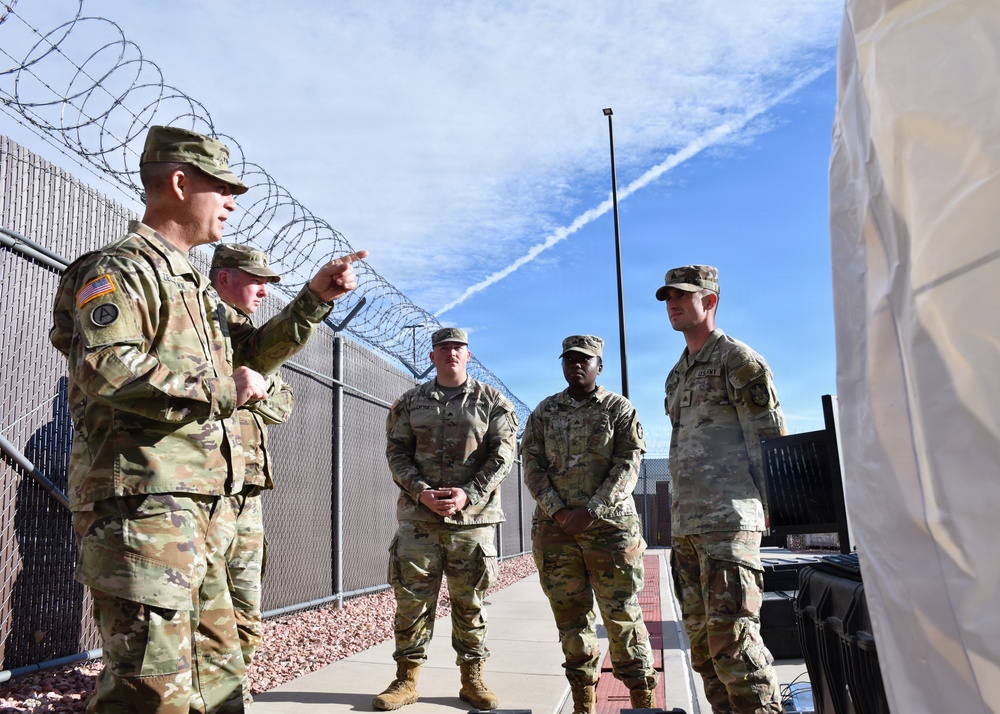
Photo By Brooke Parcus | Lt. Gen. Zellmann, U.S. Space Command deputy commander, receives a demonstration of a...... read more read more
 Subscribe
REDSTONE ARSENAL, Ala. – Lt. Gen. Richard Zellmann, deputy commander for U.S. Space Command, visited U.S. Army Space and Missile Defense Command units in Colorado and Alabama to assess new capabilities from one of USSPACECOM’s component commands.
During his visit to the 1st Space Brigade, headquartered at Fort Carson, Colo., brigade Soldiers demonstrated an expeditionary small form factor system, which can rapidly deploy to provide close space support to Army, joint and coalition ground forces. Marines with the U.S. Marine Corps Forces Space Command, the Marine Corps service component to USSPACECOM, also demonstrated expeditionary space capabilities alongside the Soldiers. Since 2021, the brigade has trained select Marines on using space-based capabilities to assist warfighters.
“We were happy to demonstrate how Army Space capabilities work to provide close space support to Army and Joint Force commanders,” said Lt. Col. Ryan Stephenson, commander, 1st Space Battalion. “We showed Lt. Gen. Zellmann how we train alongside our Marine counterparts and deploy to give options to the Joint Force and the Department of War.”
Zellmann, a former 1st Space Brigade commander, said the visit demonstrated how Army space capabilities have expanded to include smaller, tactical systems to meet emerging adversary technologies.
“[1st Space Brigade] has changed a lot,” Zellmann said “We have become more fires-centric, and because we have pivoted away from counter-insurgency operations to now be prepared for peer adversaries and large-scale combat operations, our footprint has become smaller, more agile and more maneuverable,” said Zellmann, who has served in operational space assignments since 2004, including at various levels at USASMDC.
Zellmann also visited USASMDC’s headquarters at Redstone Arsenal, Ala., to meet with Lt. Gen. Sean A. Gainey, USASMDC commanding general. He discussed how USASMDC, operating as the Army’s only Service Component Command to USSPACECOM, can utilize those capabilities to support USSPACECOM’s priorities.
“The Army exists to conduct prompt and sustained combat on land, but that doesn’t necessarily mean that the Army is tied to land,” Zellmann said. “A two-dimensional battlefield may stretch for hundreds of kilometers in either direction, but if you take your head, rotate 90 degrees and look straight up, that’s space,” Zellmann said. “All of the Army’s warfighting functions that are important to the standard land domain are also important in that land-space interface, and SMDC is contributing the expertise to bring land and space together.”
Zellmann, having served as commander of both the 1st Space Brigade and 1st Space Battalion, spoke about how his experience at USASMDC helped prepare him for his current position.
“At that time, the brigade and battalion had allies, Soldiers and officers working in our formation,” Zellmann said. “That was my first opportunity to work with allies integrated into the unit. The lion's share of our work today is our relations with our allies and partners.”
He said that this experience integrating with allies and partners, paired with several of the technical competencies that are now prominent in the space domain, have allowed him to better lead in USSPACECOM operations.
His experience in Army space operations has also shaped Zellmann’s view on how the Army’s newest military occupational specialty, the MOS 40D Space Operations Specialist, will complement current FA40A officers and help USASMDC’s warfighting capabilities. Previously, there was no enlisted MOS for Soldiers conducting space operations roles, and Soldiers were “borrowed” from other branches such as the signals and intelligence corps but returned after two or three years.
The MOS will go live on Oct. 1, 2026, and provide a permanent career path for these enlisted personnel.
“When I first got into this career field, we, of course, didn’t have an enlisted MOS,” he said. “We would have Soldiers come to us, and we would spend a year training them on how to do space operations. Then, we would get two years out of them before they returned [to their original branch],” Zellmann said “With a dedicated MOS, you get a whole new level of expertise. Someone could serve in this career area for 20 years. Twenty years is wildly different than three years, and the expertise level across the entire force is going to get so much better, because that expertise is going to get deeper and deeper.”
Zellmann said that, in addition to the standup of the 40D MOS, he believes that rapid changes in structure, operations and capabilities of the Army and USASMDC indicate a positive outlook for space operations.
“The Army leadership is moving fast,” he said. “I talked to a number of folks who said [leadership is] moving at a speed that they haven't seen in a long time, and doing it in a manner that allows for the transformation that the chief of staff of the Army is looking to do. It’s a great time to be in the Army.”
| Date Taken: | 01.12.2026 |
| Date Posted: | 01.13.2026 10:26 |
| Story ID: | 556129 |
| Location: | REDSTONE ARSENAL, ALABAMA, US |
| Web Views: | 214 |
| Downloads: | 1 |

This work, USSPACECOM deputy commander visits SMDC, by Jacob Wologo, identified by DVIDS, must comply with the restrictions shown on https://www.dvidshub.net/about/copyright.

No keywords found.




