
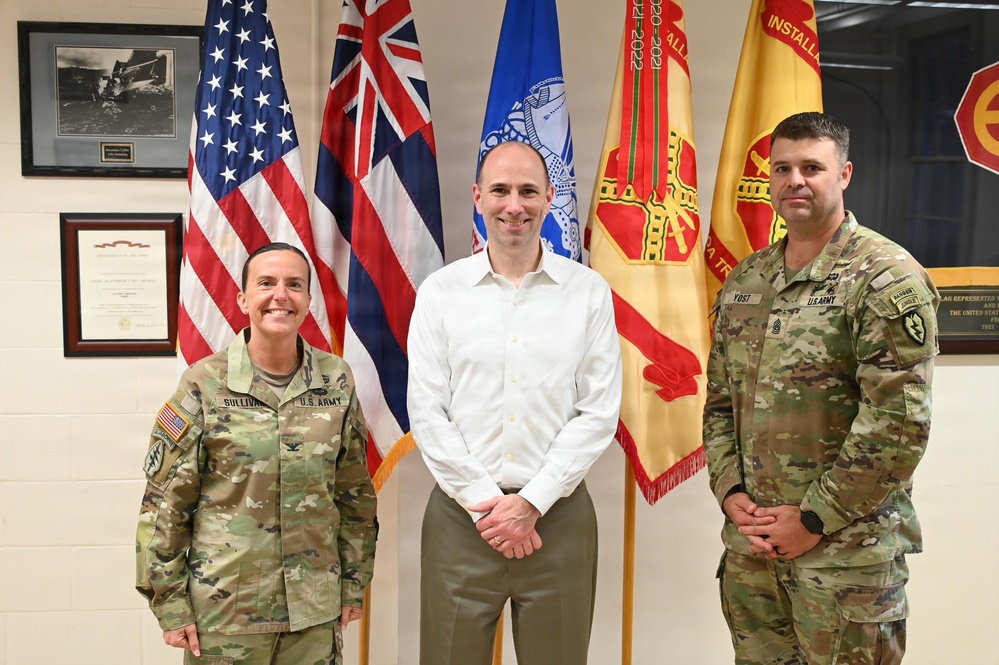
Photo By Mike Osier | The Honorable Jordan Gillis, Assistant Secretary of the Army for Installations, Energy...... read more read more
SCHOFIELD BARRACKS, Hawaii — U.S. Army Garrison Hawaii hosted Assistant Secretary of the Army for Installations, Energy and Environment Jordan Gillis, for a 48‑hour assessment Jan. 8 focused on Soldier living conditions, installation infrastructure and key programs supporting readiness across the garrison.
Gillis’ visit comes as U.S. Army Hawaiʻi experiences rapid growth driven by recent Army force structure changes and continuous transformation initiatives. Combined with a backlog of personnel movements caused by the recent lapse in appropriations, the installation is managing a sustained strain on barracks capacity that will continue for several years as the Army modernizes its infrastructure in Hawaii.
“We are committed to the quality of life for all Soldiers, which is why we are conducting comprehensive clean, comfortable and safe barracks inspections across the force,” Gillis said. “This effort is supported by new funding for quick fixes, major renovations and improved maintenance policies. The inspection data is vital; it informs where we need to invest our resources.”
Approximately 300 Soldiers who were scheduled to move to new duty stations were unable to do so during the federal funding lapse. At the same time, Army installations across Oahu are preparing to receive more than 850 new Soldiers over the next few months. Several barracks buildings also remain unavailable while undergoing long‑term, mission‑essential renovations. With barracks occupancy already above 99 percent, the garrison is implementing a long‑term strategy to responsibly manage demand.
To ensure every Soldier has a safe, clean and secure place to live, U.S. Army Hawaii has submitted an exception to policy through Army channels to authorize higher‑density living in the barracks.
“Taking care of Soldiers is our top priority,” said Col. Rachel Sullivan, U.S. Army Garrison Hawaii commander. “This is not a short‑term challenge. We will be in a doubled‑up posture for some time, and our responsibility is to make that experience as safe, clean and comfortable as possible.”
Leaders across the installation are meeting directly with affected Soldiers, and the garrison has requested more than $600,000 in new furniture and supplies to improve the quality of double‑occupancy rooms. Interim housing solutions, including temporary use of facilities at the Schofield Barracks Noncommissioned Officer Academy, are being closely managed to ensure safety and quality of life.
While the PCS backlog will clear in the coming months, the overall housing strain will continue as the Army cycles barracks through renovation and prepares for additional force growth.
Two renovated barracks buildings — Schofield Barracks Building 2077 and Wheeler Army Airfield Building 118 — are slated to come online in 2026, each providing 84 new beds once furnished. As those buildings open, additional barracks will immediately enter renovation, maintaining a continuous modernization cycle.
Beyond these near‑term additions, U.S. Army Hawaii is executing a long‑range modernization plan that includes the renovation of 13 additional barracks over the next decade.
Garrison leaders noted that the long‑term barracks strategy also supports the surrounding community by reducing the number of Soldiers competing for off‑post rental units. Hawaii’s governor and members of the state’s congressional delegation have formally requested that the Army limit the number of Soldiers living on the local economy to help ease pressure on the island’s housing market.
“Strengthening our barracks footprint isn’t just about improving quality of life on post — it also supports our neighbors across the island,” Sullivan said. “By reducing the number of Soldiers competing for off‑post rentals, we help ease pressure on the local housing market and contribute to a healthier balance for the community we’re proud to be part of.”
Gillis’ visit to Hawaii aligns with the Secretary of War’s Barracks Task Force, established in October 2025 by Secretary of War Pete Hegseth. The task force is charged with developing a department‑wide barracks improvement plan, identifying investment opportunities and creating a standard for unaccompanied housing across the Army.
“We are holding ourselves accountable, and the inspections are how we prove we have our Soldiers’ backs,” Gillis said. “As Secretary Hegseth has stated, every Soldier deserves a clean, comfortable and safe place to live, rest and recover, and the Army is stepping up to deliver that.”
As U.S. Army Hawaii continues to grow and transform, leaders emphasize that Soldier welfare remains central to readiness.
“We understand how important housing is to our Soldiers and their families,” Sullivan said. “We are committed to being transparent, proactive and responsive as we work through this long‑term transition and deliver modern, high‑quality barracks for the future force.”
-30-
| Date Taken: | 01.12.2026 |
| Date Posted: | 01.14.2026 16:30 |
| Story ID: | 556099 |
| Location: | HAWAII, US |
| Web Views: | 346 |
| Downloads: | 0 |

This work, Assistant Secretary of the Army assesses USAG Hawaii barracks as rapid force restructuring drives long-term housing transition, by Nathan Wilkes, identified by DVIDS, must comply with the restrictions shown on https://www.dvidshub.net/about/copyright.


No keywords found.





