
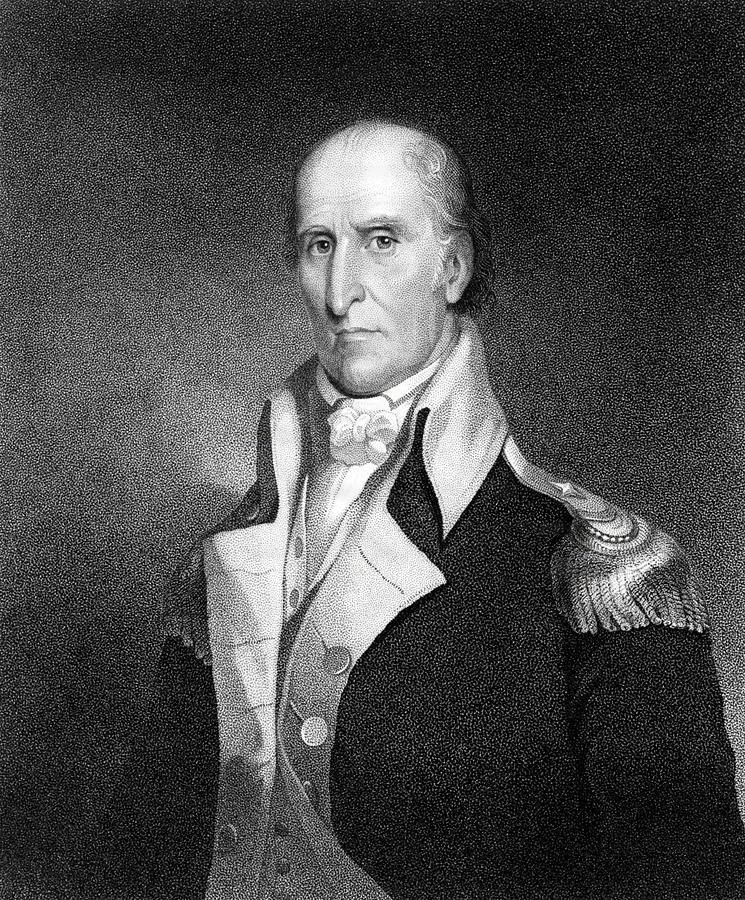
Photo By Erin Thompson | Brig. Gen. Andrew Pickens of the South Carolina militia... read more read more
 Subscribe
On Jan. 17, 1781, Brig. Gen. Daniel Morgan and his small American army decisively defeated a British force under Lt. Col. Banastre Tarleton at the Battle of Cowpens. In his victory, Morgan showed inspired leadership and a brilliant tactical plan. Before the battle, moreover, he had continuous intelligence on Tarleton’s strength and location. Much of this intelligence came from Col. Andrew Pickens and his South Carolina militia.
By this stage of the war, the 41-year-old Pickens was a veteran leader and had fought Indians, loyalists, and the British in South Carolina. He had a wide-spread reputation as a competent soldier. Unlike many southern militia leaders, he was willing to cooperate with Continental officers and readily joined Morgan’s forces in late December 1780. His association with Morgan was particularly effective, but they made an odd pair. Pickens was tall, gaunt, and laconic, while Morgan was hale, broad, and jocular. Both, however, appreciated the strengths of the other. Soon, Morgan placed all the South Carolina militia, about one-third of his force under Pickens.
In early January, as Morgan continued to gather forces, he had Pickens move the militia brigade to Fair Forest Creek, about 20 miles south of the main Continental encampment along the Pacolet River. From this position, Pickens sent out his reconnaissance parties to great effect.
On Jan. 12, Pickens learned that Tarleton was moving north and sent the news to Morgan. Two days later, his reconnaissance parties discovered the enemy was crossing the Enoree and Tyger Rivers, about 30 miles from the main American position. The next day, he sent word to Morgan that Tarleton’s force was between 1,100 and 1,200 strong, a remarkably accurate count. Avoiding battle, Pickens withdrew in the face of the stronger British forces but continued to report his positions to Morgan.
As Pickens withdrew, so did Morgan. As he moved north, however, he began to call in his detachments and to prepare for battle. The South Carolinian leader worked to consolidate his militia forces but continued to push scouts out. He sent out a party of his best officers to reconnoiter the British line of march and give notice of the British advance. He also sent out men of the local area, such as Lt. Col. Benjamin Roebuck of nearby Spartanburg, to remain scouting until just before the coming battle On the evening of Jan. 16, Morgan decided not to retreat further. Interestingly, he did not make the decision to fight until Pickens had joined him. For the battle, Morgan carefully chose his ground and organized his forces to make the best use of the terrain. All militia forces were placed under Pickens and formed the second line of the American defenses. As the Americans made their final preparations, scouts—most likely from Pickens’ militia—continued to watch and track the British until they reached the American’s first lines.
The battle on Jan. 17 proved an overwhelming defeat for the British. Morgan’s defense absorbed the initial impact of the British attack, and when his men counter-attacked, they totally overwhelmed the British. Tarleton lost more than 80 percent of his force.
After the battle, Morgan wrote to Maj. Gen. Nathaniel Greene, his commander, and reported, “I received regular intelligence of the enemy’s movement from the time they were first in motion.” This was largely due to the efforts of Colonel Pickens and his militiamen.
Article by Michael E. Bigelow, INSCOM Command Historian. New issues of This Week in MI History are published each week. To report story errors, ask questions, request previous articles, or be added to our distribution list, please contact: TR-ICoE-Command-Historian@army.mil.
| Date Taken: | 01.09.2026 |
| Date Posted: | 01.09.2026 13:17 |
| Story ID: | 555920 |
| Location: | US |
| Web Views: | 67 |
| Downloads: | 0 |

This work, Colonel Pickens Provides Intelligence Before Decisive Battle (17 JAN 1781), must comply with the restrictions shown on https://www.dvidshub.net/about/copyright.

No keywords found.




