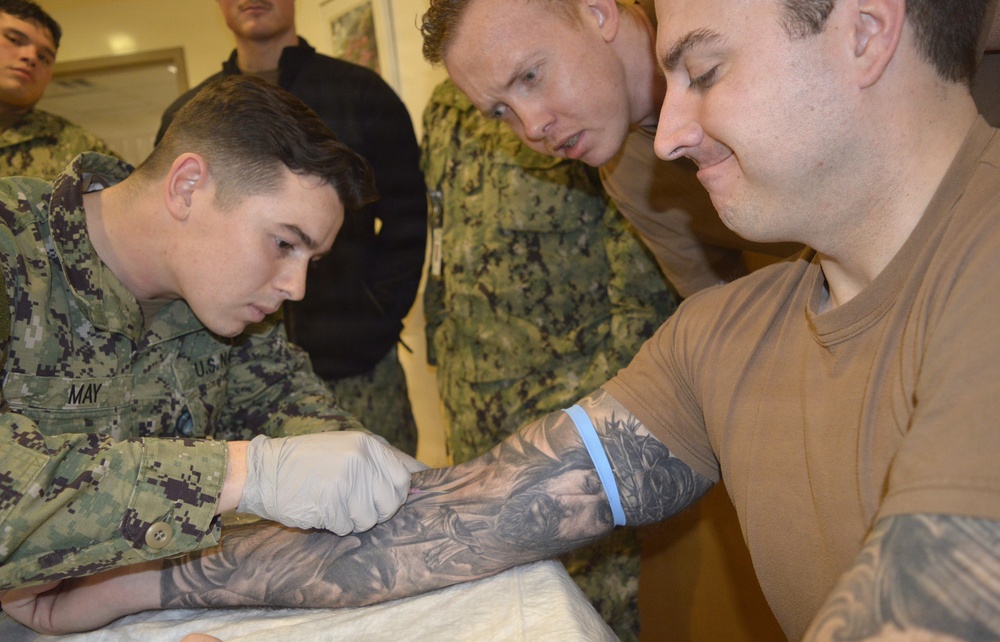
From bedside to battlefield, Navy hospital corpsmen need to stick it to a patient when required.
In adhering to the Defense Health Agency Fiscal Year 2026 mission focused directive of prioritizing such lines of effort as providing tactical medical support to combat operations, hands-on peripheral IV insertion training was conducted to sharpen preparatory skills for just that need to all hospital corpsmen at Naval Hospital Bremerton.
“This skill is useful in the hospital, in the clinic, in the emergency room, in the deployed setting, on the battlefield,” said Lt. Agustina Aure, NHB Primary Care Services group practice manager, who helped organize the training session.
According to Aure, the procedure is considered a use-it-or-lose-it ability.
“Peripheral IV insertion is a basic and vital skill for healthcare professionals, but isn’t one widely used/practiced in the ambulatory care setting,” said Aure. “It is also a perishable skill, in that if you don’t practice it enough, you lose the skill. We wanted to give all our corpsmen the chance to practice their PIV insertion skills, especially those who work in settings that don’t utilize this in daily patient care.”
During the training session corpsmen were able to practice the complete sequence of care, which included proper procedure set-up and personal hand hygiene, PIV insertion technique to proper discontinuation of a PIV line, along with discussions on PIV site management, indications and contraindications.
Aure attests that being adept at such a fundamental skill is a crucial necessity for those at the vanguard in providing patient care.
“Hospital corpsmen and nursing staff are your frontline healthcare providers who utilize this skill. It is very important because it can be applied in multiple settings. It is useful in a hospital setting when taking care of a dehydrated patient who needs fluids or a sick patient who needs IV medication therapy. It is extremely needed and useful in an emergency/trauma setting because fluid resuscitation is one of the most important interventions that can help save a life. It is also useful on the battlefield when treating a patient experiencing a massive hemorrhage who needs emergency resuscitation,” explained Aure.
Willing volunteers assigned to Navy Medicine Readiness Training Command Bremerton provided their arms for the cause, so all students will be able to perform a live PIV stick. Senior enlisted hospital corpsmen, Fleet Marine Force qualified hospital corpsmen and Navy Nurse Corps officers gave real-time tips and coaching to the junior hospital corpsmen attending the session.
“The most difficult aspect of learning this skill is getting over the nerves of poking a patient with a needle. Some people are hesitant because they don’t want to hurt the patient. Rightfully so. In teaching this skill, we stress that yes, this is an invasive procedure and can be a bit uncomfortable for the patient no matter what. The best thing we, as their healthcare provider, can do for them is be confident and do not hesitate. Hesitating while sticking a patient with a needle will hurt more and we want to avoid that,” stated Aure.
The peripheral IV insertion training was the initial 2026 continuation session of the NHB/NMRTC Bremerton’s Battle Ready Training Tuesday, a command-wide initiative designed hone operational readiness capabilities of hospital corpsmen. Ten training sessions were held after starting in October 2025, covered seven subjects, with total participant attendance of 231 up until the end of the year. The training covered such relevant skills as hands-on suture training to recognizing abnormal vital signs in the field – ranging from hypothermia to hyperthermia - with direct guidance to allow the corpsmen to identify patterns, prioritize urgency, take action and conduct reassessment for a wounded patient in the field.
| Date Taken: |
01.08.2026 |
| Date Posted: |
01.08.2026 16:32 |
| Story ID: |
555887 |
| Location: |
BREMERTON, WASHINGTON, US |
| Web Views: |
182 |
| Downloads: |
0 |
PUBLIC DOMAIN

This work, Making the point with peripheral IV insertion training at NHB, by Douglas Stutz, identified by DVIDS, must comply with the restrictions shown on https://www.dvidshub.net/about/copyright.