
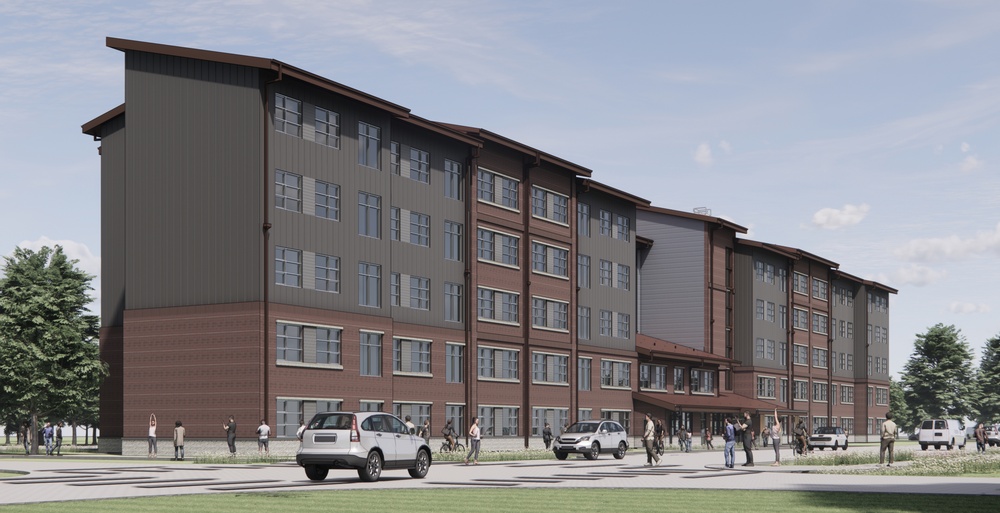
Photo By Louis Velasco | USACE Seattle District architectural design rendering of the FY25 "mass timber"...... read more read more
With one ceremonial shovel swing during a Dec. 12, 2025, groundbreaking ceremony, the U.S. Army Corps of Engineers (USACE) is redrawing the blueprint for soldier housing and military construction at Joint Base Lewis-McChord (JBLM), using structural materials long used in private industry but new to the Department of War.
U.S. Army Corps of Engineers (USACE) Seattle District, JBLM Army Garrison, and 1st Special Forces Group leadership joined to celebrate the DoW’s largest-to-date construction project using mass timber. When complete, the five-story, 105,000-square-foot barracks will house 200 soldiers.
The Seattle District is leading the design and construction management of the first-of-its-kind mass timber structure to break ground in the DoW, ensuring building functionality, ease of maintenance and longevity.
“This is a challenge to build faster, stronger, and with greater environmental stewardship using cross-laminated mass timber materials – materials with a long history in the private sector but with minimal use in the DoW,” said Col. Kathryn Sanborn, USACE Seattle District commander. “Today, with our contractor partners, we take the next step.”
The Army selected the project for its Mass Timber Pilot Program in early 2023 while the design was already underway, following the pilot’s authorization in the fiscal 2023 National Defense Authorization Act.
The pilot program directs each military department secretary to carry out a program to evaluate the use of mass timber as the primary construction material in military construction projects and its effect on environmental sustainability, infrastructure resilience, cost-effectiveness and construction schedule.
These efforts place USACE and the Seattle District at the forefront of engineering to tackle one of the Army’s most critical priorities: to provide high-quality housing essential for the readiness and morale that underpins national defense and to rebuild the nation’s military infrastructure.
“By building modern, high-quality barracks, we’re not just improving readiness, we’re improving lives,” said Col. Joseph Handke, JBLM Army Garrison commander. “It’s one of several steps we’re taking to ensure JBLM remains a place where service members can thrive – not just professionally, but personally.”
Ultimately, tapping into the mass timber resource required a fundamental shift in design to for military use and standards.
A New Way of Building: Mass Timber’s Promise
Mass timber represents a seismic shift for USACE architects and engineers tasked with incorporating the new and sustainable building material. Created by bonding layers of wood into large, exceptionally strong structural panels and beams, cross-laminated mass timber offers a sustainable alternative to traditional materials.
“This is the way of the future for providing a lower embodied carbon footprint,” said Breanna McBride, a sustainability architect with USACE’s Northwestern Division who was integral to the project’s development. “Buildings use the most energy, and that’s why we’re incorporating mass timber as a lower carbon alternative to concrete and steel.”
This sentiment is at the project’s heart. The challenge is to demystify mass timber for the DoW, proving it can meet the rigorous demands of the military in different climates, regions and seismic conditions. McBride emphasized the need to educate stakeholders and overcome a natural hesitancy toward the unfamiliar.
“Mass timber is a new category of wood product, but we need to make sure that people aren't afraid of new things,” McBride said. “For example, mass timber has a high fire resistance, just like thicker, old-growth wood.”
The JBLM mass timber barracks project is particularly ambitious. Its five-story height and location in a high seismic zone make it a challenging and vital test case. “It’s a little more challenging because of the seismic zone we’re in, requiring we do more of a hybrid approach, rather than using 100% mass timber,” McBride said.
Success at JBLM would provide a powerful proof of concept for wider adoption and for constructing a 100% mass timber building, rather than the project's hybrid approach.
The Engineer’s Challenge: A Team Sport in Design
Bringing the first DoW mass timber barracks from concept to reality fell to the Seattle District’s in-house design team. For the structural engineers and architects, it was a challenging task because the project was already at 35% design when selected for the pilot. The redesign, however, proved to be an exhilarating and innovative opportunity.
“When this project was selected to be the mass timber pilot, I was really excited,” said Jacob McCarty, a structural engineer with the Seattle District. “I think deep down in every structural engineer, there are two natures: to be risk-averse and do the same thing you’re comfortable with, or embrace a fun new challenge.”
That challenge required a deep level of collaboration that pushed the design team beyond their normal routines. Unlike the automatic process of using familiar materials, mass timber demanded that every discipline—structural, architectural, mechanical, electrical and fire protection—engage in constant and detailed coordination to be in sync.
“We talked closely about what we were trying to achieve at levels that you may be on autopilot for with the materials we’re used to,” McCarty said. “It boils down to that understanding and collaborating and being willing to be a team player and think outside the box.”
Juhun Lee, another Seattle District structural engineer who brought experience from the private sector, highlighted a key advantage of the district’s project delivery team. “We have everything in-house here,” Lee said. “I can talk to an architect or a mechanical engineer anytime I want. I just reach out to them and ask questions, and it's so easy.” This integrated team approach proved essential for navigating the complexities of a first-of-its-kind project while avoiding delays and missed milestones.
McCarty sums up the ethos that drove the design forward: “Building design is a team sport. The best teams I've been on are the ones that can listen to each other, understand each other's perspective and help each other implement the design. It takes professionalism and working well together.”
To enable designers and builders, the DoW developed key resources like the Unified Facility Guide Specifications for cross-laminated timber and glued-laminated construction. The department updated these standards to align with the 2021 International Building Code, which formally recognized new mass timber construction types and paved the way for a wider variety of wood-based building designs.
A network of external partners, including WoodWorks, the American Wood Council and the U.S. Department of Agriculture Forest Products Laboratory, supports the effort. They provide crucial training and resources to designers and broaden knowledge across USACE.
Data-Driven Future: Informing the Next Generation of Standards As a pilot project, the barracks’ true legacy comes from the data it generates. USACE’s Engineer Research and Development Center is a key partner, tasked with analyzing the project’s performance to shape future DoW-wide construction efforts.
The central question the pilot will try to answer is: Does this work, and can we do it again, better and more efficiently?
“High-level leadership has been asking that question a lot, trying to get the results as soon as possible,” McBride said. To answer it, the contractor will provide detailed cost and material data throughout the construction process. This information will feed into two critical analyses conducted by ERDC: a life-cycle cost analysis and a life-cycle assessment of the environmental impacts.
The goal is to produce concrete, data-backed recommendations. “They can see where they're able to update recommendations for things that were cost-effective,” McBride said. “That way, we can realize the savings on things that make sense.”
This data-driven approach is what separates a one-off demonstration from a true innovation. The lessons learned from the JBLM barracks—from its seismic performance to its supply chain logistics and final cost—will directly shape the Army’s building standards, potentially making high-quality construction the norm rather than the exception.
For the Soldier: A Better Place to Call Home
Ultimately, every nut, bolt and beam serves a single, vital purpose: supporting our nation’s soldiers. The U.S. Army’s push for new and remodeled barracks is a critical piece toward improving quality of life, a factor directly linked to soldier readiness, retention and overall force effectiveness. As the largest Army installation west of the Rocky Mountains, providing modern, high-quality housing for JBLM is a matter of national defense.
While the project will evaluate the structural and environmental benefits of mass timber, the design team did not forget the quality-of-life improvements for the soldiers living inside, where small details can have an outsized impact on daily life.
Different features have had strong support, even from the highest levels of the Army. For a previous JBLM barracks pilot, U.S. Army HQ approved a waiver for the Multi-Domain Task Force barracks to incorporate communal balconies to improve socialization, resilience and readiness. In a large survey, residents and senior enlisted barracks managers strongly supported communal balconies.
“Juhun and I walked on those balconies this summer. Others might not get them, but these ones do,” McCarty said.
This passion for improving the soldier experience permeates the mass timber project. It’s a commitment to building not just a facility but a home—a place of respite and recovery for soldiers who dedicate their lives to the nation’s defense.
When the first truckloads of cross-laminated mass timber are delivered to the construction site, it will represent more than a simple delivery. It is also the expectation and promise of a future built with greater environmental stewardship, resilience to extreme weather events and a sharp focus on building the next generation of barracks for our soldiers and future service members.
At the project groundbreaking, surrounded by colleagues and friends, Seattle District Commander Col. Kathryn Sanborn explained her excitement to the audience about this project milestone.
“I’ve personally kept my eye on this project for a long time. It was hard not to; my doctoral dissertation was on mass timber, and I really hope to be back for the ribbon cutting.”
“When this project is complete and there’s a five-story structure standing here, it will stand as a testament to the U.S. Army Corps of Engineers’ role as a leader in innovation, a trusted partner in national defense and an organization dedicated to building strong for the soldiers who keep America safe,” she added.
| Date Taken: | 01.05.2026 |
| Date Posted: | 01.07.2026 11:36 |
| Story ID: | 555813 |
| Location: | SEATTLE, WASHINGTON, US |
| Web Views: | 305 |
| Downloads: | 0 |

This work, Rooted in strength: JBLM barracks tap into Pacific Northwest’s timber legacy for new military construction era, by Louis Velasco, identified by DVIDS, must comply with the restrictions shown on https://www.dvidshub.net/about/copyright.


No keywords found.





