
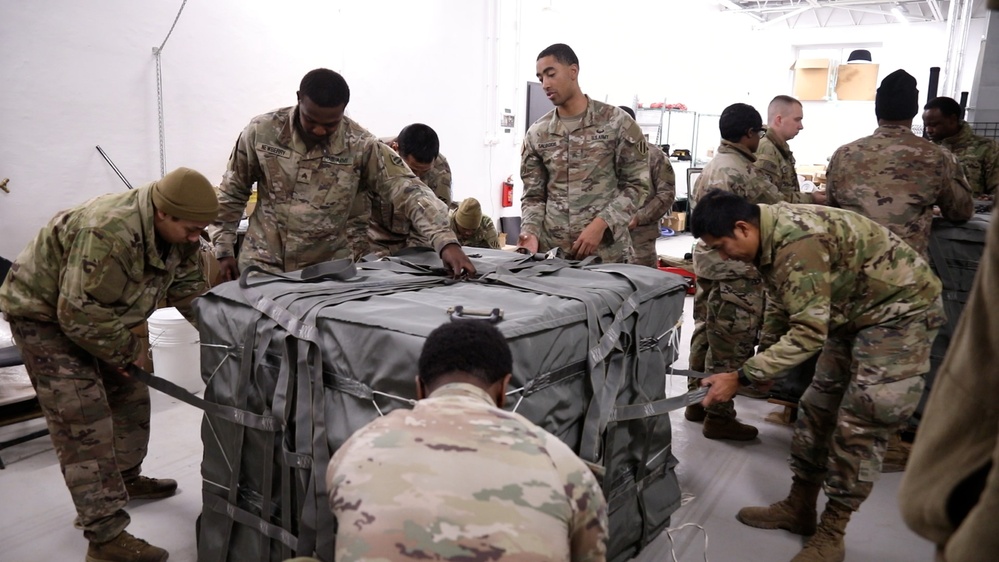
Photo By Staff Sgt. Dean Johnson | U.S. Soldiers assigned to 3rd Division Sustainment Brigade, 3rd Infantry Division,...... read more read more
POWIDZ, Poland - In the crucible of modern high intensity conflict, a mechanized division’s greatest strength, its heavy armor, can rapidly become a liability if supply lines are severed. Traditionally, non-airborne units like the 3rd Infantry Division (3ID) have relied almost exclusively on ground-based convoys to move tons of materiel required for combat. However, the 3rd Division Sustainment Brigade (3DSB) is currently shattering that mechanized logistics mold while deployed to Powidz, Poland, in support of 3ID units. By building a sophisticated aerial delivery capability from the ground up, the brigade is working to ensure the "Lifeline of the Marne" remains unbroken, even when roads are cratered or contested.
This initiative represents a significant cultural and operational shift, as aerial delivery capabilities are most commonly associated with airborne or light infantry units. The program’s resurrection was first hindered by long-standing structural gaps; due to previous personnel shortages across the Army’s rigger field, the 3DSB had not filled a senior airdrop systems technician position since approximately 2017. Because mechanized units are not inherently 'Airborne', they have historically operated without these organic capabilities for years, viewing them as a luxury rather than a necessity. As the rigger field has stabilized and these technical positions are once again being filled at the brigade level, the challenge has shifted from a lack of personnel to a lack of precedent.
The architect of this shift, Chief Warrant Officer 2 Marco Villecco, the 3DSB senior airdrop systems technician, recognized that once the staffing issue was resolved, the new primary obstacle was a deep-seated reliance on established ground-delivery norms. In a mechanized culture where "logistics" is often synonymous with truck convoys, securing the buy-in of Col. Aaron Becker and Command Sgt. Maj. John Kreifels was the essential catalyst. For the program to move from a niche concept back to a core operational priority, leadership had to see the value in a "vertical dimension" that could double the resupply options available to commanders in a field where roads may no longer be a guarantee.
"We aren't just checking a box; we are building a toolkit that allows a commander to say 'yes' to a mission regardless of whether the roads are open," said Villecco. "Seeing these Soldiers go from managing truck manifests to mastering complex sling-load rigging in just a few months shows the incredible hunger for innovation in this brigade."
The urgency of this evolution is underscored by critical sustainment lessons from the Russo-Ukrainian War. The conflict has highlighted the extreme vulnerability of exposed supply lines to drones, precision strikes, and attrition. Russian forces have suffered from truck shortages and an over reliance on fixed railheads, often stalling offensives when logistics are stretched. By integrating aerial delivery, the 3DSB is mitigating these risks. Capt. Mackenzie Macilvennie, commander of the 5th Quartermaster Theater Aerial Delivery Company (TADC), noted the strategic importance of this transition for a heavy division.
"I think the establishment of an aerial delivery capability within a mechanized division is an effort that can enhance operational capabilities and reach across the battlefield," said Macilvennie. "Aerial delivery allows for rapid resupply and reinforcement of units in areas that may be difficult to access by ground, which is crucial in mechanized operations where speed and mobility are essential. The flexibility aerial delivery provides to a mechanized division increases the lethality and tactical options available to commanders. They can execute a broader range of missions without being constrained by ground transportation."
As the commander of the theater’s premier aerial delivery unit, Macilvennie’s role is to provide 3ID with specialized expertise and equipment they may not otherwise possess while in theater. The 5th Quartermaster TADC (Theater Aerial Delivery Company) is instrumental in this process, assisting in training rotational units on sling load operations and low-cost aerial delivery systems to ensure these capabilities become self-sustaining for the brigade.
The transformation began in earnest in September 2025 with a Low-Cost Low-Altitude (LCLA) proof-of-concept operation conducted alongside the 2nd Armored Brigade Combat Team, 3ID. This success has since blossomed into a comprehensive training pipeline involving bi-weekly sessions at Powidz Airfield. Soldiers who once only managed truck manifests are now mastering the intricacies of helicopter sling sets, signalman duties, and rigorous safety inspections. On January 8, the brigade will reach a major milestone by executing its first organic sling load and LCLA operation utilizing CH-47 Chinook and UH-60 Black Hawk helicopters from the 3rd Combat Aviation Brigade. This foundational training is designed to give Soldiers the fundamentals necessary to progressively increase complexity, eventually leading to night operations, multi-aircraft coordination, and multi-point hook-up procedures.
The most forward-leaning aspect of this effort involves the integration of high-tech systems rarely seen in mechanized brigades. Villecco is leading an effort to hopefully pair the Joint Precision Airdrop System (JPADS) with CH-47 Chinooks, an unconventional pairing in standard Army operations. JPADS utilizes GPS-guided parachutes to steer cargo to precise points from high altitudes, providing a stealthy, precise alternative to traditional resupply without the need for a cleared landing zone. Proficient use of these tools reduces risk to the force by enabling delivery at a variety of altitudes, which decreases the number of vulnerable trucks required on the ground.
Innovation within the program is also measured by the strength of its international alliances. Collaboration with the Polish 6th Airborne Brigade in Kraków has allowed for a vital swap of technical expertise. This partnership is set to culminate in a 2026 humanitarian mission to deliver toy-filled boxes to local Polish children via LCLA drops, serving as both a complex training exercise and a bridge to the local community. These joint activities stress-test the interoperability of NATO logistics as the brigade aligns with the 5th QM TADC and prepares for future synchronization with partners in Sweden, Lithuania, and the Baltic states.
As the 3DSB prepares for Defender-Europe 2026, the focus remains on ensuring these skills become a permanent fixture of the unit’s identity. The long-term vision includes creating a multi-modal powerhouse capable of airdropping equipment and immediately reconfiguring it for rotary-wing transport to the front lines. Future explorations may even include unmanned aerial systems to handle "last-mile" logistics, a concept inspired by the essential role drones have played in delivering medical supplies and rations in recent global conflicts. This evolution proves that a sustainment unit does not need an "Airborne" tab to master the air domain. By blending the raw power of a mechanized division with the flexibility of organic aerial delivery, the brigade is ensuring that the 3rd Infantry Division remains an agile, lethal, and constantly supplied force on the modern battlefield.
| Date Taken: | 12.31.2025 |
| Date Posted: | 01.02.2026 22:07 |
| Story ID: | 555639 |
| Location: | POWIDZ, PL |
| Web Views: | 209 |
| Downloads: | 0 |

This work, 3rd DSB Shatters the Mechanized Logistics Mold, by CPT Lydia Laga, identified by DVIDS, must comply with the restrictions shown on https://www.dvidshub.net/about/copyright.


No keywords found.





