
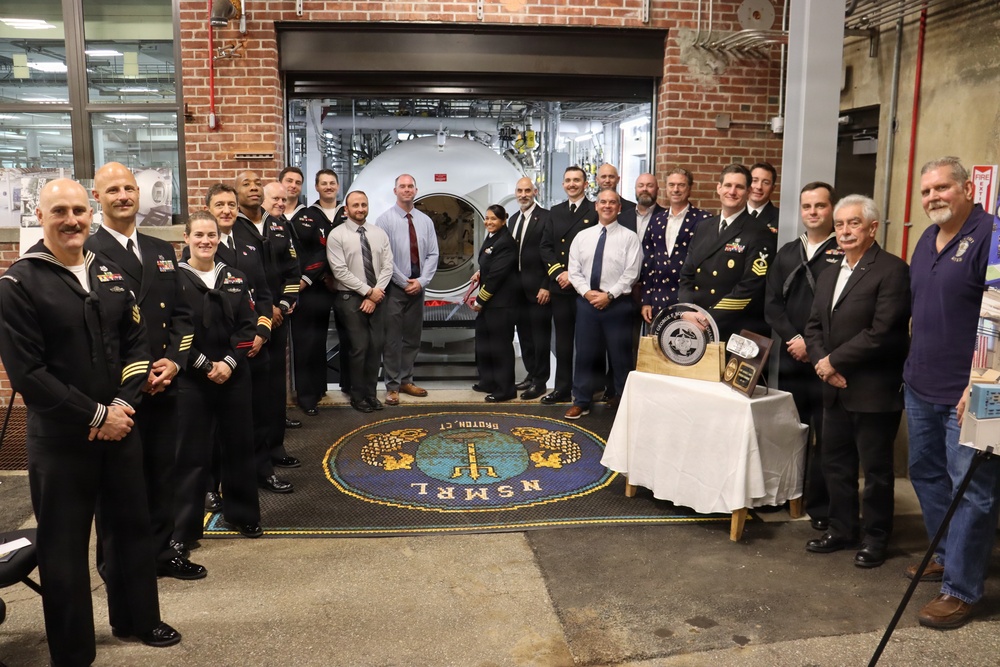
Photo By Emily Swedlund | GROTON, Conn. (Nov. 6, 2025) Past and present members of Naval Submarine Medical...... read more read more
GROTON, Conn. – Naval Submarine Medical Research Laboratory (NSMRL) marked the completion of a renovation of their hypo-hyperbaric chamber complex during a ribbon cutting in September 2025.
This renovated chamber, known as “Genesis,” a multi-lock chamber certified for pressurization to a depth of 300 feet or an altitude of up to 70,000 feet, restores human hyper-hypobaric research capabilities to Navy Medicine Research & Development (NMR&D) for the first time since 2017.
Past research in the chamber complex has led to multiple scientific breakthroughs in the undersea and aerospace environments, providing important information about how humans can survive and function under high and low pressure. This information has been critical to informing equipment design, policies, and procedures to for the health and safety of divers, submariners, and other warfighters operating in the undersea domain.
“The Genesis Chamber is a unique national asset,” explained Capt. Tatana Olson, commanding officer of NSMRL. “One that will enable future advancements in hypo- and hyperbaric research to ensure the safety, survivability, and effectiveness of our warfighters operating in the most extreme environments.”
NSMRL chamber complex is comprised of three different-sized hyper-hypobaric chambers, each with a slightly different purpose. Chamber 1, (Genesis), is the largest of the three. Chamber 2 is a smaller double-lock chamber, primarily designed for short duration dives. A third small chamber, used to test equipment, rounds out the complex.
The updated chamber is outfitted with high tech life-support systems, a modernized fire suppression system, cutting edge remote operability controls, and a vacuum pump capably of “flying” the chamber to 70,000 feet of atmosphere.
NSMRL scientists are already using these updates to advance research on behalf of U.S. warfighters through three separate studies. One is to determine the necessary amounts of materials that can absorb carbon dioxide in case of a disabled submarine. A second study examines how the body’s sympathetic nervous system acts while exposed to decompression stress. The final study is a collaboration with NASA to advance critical hypobaric decompression spaceflight research.
In 2017, NSMRL made the decision to completely overhaul and modernize the Genesis chamber. This overhaul, initiated in 2019, was the largest and most comprehensive update since the complex was installed in the early 1960s under the direction of Capt. George F. Bond.
Bond’s work defined the early years of the chamber’s use. It was during his time as officer-in-charge that he signed a contract with the Bethlehem Corporation for a man-rated vacuum pressure climatized facility with hyperbaric oxygenation operations room capabilities. This was the world’s first chamber built specifically for research purposes, originally to prove the feasibility of saturation diving, or the ability for divers to go down to great depths for long periods of time (thus reducing the time needed to decompress every time they surfaced), which was seen by many to be radical.
“Captain Bond was an exceptional man,” said Louis Deflice, NSMRL Dive Department head and a retired master diver. “During Project Genesis, he and his team proved the theory of saturation diving, which is now used in the diving industry worldwide. A bigger jump in manned deep sea diving capabilities hasn’t happened since.”
“NSMRL’s early diving physiological studies set the standards that remains the foundation of today’s more “modern” work,” Deflice added during his remarks at the chamber re-opening.
Although the inaugural Project Genesis is what gave the chamber complex its epithet, many other ground-breaking studies have been carried out in NSMRL’s chambers throughout the years. In the late 1960s, a series of studies on nitrogen/oxygen dives resulted in recalculating the values used for decompression. In the 1970s, Project SHAD (Shallow Habitat Air Diving) used only compressed air as breathing gas, with divers spending up to thirty-days at depth, demonstrating that compressed air was a feasible alternative to more expensive helium/oxygen mixtures. Project Nisat focused on submarine crew rescue, emulating a scenario in which a crew had been trapped in a compressed air environment, and might be required to switch atmospheres during rescue.
Results from Project Nisat are still included in decompression tables used today.
Efforts in the 1980s and 1990s focused on non-pressurization research, studying how humans function in confined spaces and allowing researchers to draw conclusions about how submariners adjust to the confined submarine environment.
“As many incredible things that have happened in this chamber so far, I know that the things to come will be even better,” said Deflice. “Someone at this lab right now could very well be the next George Bond and develop the next innovation in diving research right here.”
NSMRL, part of Navy Medicine Research & Development and based out of Groton, Connecticut, sustains the readiness and superiority of U.S. undersea warfighters through innovative health and performance research and works to lead the world in delivering science solutions to ensure undersea warrior dominance.
| Date Taken: | 12.31.2025 |
| Date Posted: | 12.31.2025 11:09 |
| Story ID: | 555445 |
| Location: | GROTON, CONNECTICUT, US |
| Web Views: | 577 |
| Downloads: | 0 |

This work, NSMRL Genesis Chamber Returns to Operation, by Emily Swedlund, identified by DVIDS, must comply with the restrictions shown on https://www.dvidshub.net/about/copyright.


No keywords found.





