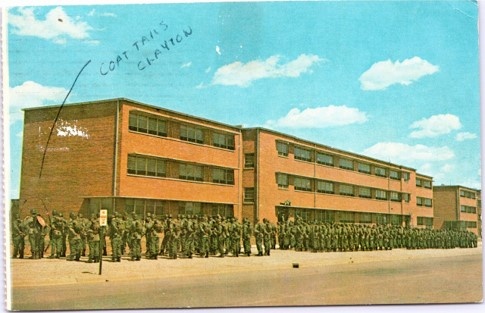
Cold War-era rolling pin barracks undergo vital renovation
Courtesy Photo |
A postcard of the “rolling pin” barracks at Fort Leonard Wood, dated 1965. | Photo......read moreread more
Courtesy Photo | A postcard of the “rolling pin” barracks at Fort Leonard Wood, dated 1965. | Photo provided by the Missouri Resident Office, Kansas City District, U.S. Army Corps of Engineers. see less
| View Image Page
Cold War-era rolling pin barracks undergo vital renovation
Soldiers marching in uniform, drill sergeants yelling, muddy obstacle courses – these are often the images the words “basic training” evoke. Hollywood and pop culture have helped ingrain the military’s grueling boot camp experience in the minds of the average person. Whether Hollywood’s depictions of basic training are based in truth or not, one thing is for sure: the soldiers who complete Army basic combat training are some of the toughest in the world.
Tucked away amongst the dense forests and scenic lakes of central Missouri lies Fort Leonard Wood, one of four installations home to the Army’s basic combat training course. Originally built in 1940 as a small World War II training site, Fort Leonard Wood is now a premier training installation within the Army, the U.S. military and the world.
“[Fort Leonard Wood] was originally founded during the upsurge of WWII. After the war, it went dormant for several years but with the Cold War, it was reactivated and it’s been running strong ever since,” said Brad Slone, engineering technician with the Kansas City District, U.S. Army Corps of Engineers’ Missouri Resident Office. “[The installation] has advanced beyond just a basic training function.”
A full renovation
Fort Leonard Wood is home to training schools for the Army, Marine Corps, Air Force, Navy and the Coast Guard, training between 75,000 and 80,000 service members annually. Additionally, the installation hosts and trains international students from over 70 partner nations. With all these service members visiting Fort Leonard Wood each year, many support facilities are needed, including dozens of barracks.
Barracks are dormitory-style buildings and provide temporary housing for soldiers and other service members while they attend training. Many of the barracks at Fort Leonard Wood were first built in the 1960s and are still standing today. However, with few updates completed since they were originally built, many need serious renovations.
“Things deteriorate with age. Everything essentially has a useful life and a lot of these [barracks] have reached that point,” said Wes Safarik, resident engineer with the Kansas City District’s Missouri Resident Office.
Typically working two buildings per project, the Missouri Resident Office is renovating the barracks to bring them up to current standards and provide troops with suitable living conditions. According to Safarik, not only have building codes and standards changed since the 1960s, but attitudes around morale have also changed, sparking a renewed effort to renovate these buildings to provide safer, more acceptable living conditions for our nation’s service members.
“Standards have changed over time. Construction standards change, electrical codes and mechanical [codes],” said Safarik. “But the Army standards have also changed. A rundown facility has a negative impact on morale.”
Having completed dozens of barracks renovations over the years, the Missouri Resident Office has it down to a science. Renovating two buildings at a time takes roughly 540 days and the current price of a two-building renovation is around $36 million.
The office is currently working on renovations of what are informally known as “rolling pin” barracks. Named after the kitchen utensil, these 1960s-era buildings resemble a rolling pin from an aerial view. According to Slone, there is nothing wrong with the buildings structurally. So, they can be renovated rather than torn down and built from scratch.
“They’re all a pretty standard approach. You strip all the utilities, all the mechanical, all the interior walls, everything non-structural and what you’re left with is a shell. They’re like parking garages,” said Slone. “Then you put in new mechanicals, technology, new roof, new interior finishes, the whole nine yards. We’re basically recycling an entire building and giving it a new function of life.”
A rare occurrence
The Army’s basic combat training is a 10-week course every prospective soldier must complete. But it’s just the beginning of a rigorous training regimen service members receive upon entering the military. After basic combat training, and depending on a soldier’s job specialty, there can be months of additional specialized training required.
Additionally, soldiers receive training throughout their careers and many of these career-level trainings are held at Fort Leonard Wood. Providing comfortable, safe spaces for service members to sleep and study is vital to ensuring our nation’s military remains a global superpower.
“We need to be able to offer a state-of-the-art training environment if we’re going to maintain our stature in a global sense,” said Slone. “You can’t train personnel to do what they need to do in a facility that’s subpar. We need to provide a quality place for our trainees to prepare for what they may encounter.”
Renovating the existing barracks also helps with the cost of long-term operation and maintenance. Ensuring the buildings are renovated to reduce maintenance costs and extend their lifespan is important to the Missouri Resident Office team.
“The [installation] is responsible for all the upkeep of the buildings [after construction] so in that respect, you need to work towards a mindset of low maintenance and ensure longevity,” said Safarik.
But more than that, the team understands the lasting impact of basic combat training goes well beyond the soldier and touches many families, too. According to Slone, often a parent who is in attendance for their soldier’s graduation will stop by the construction site to look around.
“Frequently, we’ll have a parent come up to the fence because that is the building they did basic [training] in, and they’ll be there looking, and you can usually tell. What I love to do is engage with them, talk with them and listen to their experiences,” said Slone. “And once in a blue moon, you’ll have someone whose son or daughter has been through the same building as them – it’s multigenerational. That’s pretty incredible.”
Being able to provide a comfortable living area for trainees is important to the team at the Missouri Resident Office. Safarik has a personal connection not only to the installation, but to the exact barracks he and his team are currently renovating. His father trained at Fort Leonard Wood around the same time the “rolling pin” barracks were first built.
“My dad was in basic training here. An important aspect of the training environment is the living condition. It’s the only portion of their environment they can call their own. Everything else outside of that is controlled,” said Safarik. “These rolling pin barracks are rock solid, they’re structurally sound. But there has been a shift to change that environment and get away from the cold, military setting to something that has a warmer touch.”
For past, present and future soldiers, renovating the barracks at Fort Leonard Wood is more than just a construction project. It’s a vital endeavor for the security of our nation and for the continued success of America’s military.